. Sumidagawa 隅田川 .
:::::::::::::::::::::::::::::::::::::::::::::::::::::::::::::::::::::::::::::::::::::::::::::::::::::
Temple Mokubo-Ji and Umewakamaru
木母寺 (もくぼじ) と 梅若丸伝説
Mokubozi
This temple is famous for the story of Umewakamaru (Plum (blossom) Boy 梅若丸), the son of an emperor (? the high-ranking official 吉田少将惟房) during the Heian period. He lost his father at age 5 and became a monk at this tender age at the temple Hieizan near Kyoto. A traffiker for children abducted him from there at age 12 to sell him in the North of Japan. He became ill on the trip and died abandoned and alone at the shores of river Sumidagawa in the year 976. His mother came looking for him one year later. There is a famous Noh-Play written by Soami about his ill fate. See below.
In the temple compound is a mound in memory of Umewaka (梅若塚), where mothers pray for the good fate of their children. A willow tree was planted on this mound and the official name of the temple, given later by Tokugawa Ieyasu (the founder of the city of Edo), is Plum-Willow-Mountain (Bairyuusan 梅柳山). Many illustrations and woodblock prints of the Edo period usually show the willow tree on the grave mound.
The name MOKUBO has an interesting history.
The calligrapher Konoe Nobutaka (近衛信尹 (1565-1614))wrote the letters for a frame for the temple hall. He used the Chinese technique of taking only one character, the PLUM 梅 and divided into the parts of "Tree" and "Mother" 木 母, ignoring the top part above "mother", as was customary. He read both characters with their Chinese reading MOKU BO. In this way he could convey part of the story of Umewaka and his mourning mother.
Since Nobutaka was a highly educated man, he might have alluded to the Chinese story of the "Wood Mother MokuBo", which tells of the pious son Ting Lan (Tei Ran) 丁蘭, who made a wooden statue of his mother after her death and attended and prayed to her every day, as if she was still alive. This is one of the 24 examples of filial piety in China (nijuu shikoo 二十四孝, ref. see below).
The Great Amida Prayer Ceremony (大念仏興行) was held at this temple during the Edo period on March 15 of the lunar calendar. The temple was quite popular with mothers.
The temple is located in Mukojima (Mukoojima 向島), an island that could only be reached by boat during the Edo period in the times of Issa. The place was famous for its cherry blossoms and the Geisha girls.
Gabi Greve
(Partly quoted from a book about Japanese temple names by my professor of Japanese Art, Dietrich Seckel .)
...............................................................................................
QUOTE:
.. the interpretation of the Noh play "Sumidagawa (Sumida river)" which was said to be a Noh of "no reunion". A woman arrived at Sumidagawa which was at the end of the "Azuma (東 eastern border)" area of ancient Japan after a long unsuccessful search for her kidnapped son. On the opposite bank of the river, she found a crowd of people gathered around a tomb mound to hold a chanting rite for a stray child who died there on exactly the same day last year.
And the mother happened to know the late child was undoubtedly her lost son Umewaka-maru 梅若丸. Then she began to hear her son's voice among the chanting crowd and even saw his vision behind the tomb mound. But it was only an illusion and disappeared at the break of dawn.
The two fundamental elements of this Noh play, Sumidagawa and Umewaka legend are rooted in two places, Kanegafuchi and Kasukabe. Both towns are in Azuma area and about 30 km apart. Two Sumidagawas flow, Sumidagawa in the former and Old Sumidagawa in the latter. Each town has its own Umewakazuka (Umewaka's tomb mark) and several other related historical momuments.
After a series of river system reconstructions in the past, two Sumidagawas no longer join and run in a single line, but they still exist and run separately at this moment. And with the Industrial Revolution in this country, spinning mills and railroads have placed even more complicated "threads" and "lines" over the two rivers. Along them, all sorts of dreams came across, being rewritten, replaced, replanted and layered over and over. Now those dreams, "Memories of a City" come out. We trace the destinies of those innumerable Umewaka-marus (bury the young*) that had been absorbed into such a land.
*The phonation of the word "umewaka" can also be understood as "bury the young" in Japanese. http://portb.zone.ne.jp/eng/replace/rep_home.html
Utagawa Hiroshige 歌川広重 : Mokubo-Ji 木母寺

This is famous for the legend of Umewakamaru who was said to have been brought by a slave trader and died on the bank of Sumida River.
There was the Tokugawa Shogunate's "Gosenzai-bata" (vegetable garden) in the temple grounds and vegetables were grown.
- source ; Tokyo Metropolitan Museum
ooo ooo ooo ooo ooo ooo ooo ooo ooo ooo ooo ooo
木母寺(もくぼじ) と 梅若丸伝説
Mokubo-Ji and the Legend of Umewakamaru
天台宗 梅龍山 Bairyuzan
Umewakamaru is the son of a high-ranking official, 吉田少将惟房 Yoshida Shosho Korefusa and Hanagozen 花御膳 in Kyoto; he had been sent to a Buddhist monastery at age seven. Later during an upheavel in the country, he should escape from there to Northern Japan, but only made it secretly to the shores of Sumida River (Sumidagawa), at that time far away in the North-East (Azuma), where he fell ill and died at an early age.
His desperate mother, who went looking for him,
was called "Hana Gozen".
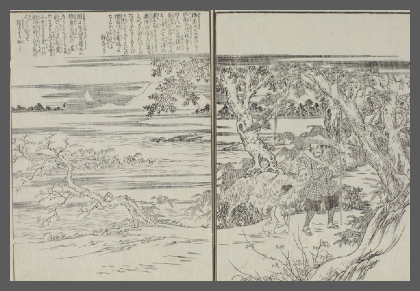
at the age of seven.
The sad story of "Sumida River" features in Noh songs and Jōruri plays
and the story was well known by the people of Edo.
The 梅若塚 Umewaka grave is in the grounds of Mokubo-ji Temple
and 梅若忌 the Umewaka Memorial
has been conducted every year on March 15 (it is now held on April 15.)
- source - Tokyo Metropolitan Library
木母寺縁起によれば梅若丸は洛陽(京都)北白川吉田少将惟房卿の子なり。惟房卿は子無きを憂え日吉の上に祈願してもうけた。7歳の年に比叡の月林寺に入り修学した。そのころ東門院というところに松若丸という子がいて、日頃の才の程を争ってきたが梅若丸には及ばなかったので、その坊の法師が口惜しがり闘争をかけてきた。梅若丸は密かに北白河の家に帰ろうと思い、さまよって大津の浦に至るころは2月20日余りの夜のことであった。陸奥国の信夫籐太(しのぶのとうた)という商人に出会い、欺かれて遠い東のほうに下り、かろうじてこの隅田川に至る。時に貞元元年(976)3月15日なり、道の程より病に罹りついにこの地でみまかった。

今わの際に和歌を詠む「尋ね来て問わばこたへよ都鳥すみだ河原の露と消えぬと」。この時出羽の国羽黒山の下総坊忠圓阿闍梨(ちゅうえんあじゃり)という尊い聖が通りかかり、村人と語って亡骸を一推の塚に築き柳一株を植えて印とした。明くる年の3月15日里人が集まって仏名を唱えお経を上げていると、その日梅若丸の母君(花御前といい美濃野上の長者の娘という。または花子ともいう。後薙髪(ていはつ)して妙亀尼(みょうきに)と号する。)がこの隅田川に来て、青柳のところに人が群れて拝んでいるのを見て、舟人に訳を問わせ、その塚が我が子の塚であることを知り悲歎に暮れた。その夜は里人と共に唱名し明くる朝忠圓阿闍梨に会い、この地の草堂を営み阿闍梨をここに居らしめ常行念仏の道場となして児の亡跡を弔うこととした。
http://kkubota.cool.ne.jp/mokuboji.htm
:::::::::::::::::::::::::::::::::::::::::::::::::::::::::::::::::::::
......................... HAIKU
Umewaka Memorial Day, Umewaka ki 梅若忌
kigo for late spring
15th day of the third lunar month
Nowadays on April 15
Umewaka Festival, umewaka matsuri 梅若祭
..... Umewaka sama 梅若様
..... Umewaka Maru 梅若丸
..... Umewaka goto 梅若ごと
..... koto no hi ことの日
..... koto matsuri こと祭
teardrop rain of Umewaka, umewaka no namida ame 梅若の涙雨
Rain falling on the day of this festival.
This festival is now held on April 15 at the Temple Mokubo-Ji.
Great Amida Ceremony at Mokubo-Ji
..... Mokuboji dainenbutsu 木母寺大念仏
雉なくや彼梅わかの涙雨
kiji naku ya kano umewaka no namida ame
a pheasant cries--
the teardrop rain
of Umewaka Day
木母寺の念仏さづかりて帰る雁
mokuboji no nembutsu sazukarite kaeru kari
learning to praise Buddha
at Mokubo Temple...
geese flying north
木母寺の鐘に孝行かはづ哉
mokuboji no kane ni kookoo kawazu kana
Mokubo Temple's bell
fills him with filial piety...
the frog
Tr. David Lanoue
Issa has written 16 haiku about this temple. !!!
Tr. David Lanoue
ooo ooo ooo ooo ooo ooo ooo ooo ooo ooo ooo ooo
木母寺の鉦の真似してなく水鶏
mokuboji no kane no mane shite naku kuina
mocking Mokubo Temple's
bell...
the moorhen calls
(Tr. David Lanoue)
almost like the
prayer gongs at Temple Mokuboji -
the moorhen's call
Tr. Gabi Greve
Read more about the prayer gong (kane)
and the temple bell (kane) .
ooo ooo ooo ooo ooo ooo ooo ooo ooo ooo ooo ooo
mokuboji ga miyuru miyuru to higasa kana
木母寺が見ゆる見ゆると日傘哉
"I see Mokubo Temple!"
"I see!"
ladies with parasols
by Issa, 1803
Issa doesn't directly mention "ladies" in his original text, but Shinji Ogawa suggests that the closing image, higasa ("parasol"), is meant to evoke "ladies with parasols."
Tr. David Lanoue

川辺のお寺舟でお参り
kawa-be no otera fune de omairi
the temple near the river
visiting by ship
Renku and Haiga by Sakuo Nakamura
Mokubo Temple
look-look
parasols!
"chibi" (pen-name for Dennis M. Holmes)
Read a discussion about this translation.
Sakuo Nakamura suggested the key to this haiku was the repetition of miyuru. Here is now another try at the translation:
"There is Temple Mokubo-Ji!
Look! Look!"
parasols
Tr. Gabi Greve
.......................................................................
木母寺の鐘に孝行かはづ哉
mokuboji no kane ni kookoo kawazu kana
as the big bell booms
at Mokuboji Temple
frogs long for lost parents
Tr. Chris Drake
This hokku is from the 2nd month (March) of 1819, the year evoked in Issa's Year of My Life. Issa is in his hometown when he writes the hokku, so he must be remembering something he saw when he lived in Edo. He seems to have had great respect for Mokuboji Temple, a Tendai-school Buddhist temple located near the wide Sumida River, since he visited the temple many times and wrote several hokku about it.
The original name of the temple practically means Devotion to Parents Temple, since it is named after a boy who, at least in legend, met a tragic death there because he felt deep love for and devotion to his mother. The boy, named Umewaka-maru, lost his father when he was five and at seven was sent to a Tendai monastery on Mt. Hiei to begin studies before becoming a monk. When he was ten, however, he was kidnapped by a slave trader, who took him to the northeast part of Honshu before selling him. Umewaka-maru missed and longed for his beloved mother so deeply that he grew weak and then fell very ill. Since the sick boy had no more value as a slave, the trader tried to drown him in the Sumida River. Umewaka-maru grabbed some willow branches, but by the time local villagers pulled him out of the water he was already dying. The boy is said to have died on lunar 3/15 in 976.
Following Umewaka-maru's death, a grave mound was built, and many Buddha-name services were held for his soul. Meanwhile, the boy's worried mother, going mad with grief, searched the land for him. By chance she crossed the Sumida River exactly one year after her son's death and saw a first-anniversary Buddha-name requiem taking place near the river. Discovering it was for her own dead son, the mother prayed fervently and at last heard her son's voice. Then the boy's shape appeared, only to disappear again into the mist. The mother then had a proper grave mound made, and people erected a small Shinto shrine to his soul. The number of people who came to pray increased, and a small temple named Umewaka Temple (Bainyakuji 梅若寺) was built. There a large Buddha-name ceremony was held every year on lunar 3/15 (now on April 15) for the soul of the boy. Later the temple became larger and in 1607 changed its name to Mokuboji by dividing the first character of the boy's name Ume (梅), or plum tree, into two of its components, Moku (木) or tree, wood, and Bo (母), or mother. This new temple name stressed both the boy (the plum tree) and his mother, whom he loved very much. Perhaps one reason Issa visited Mokuboji Temple so often was because he felt a special affinity with Umewaka-maru, since his own mother had died when he was three and he always regarded himself as a semi-orphan.
Since Mokuboji is a riverside temple, there must have been many frogs in its precincts whenever Issa visited, and he seems to have sympathized with frogs, which have been separated from their parents since they were young tadpoles. In fact, in the hokku before the above hokku in Issa's diary, he seems to be suggesting that frogs are aware of a vague feeling of parent-loss:
oyabun to miete kamiza ni naku kawazu
the frog croaking
in the place of honor
must be the godfather
The older frog croaks in front of several younger frogs as if he were their surrogate father or godfather sitting at the head of a family gathering. In the human world oyabun often refers to yakuza gang leaders, but in this hokku Issa seems to be using surrogate father in the sense of a father adopted by the younger frogs, who were separated very early from their real parents, whom they do not know. Since this hokku was probably written on the same day as the first hokku above, the koukou or 'devotion to parents' in the first hokku above may refer partly to the devotion shown by younger frogs to their adopted godfathers. However, since the devotion occurs while the frogs hear the booming of the big temple bell, Issa may feel that all these essentially orphaned frogs somehow vibrate to the bell's message about constant change and the passing of all things and therefore experience a special desire at this moment for their unknown real parents. Toward dead or lost parents, the highest form of koukou or devotion is sincere and constant prayer for their souls, so perhaps the frogs at Mokuboji Temple are croaking out their subliminal longing for their parents while making frog prayers for them as well as frog statements of thanks to their parents.
Chris Drake
. Kobayashi Issa 小林一茶 in Edo .
:::::::::::::::::::::::::::::::::::::::::::::::::::::::::::::::::::::::::::::::::::::::::::::::::::::
いつの世も母わ淋しいや梅若忌
itsu no yo mo haha wa sabishi ya umewaka ki
in any period
a mother is a lonely person -
Umewaka Memorial Day
(tr. Gabi Greve)
Umezawa Yoshiko 梅沢与志子
:::::::::::::::::::::::::::::::::::::::::::::::::::::::::::::::::::::::::::::::::::::::::::::::::::::
木母寺や実桜落ちて人もなし
Mokuboji ya mizakura ochite hito mo nashi
Temple Mokubo-ji -
the cherries have fallen
but nobody is there
Masaoka Shiki
. Fallen berries and Haiku
:::::::::::::::::::::::::::::::::::::::::::::::::::::::::::::::::::::::::::::::::::::::::::::::::::::
Reference Material
- Filial Piety in China -
3. Ding Lan 丁蘭 (Jp: Tei Ran),
after the early death of his mother, carved a wooden image of her to which he payed his respects. Returning home one day he found a frown on the face of the statue and learned that his wife had insulted his late mother. He apologized to the wooden image and severely scolded his wife.
nujuu shikoo. Reference Material
:::::::::::::::::::::::::::::::::::::::::::::::::::::::::::::::::::::::::::::::::::::::::::::::::::::
[ . BACK to WORLDKIGO . TOP . ]
[ . BACK to DARUMA MUSEUM TOP . ]
#mokuboji #mokubooji #umewakamaru >
:::::::::::::::::::::::::::::::::::::::::::::::::::::::::::::::::::::::::::::::::::::::::::::::::::::


 Posts
Posts



5 comments:
とても楽しい梅若の話を沢山有難うございました。
私の拙い絵も紹介して下さり光栄です。
今の東京の人は、あまり良く木母寺の事は
知りませんが、一茶の頃は大変賑わった様ですね。
sakuo
Gabi san,
I was surprised to hear your earnest study on the Ume-Waka story that is a romantic tragedy which is sweet and sorrow.
Issa would love this story because of his being a motherless child himself.
The researching and making art on this theme were a great pleasure for me.
Thank you for sharing it with me.
sakuo.
http://groups.yahoo.com/group/translatinghaiku/message/1048
old temple
I know all my prayers
by heart
temple walls
all day long echoes
of prayers
downpour
prayers seek shelter
inside the temple
Snow Viewing at Mokubo-ji Temple: the Uekiya Restaurant
木母寺雪見 植木屋 ー 江戸高名会亭尽
Utagawa Hiroshige
.
and more about the uekiya 植木屋 gardeners in Edo
.
http://darumamuseumgallery.blogspot.jp/2007/05/japanese-gardens.html
takagari 鷹狩り hunting with hawks and falcons
>
https://edoflourishing.blogspot.jp/2015/10/kamimeguro-district.html
.
Post a Comment