:::::::::::::::::::::::::::::::::::::::::::::::::::::::::::::::::::::::::::::::::::::::::::::::::::::
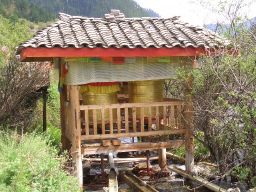
Prayer Wheel (maniguruma マニ車)

http://nomad.de-blog.jp/photos/2004travel/pict2918.html
These weels are also called chhos-hkor in Tibetan, 'Wheel of the Law'.
:::::::::::::::::::::::::::::::::::::::::::::::::::::::::::::::::::::::::::::::::::::::::::::::::::::
strong rain again -
the prayer wheel turns
faster

Gabi Greve, July 2006
:::::::::::::::::::::::::::::::::::::::::::::::::::::::::::::::::::::::::::::::::::::::::::::::::::::
Quote
Copyright © 2004 Dharma Haven
Spiritual Technology from Tibet
Tibetan prayer wheels (called Mani wheels by the Tibetans) are devices for spreading spiritual blessings and well being. Rolls of thin paper, imprinted with many, many copies of the mantra (prayer) Om Mani Padme Hum, printed in an ancient Indian script or in Tibetan script, are wound around an axle in a protective container, and spun around and around. Typically, larger decorative versions of the syllables of the mantra are also carved on the outside cover of the wheel.
Tibetan Buddhists believe that saying this mantra, out loud or silently to oneself, invokes the powerful benevolent attention and blessings of Chenrezig, the embodiment of compassion.
Viewing a written copy of the mantra is said to have the same effect -- and the mantra is carved into stones left in piles near paths where travelers will see them. Spinning the written form of the mantra around in a Mani wheel is also supposed to have the same effect; the more copies of the mantra, the more the benefit.
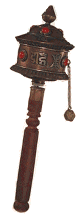 Traditionally wheels were not used at all in Tibet except for spiritual purposes -- carts and similar wheeled devices were known from other cultures, but their use was intentionally avoided. The earliest known mention of prayer wheels is in an account written by a Chinese pilgrim, in 400 AD, while traveling through the area now known as Ladakh. The idea is said to have originated as a play on the phrase "turn the wheel of the dharma," a classical metaphor for Buddha's teaching activity.
Mani wheels are found all over Tibet and in areas influenced by Tibetan culture. There are many types of Mani wheels, but small hand-held wheels, like the one shown here, are the most common by far. Tibetan people carry them around for hours, and even on long pilgrimages, spinning them any time they have a hand free.
Larger wheels, which may be several yards (meters) high and one or two yards (meters) in diameter, can contain myriad copies of the mantra, and may also contain sacred texts, up to hundreds of volumes.
They can be found mounted in rows next to pathways, to be spun by people entering a shrine, or along the route which people use as they walk slowly around and around a sacred site -- a form of spiritual practice called circumambulation.
stream spins prayer wheel
Wheels are also placed where they can be spun by wind or by flowing water. Smaller mounted wheels can be spun by the heat rising from a flame or by steam from a stove, or placed on a tabletop to be spun by hand.
LOOK:
http://www.mars.dti.ne.jp/~asanos/050503tibetmani.t5.jpg
Tibetan Buddhist Mani wheels are always spun clockwise, as viewed from above, for any or all of several reasons:
It rotates the syllables of the mantra so that they would pass a viewer in the order that they would be read, it follows the direction of the sun, and it matches the clockwise circumambulation of stupas. Practitioners of Bon, the pre Buddhist spiritual tradition of Tibet, spin their prayer wheels counter-clockwise, the same direction they use in circumambulation.
Much of Tibetan culture has now had to take refuge outside its homeland. In Tibet under Chinese rule, mechanical wheels are everywhere, on trucks and busses and cars and tanks, but spiritual training and practice, and even learning the Tibetan language, are severely restricted.
xxxxxxxxxxxxxxxxxxxxxxxxxxxxx
Click HERE to see more of these prayer wheels !!!
:::::::::::::::::::::::::::::::::::::::::::::::::::::::::::::::::::::::::::::::::::::::::::::::::::::
JAPAN
There are some large prayer wheels in many temples, where copies of the sutras are kept. You can walk around them, pushing the spokes while you walk to spin the wheel and have your prayers reach heaven.
The famous Maniguruma 摩尼車 from temple Hasedera
Kamakura

http://yama2000.com/2003/hasedera20030627-02.html
At the Nepal Exhibit, Aichi Banpaku Exhibition 2005

愛知万博 ネパール館にて展示されていた マニ車をネパール政府から譲り受ける。
一回転させるとお経を一回読んだことになり、功徳が積めます。
www1.canet.ne.jp/users/sakura/etc.htm
:::::::::::::::::::::::::::::::::::::::::::::::::::::::::::::::::::::::::::::::::::::::::::::::::::::
The Jizoo Wheel, Jizooguruma 地蔵車

Eifuku-Ji, Nr. 54, Shikoku, May 2005
Jizoo Wheel -
a mother places flowers
on the grave
There is a Japanese Buddhist variant of the Hyakudo Mairi Shinto tradition that involves the beloved Jizo Bosatsu. It is called the Jizoguruma 地蔵車. This translates as the Jizo Wheel (which includes the afterlife wheel, goshooguruma 後生車, ごしょうぐるま) and the Bosatsu wheel (bodaiguruma 菩提車, ぼだいぐるま).
Found in front of many temples. When you say your wish while turning the wheel downward, a wish for the afterlife will be granted.
When you turn the wheel upward, a wish for your present life will be granted.
Read more about this Jizoo Wheel at Mark Schumacher's pages:
http://www.onmarkproductions.com/html/other-stones-jizo-hyakudo.html
jizooguruma
Women used to do the "100 prayers circuit" (百度参り hyakudo mairi) to pray for the safety of their husbands on dangerous missions, for the recovery of illness of their loved ones or other very important reasons.
Sometimes ablutions with buckets of cold water were added to make the prayer more effective.
It could be walking the dedicated path for 100 times at one time or visiting the same shrine (temple) on 100 days.

stone marker for the 100 prayers circuit 百度石
The 100 prayers circuit would be from this stone marker to the main hall of the shrine (temple) and back again.
hyakudo sankei 百度参詣
hyakudo meguri 百度めぐり
hyakudo moode 百度もうで
o-hyakudo お百度
o-hyakudo mairi お百度まいり
hyakudo 百度 "100 times"

. Gankake 願掛け wish-prayer, to make a wish .
:::::::::::::::::::::::::::::::::::::::::::::::::::::::::::::::::::
蜻蛉の百度参りやあたご山
tonboo no hyakudo mairi ya Atago yama
a dragonfly
does the 100 prayers circuit -
Mount Atago
Kobayashi Issa
. Bishamonten and Mount Atago
:::::::::::::::::::::::::::::::::::::::::::::::::::::::::::::::::::::::::::::::::::::::::::::::::::::
BHUTAN
long past midnight
prayer wheels creak
March wind
Sonam Chhoki
. BHUTAN SAIJIKI .
:::::::::::::::::::::::::::::::::::::::::::::::::::::::::::::::::::::::::::::::::::::::::::::::::::::





 Posts
Posts