7/17/2006

Prayer Wheel (maniguruma)

[ . BACK to WORLDKIGO  TOP . ]
::::::::::::::::::::::::::::::::::::::::::::::::::::::::::::::::::::::::::::::::::::::::::::::::::::: 

Prayer Wheel (maniguruma マニ車)


http://nomad.de-blog.jp/photos/2004travel/pict2918.html


These weels are also called chhos-hkor in Tibetan, 'Wheel of the Law'.

:::::::::::::::::::::::::::::::::::::::::::::::::::::::::::::::::::::::::::::::::::::::::::::::::::::

strong rain again -
the prayer wheel turns
faster


Gabi Greve, July 2006

:::::::::::::::::::::::::::::::::::::::::::::::::::::::::::::::::::::::::::::::::::::::::::::::::::::

Quote
Copyright © 2004 Dharma Haven

Spiritual Technology from Tibet

Tibetan prayer wheels (called Mani wheels by the Tibetans) are devices for spreading spiritual blessings and well being. Rolls of thin paper, imprinted with many, many copies of the mantra (prayer) Om Mani Padme Hum, printed in an ancient Indian script or in Tibetan script, are wound around an axle in a protective container, and spun around and around. Typically, larger decorative versions of the syllables of the mantra are also carved on the outside cover of the wheel.

Tibetan Buddhists believe that saying this mantra, out loud or silently to oneself, invokes the powerful benevolent attention and blessings of Chenrezig, the embodiment of compassion.
Viewing a written copy of the mantra is said to have the same effect -- and the mantra is carved into stones left in piles near paths where travelers will see them. Spinning the written form of the mantra around in a Mani wheel is also supposed to have the same effect; the more copies of the mantra, the more the benefit.
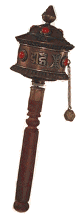
Traditionally wheels were not used at all in Tibet except for spiritual purposes -- carts and similar wheeled devices were known from other cultures, but their use was intentionally avoided. The earliest known mention of prayer wheels is in an account written by a Chinese pilgrim, in 400 AD, while traveling through the area now known as Ladakh. The idea is said to have originated as a play on the phrase "turn the wheel of the dharma," a classical metaphor for Buddha's teaching activity.

Mani wheels are found all over Tibet and in areas influenced by Tibetan culture. There are many types of Mani wheels, but small hand-held wheels, like the one shown here, are the most common by far. Tibetan people carry them around for hours, and even on long pilgrimages, spinning them any time they have a hand free.

Larger wheels, which may be several yards (meters) high and one or two yards (meters) in diameter, can contain myriad copies of the mantra, and may also contain sacred texts, up to hundreds of volumes.

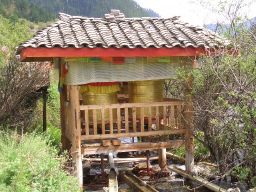
They can be found mounted in rows next to pathways, to be spun by people entering a shrine, or along the route which people use as they walk slowly around and around a sacred site -- a form of spiritual practice called circumambulation.

stream spins prayer wheel
Wheels are also placed where they can be spun by wind or by flowing water. Smaller mounted wheels can be spun by the heat rising from a flame or by steam from a stove, or placed on a tabletop to be spun by hand.
LOOK:
http://www.mars.dti.ne.jp/~asanos/050503tibetmani.t5.jpg

Tibetan Buddhist Mani wheels are always spun clockwise, as viewed from above, for any or all of several reasons:
It rotates the syllables of the mantra so that they would pass a viewer in the order that they would be read, it follows the direction of the sun, and it matches the clockwise circumambulation of stupas. Practitioners of Bon, the pre Buddhist spiritual tradition of Tibet, spin their prayer wheels counter-clockwise, the same direction they use in circumambulation.

Much of Tibetan culture has now had to take refuge outside its homeland. In Tibet under Chinese rule, mechanical wheels are everywhere, on trucks and busses and cars and tanks, but spiritual training and practice, and even learning the Tibetan language, are severely restricted.

xxxxxxxxxxxxxxxxxxxxxxxxxxxxx

Click HERE to see more of these prayer wheels !!!

:::::::::::::::::::::::::::::::::::::::::::::::::::::::::::::::::::::::::::::::::::::::::::::::::::::

JAPAN

There are some large prayer wheels in many temples, where copies of the sutras are kept. You can walk around them, pushing the spokes while you walk to spin the wheel and have your prayers reach heaven.

The famous Maniguruma 摩尼車 from temple Hasedera
Kamakura


http://yama2000.com/2003/hasedera20030627-02.html


At the Nepal Exhibit, Aichi Banpaku Exhibition 2005


愛知万博 ネパール館にて展示されていた マニ車をネパール政府から譲り受ける。
一回転させるとお経を一回読んだことになり、功徳が積めます。
www1.canet.ne.jp/users/sakura/etc.htm

:::::::::::::::::::::::::::::::::::::::::::::::::::::::::::::::::::::::::::::::::::::::::::::::::::::

The Jizoo Wheel, Jizooguruma 地蔵車


Eifuku-Ji, Nr. 54, Shikoku, May 2005

Jizoo Wheel -
a mother places flowers
on the grave

There is a Japanese Buddhist variant of the Hyakudo Mairi Shinto tradition that involves the beloved Jizo Bosatsu. It is called the Jizoguruma 地蔵車. This translates as the Jizo Wheel (which includes the afterlife wheel, goshooguruma 後生車, ごしょうぐるま) and the Bosatsu wheel (bodaiguruma 菩提車, ぼだいぐるま).

Found in front of many temples. When you say your wish while turning the wheel downward, a wish for the afterlife will be granted.
When you turn the wheel upward, a wish for your present life will be granted.

Read more about this Jizoo Wheel at Mark Schumacher's pages:
http://www.onmarkproductions.com/html/other-stones-jizo-hyakudo.html
jizooguruma

Women used to do the "100 prayers circuit" (百度参り hyakudo mairi) to pray for the safety of their husbands on dangerous missions, for the recovery of illness of their loved ones or other very important reasons.
Sometimes ablutions with buckets of cold water were added to make the prayer more effective.
It could be walking the dedicated path for 100 times at one time or visiting the same shrine (temple) on 100 days.


stone marker for the 100 prayers circuit 百度石
The 100 prayers circuit would be from this stone marker to the main hall of the shrine (temple) and back again.

hyakudo sankei 百度参詣
hyakudo meguri 百度めぐり
hyakudo moode 百度もうで
o-hyakudo お百度
o-hyakudo mairi お百度まいり
hyakudo 百度 "100 times"


. Gankake 願掛け wish-prayer, to make a wish .

:::::::::::::::::::::::::::::::::::::::::::::::::::::::::::::::::::


蜻蛉の百度参りやあたご山
tonboo no hyakudo mairi ya Atago yama

a dragonfly
does the 100 prayers circuit -
Mount Atago


Kobayashi Issa


. Bishamonten and Mount Atago

:::::::::::::::::::::::::::::::::::::::::::::::::::::::::::::::::::::::::::::::::::::::::::::::::::::

BHUTAN


long past midnight
prayer wheels creak
March wind


Sonam Chhoki


. BHUTAN SAIJIKI .  


:::::::::::::::::::::::::::::::::::::::::::::::::::::::::::::::::::::::::::::::::::::::::::::::::::::

7/08/2006

Shimenawa

[ . BACK to DARUMA MUSEUM TOP . ]
. shimenawa - legends .
::::::::::::::::::::::::::::::::::::::::::::::::::::::::::::::::::::::::::::::::::::::::::::::::::::: 

Shimenawa 注連縄 a sacred rope

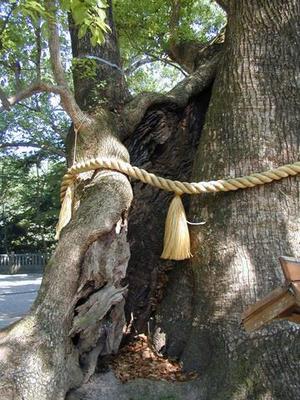
You see them at the entrance to a holy place, usually a Shinto shrine, to mark the entry into a sacred area. They are also around sacred trees.

Simplicity was the essence of the earlier Shinto shrines in Japan. The natives believe that the Japanese kami (gods) inhabit all natural phenomena such as volcanoes and rocks; these sacred places were thus marked with only a shimenawa (special plaited rope) and gohei (strips of white paper). The shimenawa will lead one to fences and on to the torii gates, which are now common features of a shrine.

I have written about the gates (torii) to a Shinto shrine here:
. Torii 鳥居
Gate of a Shinto Shrine


CLICK for more photos
The Great Shimenawa at Izumo Shrine


. Join the Shimenawa friends on facebook ! .

:::::::::::::::::::::::::::::::::::::::::::::::::::::::::::::::::::::::::::::::::::::::::::::::::::::

kigo for early winter

shime tsukuri 注連作 (しめつくり) making sacred ropes
... shime nau 注連綯う(しめなう)
They are prepared for the New Year decorations. Many farmers make small ones for their home entrances and local shrines.


kigo for the New Year celebrations
these ropes are renewed to make sure the area is purified and stays that way for the coming year. There are also smaller ropes for the home shrine (kamidana) or the Tokonoma in a private home.
shimekazari 注連飾 (しめかざり)
kadokazari 門飾 かどかざり)
toshinawa 年縄(としなわ)
wakazari 輪飾(わかざり) round straw wreath
kazarinawa 飾縄(かざりなわ), nawakazari 縄飾り(なわかざり)
kazariwara 飾藁(かざりわら)
maedarejime 前垂注連(まえだれじめ)
wajime 輪注連(わじめ)round straw rope

daikonjime 大根注連(だいこんじめ)in the form of a radish
. . . CLICK here for Photos !

goboojime 牛蒡注連(ごぼうじめ)in the form of a burdock root
. . . CLICK here for Photos !


shime morai 注連貰 (しめもらい)collecting straw rope decorations
Children go around before the "little New Year" on January 15 to collect the straw decorations for buring at a common pile, Sagichoo 左義長(さぎちょう).
Dondoyaki どんど焼 and sagichoo, burning of decorations


For more about HUMANITY KIGO look here at the New Year
WKD : New Year, shinnen shin nen 新年


::::::::::::::::::::::::::::::::::::::::::::::::::::::::::::::::::::::::::::::::::::::::::::::::::::: 

Some English Links dealing with this Shimenawa:

In Japan, shimenawa (sacred twists of ricestraw rope) can be as small and light as a feather or weigh over 3,000 pounds. They signify a sacred or newly purified space, especially when hung over doorways.

There is some more light information about the Shimenawa.
http://www.swarthmore.edu/Humanities/pschmid1/array/convolute3/shimenawa.html

A rope similar to the shimenawa is also worn by yokozuna, the highest ranked sumo wrestlers, during ritual ceremonies.

Short Information about Shinto Shrines:
http://www.japan-guide.com/e/e2059.html

xxxxxxxxxxxxxxxxxxxxxxxxx

A great LINK about Asian Rice Cultures
Over the centuries, rice has sculpted the culture of Asia. It is the grain that links Heaven and Earth, mortals and gods. Wherever the crop has been planted, festivals, traditions, rituals, and languages celebrate its importance. Even for those for whom rice is an everyday sight, something magical—spiritual—still radiates from the depths of the green fields.

Ceremonies, Rituals, and Festivals
Rice in Greetings, Meanings, and Symbolism
Medicinal Uses of Rice
Rice Landscape
Rice in the Weave
RiceWorldThe world’s only museum dedicated exclusively to rice.
Mountains of Rice: Beauty and Toil

Photos with Shimenawa / Philippines
http://www.asiarice.org/sections/gallery/gallery6-3.html

http://www.asiarice.org/sections/riceheritage/riceheritage.html

xxxxxxxxxxxxxxxxxxxxxxxxxxxxxxxxxxxxxxx


The Japanese Group for the Study of the Shimenawa
has an extensive site with all the anwers we could wish for. I will use it to show you more pictures and more explanations. Make sure you go to the pages mentioned and see the many examples given.


.. .. .. .. Shimenawa around a tree


... ... ... Shimenawa from Iwaki Shrine, Tsugaru


- source : simenawa.org/


. . . CLICK here for "simenawa" Photos !


Different forms of the hangers

http://www2s.biglobe.ne.jp/~auto/SIDE.html#SIDE.html


. Tsuruoka mingei 鶴岡民芸 folk art from Tsuruoka .
Yamagata


:::::::::::::::::::::::::::::::::::::::::::::::::::::::::::::::::::::::::::::::::::::::::::::::::::::::


. Yakubyoogami 疫病神 Yakubyogami, Deity of Diseases .
eyami no kami えやみのかみ
gyooyakujin 行疫神 gyoyakujin
ekijin, yakujin 疫神

Many villages hung a sacred rope (shimenawa) in front of the village entrance to keep him out.

:::::::::::::::::::::::::::::::::::::::::::::::::::::::::::::::::::::::::::::::::::::::::::::::::::::::


Some Pictures

Shimenawa (Sacred Rope) Naminoue Shrine, Naha City
http://www.pbase.com/image/25059964


Camphor Tree Kusunoki 楠木 くすのき


ein heiliges Seil
schmueckt die Gottheit -
tausend Jahre Leben
Gabi Greve


::::::::::::::::::::::::::::::::::::::::::::::::::::::::::::::::::::::::::::::::::::::::::::::::::::: 
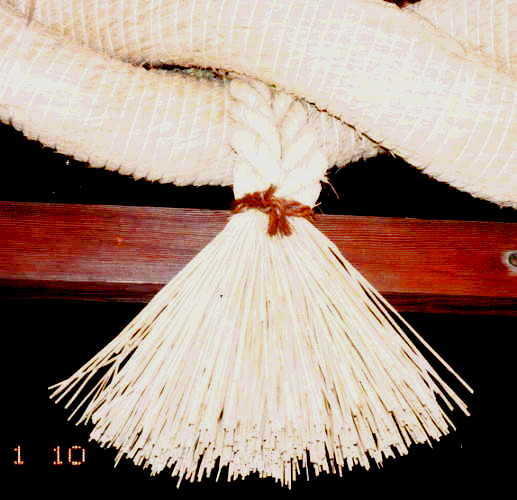

paper and straw -
the new year starts
with a clean slate


Gabi Greve, January 2007


::::::::::::::::::::::::::::::::::::::::::::::::::::::::::::::::::::::::::::::::::::::::::::::::::::: 

又ことし七五三かける也顔の皺
mata kotoshi shime kakeru nari kao no shiwa

another year
hanging the New Year's rope...
wrinkled face

Tr. David Lanoue


. Kobayashi Issa 小林一茶 in Edo .

::::::::::::::::::::::::::::::::::::::::::::::::::::::::::::::::::::::::::::::::::::::::::::::::::::: 

Futamigaura 二見ヶ浦 by 伊東深水 Ito Shinsui (1898 - 1972)


皆拝め二見の七五三を年の暮
mina ogame Futami no shime o toshi no kure

please all, worship this !
the sacred rope of Futamigaura Beach
at end of the year


Written at the end of the year 1688 元禄元年師走.
It was the hokku for a kasen 歌仙 with many of his disciples, including Sora.
In the room was a hanging scroll with the view of the "Wedded Rocks of Futamigaura" 二見が浦 夫婦岩.

Meoto Iwa 夫婦岩 "Wedded Rocks", can be found on many beaches in Japan, even in Ise.
They are venerated as a symbol for a good couple enduring all the hardships over the years.
shimenawa 七五三縄 not: shichi go san nawa


- - - - - There is another hokku by Basho about the scroll of Futami in Ise:

Worshiping at Futamigaura

うたがふな潮の花も浦の春
utagau na ushio no hana mo ura no haru

doubt it not:
the blossoms of the tide also show
spring upon this bay

Tr. Barnshill


Do not doubt it,
The bay has its spring too,--
The flowers of the tide.

Tr. Blyth


Written in 1688 元禄元年.
Basho wrote about the rocks of Ise. 三重県度会郡二見町二見浦.


. Matsuo Basho 松尾芭蕉 - Archives of the WKD .


quote
Because the sunset over the Sea of Genkai is so beautiful, Futamigaura Beach in Fukuoka is known as “Futamigaura of the Sunsets”. It is also called Sakurai Futamigaura Beach, as the two rocks lying close to one another just off the coast that are connected with a sacred straw rope are owned by Sakurai Shrine, and were venerated by the Kuroda domain lord for generations.
source : crossroadfukuoka.jp


source : zelda0726


::::::::::::::::::::::::::::::::::::::::::::::::::::::::::::::::::::::::::::::::::::::::::::::::::::: 

hidarinawa, hidari-nawa 左縄 sacred rope for a shrine
twisted with the left hand on top of the right.

miginawa, migi-nawa 右縄 for daily use
Normal straw ropes for the farmers are twisted with the right hand on top.

::::::::::::::::::::::::::::::::::::::::::::::::::::::::::::::::::::::::::::::::::::::::::::::::::::: 

. Miyazaki Folk Art 宮崎県 (Miyasaki) .
Shimenawa of all kinds and shapes

. warazaiku 藁細工 things made of straw  

::::::::::::::::::::::::::::::::::::::::::::::::::::::::::::::::::::::::::::::::::::::::::::::::::::: 

- - - Walther Sell wrote :
The Japanese characters for ‘shimenawa’ are 注連縄。The meaning of the characters are respectively
注 — attention, 連 — connect and 縄 — rope.
The meaning of ‘shimenawa’ can be seen as ‘a spiritual rope connecting one`s attention’.
This means the attention of uninterrupted self-awareness.
Behold now, what a wondrous order and what a wondrous sequence that has an obvious imprint of celestial wisdom. Thus was completed our God-created prayer as a threefold and unbroken cord, wisely and intelligently, braden and woven. -- Philokalia , Monks Callistus and Ignatius
Hold fast to the rope of God, all of you, and do not split up. -- The Koran
Breath is the essence of performance. It is like to thread that connects a set of jewels. The words are like jewels, the breath like a string. -- Komparu Zenchiku, 15th c, Japanese Noh actor
You must have the mind and the breath constantly following one another, the attention and the breath always guarded together. You need only cause them to be lengthened continuously and unbroken - like a silken thread which is never let loose. -- Yuyan Commentary on Cantong Qi (Triplex Unity)
Separation of God is like being in a well; remembrance of Him is the rope. -- Shams
See also: https://japanesesymbolsofpresence.com/shinto.html

::::::::::::::::::::::::::::::::::::::::::::::::::::::::::::::::::::::::::::::::::::::::::::::::::::: 


. Join the Shimenawa friend on facebook ! .

. shimenawa - legends .

[ . BACK to WORLDKIGO  TOP . ]
[ . BACK to DARUMA MUSEUM TOP . ]
- #shimenawa #shimekazari -
:::::::::::::::::::::::::::::::::::::::::::::::::::::::::::::::::::::::::::::::::::::::::::::::::::::