9/09/2006

Shizutani School

[ . BACK to DARUMA MUSEUM TOP . ]
. gakumonjo 学問所 Academies of Higher Learning .
::::::::::::::::::::::::::::::::::::::::::::::::::::::::::::::::::::::::::::::::::::::::::::::::::::: 
Shizutani School, Shizutani Gakkoo
閑谷学校 (しずたにがっこう)

静谷学校
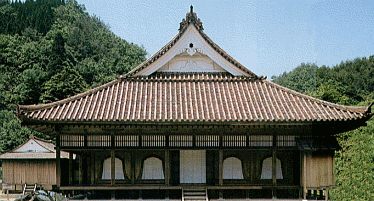
This school for Confucian Learning is quite close to my home in Okayama.It was a place of Confucian Learning during the Edo Period.

儒学の祖 学問の神閑谷学校釈
... ... The God of Learning

www3.from-c.com/data/sizu/sekisai%20PR.htm


:::::::::::::::::::::::::::::::::::::::::::::::::::::::::::::::::::::::::::::::::::::::::::::::::::::

Quote
Shizutani School
Shizutani means 'quiet valley', and it's a good name for this place. It's a very isolated valley along the tiny road from Yoshinaga to Bizen.

The primary claim to fame of the Shizutani school is that it was the oldest free public school in the world. Mitsumasa Ikeda of the Ikeda clan (daimyo of this area under the Tokugawa shogunate) had the school built to educate the children of the commoners in the province -- not just the children of the samurai class.

The other claim to fame of the school, though, is that the Ikedas had bizenyaki potters from the nearby Imbe area create, by hand, the tile roofs for the buildings. bizenyaki is a famous Japanese pottery style which does not use glazes -- the subtle and beautiful coloration is the result of mixing different clays from the area . The resulting rooflines and colorations are beautiful, and I spent several hours sketching the tile roofs at the school.

Construction projects had a different pace in those days. Nagatada Tsuda, a vassal of the Ikedas, was assigned to build the school, which he did in the period from 1670 to around 1703. As with Kourakuen gardens, built by the Ikedas in Okayama city, the composition of the views throughout the school is carefully constructed.

It was a Confucian school, dedicated to family, respect for elders and superiors, and discipline. In addition to being beautiful, the tile roofs are constructed that even if the first layer of tiles crack, no water gets through the roof.

No doubt lots of students got their knuckles bloodied in the main lecture hall for looking outside instead of at the teacher. The Ikedas declared that only charcoal was to be used for fuel here so that the ceiling would not be darkened by soot -- and 300 years later, they're not.

More photos are here. Adapted from
© 1998 Leo Hourvitz

:::::::::::::::::::::::::::::::::::::::::::::::::::::::::::::::::::::::::::::::::::::::::::::::::::::

Quote

In 1666 (Kanbun 6), Lord Mitsumasa Ikeda of Bizen visited a quiet place at Nobuhara Kitahashi in Kidani, Wake-gun on a inspection tour of his domain. He immediately thought of building an educational utopia, a large-scale learning place for common people. In order to realize an ambitious idea of his own, Lord Mitsumasa opened a learning place in 1668 (Kanbun 8).

In 1670 (Kanbun 10), his chief retainer Nagatada Tsuda began to build a full-scale construction and changed the name of the place to Shizutani. Lord Mitsumasa was so enthusiastic about building the school that he made arrangements for the school to be able to manage independently even if the Ikeda family had to be relocated. The school building was roofed with Bizen Pottery. To provide the roof tiles, he took the trouble to build a kiln nearby and brought potters from Imbe area.

His enthusiasm was inherited by his successor Lord Tsunamasa. The existing school facilities were completed by Lord Tsunamasa and Nagatada Tsuda in the Genroku years. However, the design and construction technology still has not lost its splendor. The school accepted not only common people and samurai children in the domain but also people from other domains. The spirit of Lord Mitsumasa and Nagatada in building the school continued uninterruptedly, offering many opportunities for scholars and literary people like Raisanyo.

The Shizutani School and the other domain school in the Okayama Castle town were the two leading educational institutions in the domain, and their history and tradition continued even in the Meiji Period, producing many able people to date.

Shizutani Shrine 閑谷神社
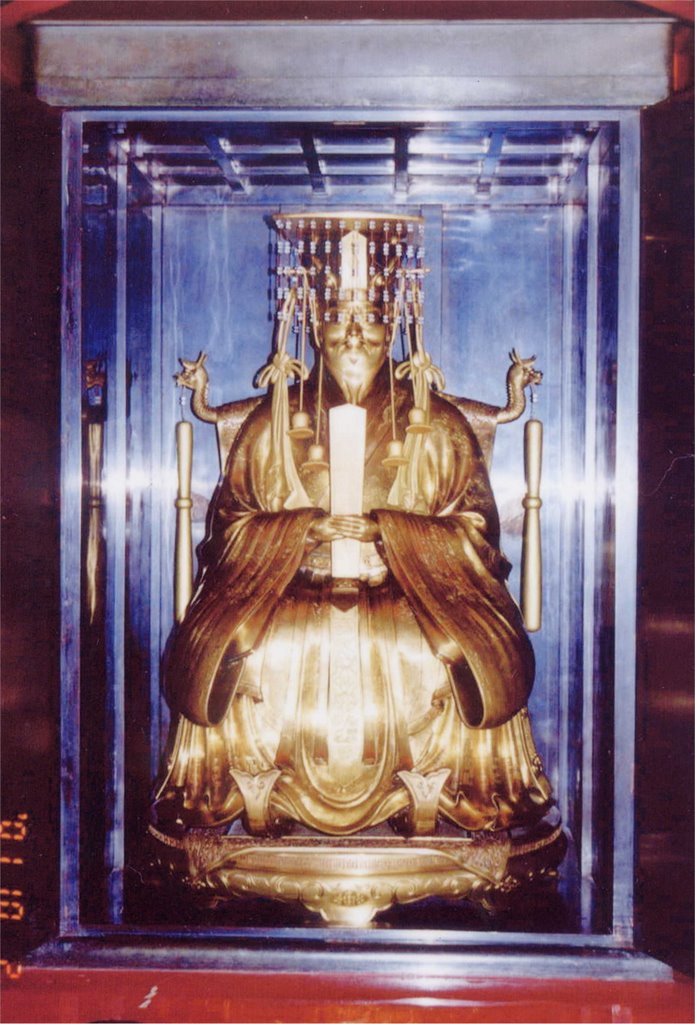
It was established in 1686 (Teiho 3) to honor Lord Mitsumasa Ikeda, the founder of the Shizutani School. The shrine is also known as Higashi Mido compared with the Holy Mausoleum in the west. There is a shining gold Lord Mitsumasa statue inside the shrine. The shrine was built 1-meter shorter than the Holy Mausoleum, there by expressing his respect for Confucius.

Holy Mausoleum 聖廟 (seibyoo, seibyō, Seibyo ) 

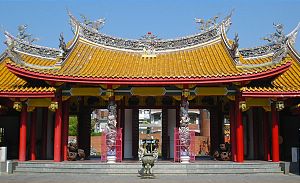
It is known as Nishi Mido compared with the Higashi Mido. The magnificent pair of Kai trees stand symmetrically on both sides, creating the beauty suitable for the holy name. Daiseiden, which is equal to the main building of a shrine, has hexagonal pattern Bizen Pottery roof tiles on the floor in order to prevent leakage for many years. This is one of the many careful construction techniques used in the building. The Holy Mausoleum still holds the gold Confucius statue inside.
聖廟には今も金色の孔子像が納められています.

Photo see above.


Auditorium 講堂

Designated as a national treasure, the auditorium is the largest building of the Shizutani School as well as the main classroom. It was built with good wood such as zelkova, cedar, camphor and others. Black lacquer was applied to the parts that are likely to weather. The auditorium was built to perfection under careful design from the foundation to the roof. The floor panels are still as shiny as mirrors.

Kai Trees (Chinese Pistachio trees) 楷(かい)の木
There are a pair of Kai trees standing on both sides of the stone steps that lead up to the Holy Mausoleum. The one on the left has leaves turning crimson, and the other on the right has leaves turning yellowish light vermilion in autumn. In early November, many tourists visit here just to see this autumn foliage. These Kai trees sprouted from seeds brought from the Confucius Mausoleum in Shandong, China, and they are called the "Trees of Academics" based on Confucius.

Shosai 小斉
This was a rest house for the lords while visiting the Shizutani School. With its hipped roof, the simple building has a tasteful atmosphere, like a tea ceremony room.

Koyo-tei 黄葉亭
This is a tea ceremony room to entertain school visitors such as scholars and literal people from other domains. The name, Koyo-tei, was taken from a poem by Teika Fujiwara. When Raisanyo visited here, he praised the scenery highly and wrote the "Koyo-tei Memories".

Tsubaki-yama 椿山  

Also known as the Tsubaki-dani, the holy place stored the school founder Lord Mitsumasa's hair, beard, nails and so on after his death.

Stone Wall 石塀
The wall surrounds the entire Shizutani School from one side of the school gate to the other. Each stone panel made of aqueous rocks is about 1.9-m wide and 2-m high, and chiseled into a semi-cylindrical shape. (The total length including the Tsubaki-yama is 846 meters.) Ever after 300 years passed, any single weed, have not grown on the wall.

Hanchi (はんち)
This is a rectangular pond 7-m wide and 11-m long that runs parallel to the stone wall. It was modeled on a school in ancient China.

© 2005 Bizen City All rights reserved.

:::::::::::::::::::::::::::::::::::::::::::::::::::::::::::::::::::::::::::::::::::::::::::::::::::::


備前藩主池田光政が庶民教育を目的に開いた学校で、藩営としては日本最古の庶民学校である。閑静な山紫水明のこの地に光政が家臣の津田永忠に命じて建設させたもので、現在の姿が整ったのは元禄14年(1701)のことである。
備前焼の瓦が美しい国宝の講堂をはじめ、敷地内の建築物のほとんどが重要文化財である。創立以来、儒教精神に基づく教育がなされ、他藩からの入学者、学者、文人の来遊も相次いだ。明治になってからは、旧制中学、新制高校と変遷し、現在は県青少年教育センターがあり、三百有余年の間、優秀な人材を送り続けている。
http://www.harenet.ne.jp/ugaidani/shizutani/

[備前市]閑谷学校一円(シズタニガッコウイチエン)


:::::::::::::::::::::::::::::::::::::::::::::::::::::::::::::::::::::::::::::::::::::::::::::::::::::

Holy Mausoleum 聖廟 (seibyoo, seibyō, Seibyo)
for Confucius or other deified persons.

- - - - - Read more about Confucius


聖廟の祭儀素朴に麗かに
seibyoo no saigi soboku ni uraraka ni

the rituals
at the Holy Mausoleum are simple -
bright spring weather


聖廟の小春絢爛たるに酔ふ
seibyoo no koharu kenran taru ni you

I get drunk
of the gorgeous early spring day
at the Holy Mausoleum


Shimomura Hiroshi 下村ひろし
Tr. Gabi Greve


::::::::::::::::::::::::::::::::::::::::::::::::::::::::::::::::::::::::::::::::::::::::::::::::::::: 

. Bizen Pottery and Daruma Statues  

. 足利学校 Ashikaga Gakkō, The Ashikaga School .
Japan's oldest academic institution. It is located in Ashikaga city, Tochigi Prefecture ...
Founded ca. 832 in the Heian period by the poet Ono no Takamura 小野篁 ...

- #shizutanigakko -
::::::::::::::::::::::::::::::::::::::::::::::::::::::::::::::::::::::::::::::::::::::::::::::::::::: 

[ . BACK to WORLDKIGO . TOP . ]
[ . BACK to DARUMA MUSEUM TOP . ]

::::::::::::::::::::::::::::::::::::::::::::::::::::::::::::::::::::::::::::::::::::::::::::::::::::: 

Confucius 02

[ . BACK to DARUMA MUSEUM TOP . ]
::::::::::::::::::::::::::::::::::::::::::::::::::::::::::::::::::::::::::::::::::::::::::::::::::::: 

Confucius - O2

Collecting Essays about this person.

:::::::::::::::::::::::::::::::::::::::::::::::::::::::::::::::::::::::::::::::::::::::::::::::::::::

© The Japan Times (C) All rights reserved Sept. 10, 2006

CONFUCIUS : A man in the soul of Japan
By MICHAEL HOFFMAN

"The Analects" and other Confucian texts were brought to Japan by the Korean envoy and scholar Wani in the fourth or fifth century A.D., some 800 years after Confucius' death. Buddhist sutras were also among the gifts he bore.

What kind of pupils Wani found the courtiers of preliterate Japan to be is not recorded. But the first fruits of Japan's early education were summarized two centuries later in the 17 articles of the "Constitution" of Prince Shotoku, dated 604. Its very first words, "Harmony is to be valued," are Confucian to the core. So is the exhortation in Article 4: "The ministers and functionaries should make decorous behavior their leading principle, for the leading principle of the government of the people consists in decorous behavior. If the superiors do not behave with decorum, the inferiors are disorderly: if inferiors are wanting in proper behavior, there must necessarily be offences."

A palace revolution in 645, known as the Taika Reform, aimed to fuse Japan's loose assemblage of rival clans into the centralized Confucian state envisioned by Prince Shotoku in Article 12: "In a country there are not two lords; the people cannot have two masters. The sovereign is the master of the people of the whole country."

Japan's cultural and political infancy, then, bears a strong Confucian stamp. A Chinese visitor to Nara at the height of the Nara Period (710-784) would have seen a model in miniature of his own society.

The Heian Period (794-1185) was a different story Ea purely Japanese cultural flowering that had little use for Confucianism. In Murasaki Shikibu's classic "Tale of Genji," the masterpiece of the age, Confucian scholars are figures of fun, their stuffy solemnity and stilted language provoking "gusts of laughter" among the guests at Genji's son's matriculation ceremony.

* * * * *


Hiraga Gennnai was a low-ranking Shikoku samurai and searing satirist against the neo-Confucianists holding sway in the Tokugawa Shogunate's "closed" Japan. He died in prison after stabbing a disciple in 1779 in a fit of madness.

* * * * *

Chinese recasting

The close of the Heian Period coincided with a Chinese recasting of the Confucian legacy by a group of scholars known to posterity as neo-Confucianists. The outstanding figure among them as far as Japan is concerned is Chu Hsi (1130-1200), for whom the quality of benevolence, very dear to Confucius' heart and central to his doctrine, is not only a human quality pertaining to society, but a natural force underpinning the physical universe: Man learns virtue by contemplating the natural order.

It is only a short leap from here to the notion that the given social hierarchy is ordained by nature itself.

Perhaps we need look no further for an explanation of why Chu Hsi's thinking was so attractive to the ultraconservative regime of the Edo Period (1603-1867). The Tokugawa shoguns closed Japan to all but the most limited foreign intercourse and froze, to the greatest extent possible, the social system in its 17th-century mold. Throughout this period, Chu Hsi's neo-Confucianism was the official state dogma.

* * * * *


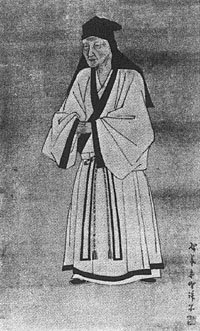
Hayashi Razan, who was the Confucian scholar-adviser to four shoguns from 1607.
PHOTO COURTESY OF YOSHIKAWA KO-BUNKAN, from "Japanese Historians and the National Myths, 1600-1945," by John S. Brownlee (Univ. of Tokyo Press; 1997)

* * * * *

"Many Japanese Confucian scholars are truly frogs who know nothing outside their own small wells," wrote the satirist Hiraga Gennai (1728-1779). "They slavishly copy everything Chinese and refer to Japan as a nation of 'Eastern Barbarians.'"

Hiraga was a jack-of-all-trades, an accomplished dabbler in Western arts and sciences whose impatience with the hidebound Confucian scholar-officials is understandable in view of the festering social problems Epoverty, peasant riots, the first hints of dangerous foreign resentment over Japan's isolationism Eto which they had no solutions beyond pedantic appeals for greater Confucian rectitude.

"The fact that people today will frivolously walk down a road from which there is no return is due to the existence of the 'Tale of Genji' and the [more overtly erotic] 'Tales of Ise,'E huffed the orthodox Chu Hsi scholar Yamazaki Ansai (1618-1682). "It is said that the 'Tale of Genji' was written as an admonishment for men and women. It is extremely doubtful, however, that such frivolity could serve to admonish anyone."

But the Confucian camp was less united than its outward ceremonial gravity made it appear. Had not Confucius himself treasured the "Book of Odes," a poetry and song collection from the ancient golden age he longed to recreate? Was it not one of the five Confucian classics? Did that not suggest there was a place for literature dealing with human emotions as well as with moral rectitude?

Disgust with the sanctimony of the Chu Hsi scholars drove other Confucianists back to their original sources.

Had Confucius really been such a stuffed shirt? On the contrary, "The Analects" show him to be a warm and at times passionate man, whose Way is rooted less in the Cosmos, as it was for Chu Hsi, than in the ordinary feelings of ordinary people Efamily sentiment in particular.

The endorsement of "ordinary feelings" had dangerous implications for a regime that survived by suppressing those feelings. Everything about the Tokugawa Shogunate was unnatural Ethe closed country, the social immobility, the very structure of the regime. "In a country there are not two lords," Prince Shotoku had admonished, but in Tokugawa Japan there were Ethe shogun and the emperor. Which of them had the sanction of heaven?

In Japan, hereditary official Confucian historians like Hayashi Razan (1583-1657) and his son and successor, Hayashi Gaho (1618-1680), bent over backwards to justify the overshadowing of the emperor by the shogun.

"Evildoers and bandits were vanquished," wrote Gaho in 1664 of the epoch-making Battle of Sekigahara, won by the Tokugawa in 1600, "and the entire realm submitted to Lord [Tokugawa] Ieyasu, praising the establishment of peace and extolling his martial virtue. That this glorious era that he founded may continue for ten thousands upon ten thousands of generations, coeval with heaven and earth!"

* * * * *


A STATUE in Asuka-dera, Nara Pref., of 604's Confucian Constitution author Prince Shotoku
CHRIS 73/ WIKIPEDIA PHOTO

* * * * *

Powerful state apparatus
The tone is bombastic, but Gaho himself seems to have had his doubts, for he wrote elsewhere, "In a book intended for the shogun's eyes it is incumbent upon one to be circumspect."

Tokugawa rule withered, but not Confucianism. In the succeeding Meiji Era (1868-1912) it merged with the native Shinto religion to buttress the most powerful state apparatus that had ever oppressed the Japanese people. Loyalty, duty, filial piety and harmony were the virtues to be cultivated Eby force if necessary. Confucius would have been appalled, but he had long since ceased to matter, his name having been co-opted as a symbol, his teachings reduced to slogans and commands.

After World War II, the Occupation authorities removed Confucian teachings from the Japanese school curriculum. "Nonetheless," comments MacMillan's "Encyclopedia of Religion," "to the extent that such ideals as harmony and loyalty can be said to belong to Confucianism, these qualities may be fundamental to Japanese culture and are likely to survive" Eas Hiraga had known all along they would. "In Japan," he wrote, tongue-in-cheek as always, "benevolence and righteousness have been spontaneously followed. Peace has prevailed even without sages."

:::::::::::::::::::::::::::::::::::::::::::::::::::::::::::::::::::::::::::::::::::::::::::::::::::::


Is Confucius dead?
Michale HOffman

He walked the Earth more than 2,500 years ago, his thinking focused even then on the remote past. Why bother with him today?

The eminence of his name, combined with aspects of his teachings that seem to favor absolute rule and unconditional obedience, have made him a convenient prop for Asian tyrants seeking to justify their dictatorships.

But does he have anything meaningful to say to the rest of us? Confucius, after all, knew little of technological change. We know nothing of stasis. To us, yesterday's wisdom seems obsolete today. To him, a filial son was one who made no change to his father's ways until the father had been dead at least three years. What can our globalized universe possibly learn from such a sage?

A good deal, argues a book titled "Confucianism for the Modern World." The volume is a collection of essays by 18 scholars, Asian and Western, who evaluate the master's legacy in terms of its contemporary relevance. Their point is that the incoherences and dissonances of our time have more in common than outward appearance might suggest with those that troubled Confucius 2Emillennia ago Eand that we, too, would be the better for a stiff dose of li.

Li is generally translated as "rites" or "rituals," but those words, with their connotation of empty forms, strike the wrong note. Think of it instead, suggests contributor Hahm Chaihark, a professor at South Korea's Yonsei University, as "a marvelous combination of education, self-cultivation, training, discipline, restraint, authority and legitimacy."

For Hahm, li served as a kind of unwritten premodern constitution, a constraint on government absolutism rather than an encouragement of it.

"For example," he writes, "during the Choson dynasty in Korea (1392-1910), the central bureaucracy included many offices" Estaffed by experts in li E"whose explicit duties were to educate, correct and criticize the behavior of the ruler."

It's a model worthy of careful study, Hahm maintains, for "once the citizens of modern East Asian countries begin to emulate their Confucian scholar-official ancestors, who first disciplined themselves with ritual propriety and then demanded the ruler's discipline, their countries will become constitutionalist states."

Skeptics doubt a globalized regime's capacity to nourish civilized values beyond mass entertainment and mass consumption. Geir Helgesen, senior researcher at the Nordic Institute of Asian Studies in Copenhagen, warns in his essay in the book of globalization's tendency to overwhelm the individual and trigger "a retreat into personal, private spheres of interest .EE " Accordingly, he says, "globalization might turn out to be a much more effective enemy of democracy than the totalitarian ideologies of the recent past ever were."

So, should we disembark from the Internet and dust off our copies of "The Analects"? Maybe we should.

Helgesen cites a recent South Korean survey showing 89 percent of respondents agreeing with Confucius that "a leader should care for the people as parents for their children." Ninety-one percent felt comfortable with the orthodox Confucian notion that "The objective of good government is to maintain harmonious social relations." For 87 percent, as of course for Confucius, "The ideal society is like a family."

Well, that's South Korea, the Confucian nation par excellence. But Helgesen's institute also conducted a similar survey in Denmark. "To our surprise," he reports, "75 percent of Danish respondents agreed that 'the ideal society is like a family.'E

What should we conclude from that? This at least, says Helgesen: "By teaching a social morality which stresses proper rituals based on the emotional pattern people recognize from family life, Confucianism may well have something to offer [our] 'runaway world.'"
- source : The Japan Times - All rights reserved

:::::::::::::::::::::::::::::::::::::::::::::::::::::::::::::::::::::::::::::::::::::::::::::::::::::

BACK TO - Confucius Part 1


::::::::::::::::::::::::::::::::::::::::::::::::::::::::::::::::::::::::::::::::::::::::::::::::::::: 

[ . BACK to DARUMA MUSEUM TOP . ]
[ . BACK to WORLDKIGO . TOP . ]

::::::::::::::::::::::::::::::::::::::::::::::::::::::::::::::::::::::::::::::::::::::::::::::::::::: 

Confucius 01

[ . BACK to worldkigo TOP . ]
:::::::::::::::::::::::::::::::::::::::::::::::::::::::::::::::::::::::::::::::::::::::::::::::::::::

Confucius


Confucius Statue at Encho En Park, Tottori, Japan
燕趙園【えんちょうえん】


Collecting Essays about this Chinese scholar
孔夫子, Kung Tzu, Kung Fu Tzu, Kung Fu Zi, Kǒng fū zǐ.
also called
Sekiten 釈奠 or Sekisai 釈菜


:::::::::::::::::::::::::::::::::::::::::::::::::::::::::::::::::::::::::::::::::::::::::::::::::::::


.................................................................................................

© The Japan Times (C) All rights reserved Sept. 10, 2006

Confucius and his 'golden age'
He shaped civilizations; his ancient values speak to us now
By MICHAEL HOFFMAN

Is what Confucius said true? Can music, poetry and decorum govern the world? Do rulers, by cultivating benevolence in themselves, plant benevolence in their subjects, and harmony in the polity?

The chaos of our time hardly invites us to take such notions seriously. But Confucius' time was chaotic too. The ancient Chou dynasty was crumbling, upstarts vied for power, and morality was falling apart.

In despair, a high government official proposed executing all wrongdoers. Confucius said, "In administering your government, what need is there for you to kill? Just desire the good yourself and the common people will be good."

The same official asked what to do about thieves. Confucius said, "If you yourself were not a man of desires" -- corrupt, in other words -- "no one would steal even if stealing carried a reward."

Asked why he did not take office, Confucius replied, "Simply by being a good son and friendly to his brothers a man can exert an influence upon government."

A society, in Confucius' view, was an extended family in which, ideally, family relationships and family harmony prevailed. "A youth who does not respect his elders will achieve nothing when he grows up." A respectful son grows into a man worthy of respect and therefore a worthy ruler -- of his family certainly, of society as a whole possibly. Rule meant, first and foremost, self-cultivation.

The gentleman "cultivates himself," said Confucius, "and thereby brings peace and security to his fellow men."

* * * * *
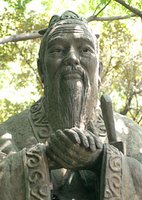


Is modern Japan a "Confucian" country? Schools no longer teach Confucian principles; the young no longer defer to the old; the hectic pace of urban life leaves scant room or patience for ritual observance. On the other hand, the world's tallest statue of Confucius (above), standing 4.57 meters high, graces the grounds of Yushima Seido in Ochanomizu 湯島聖堂 御茶ノ水, Tokyo. Yushima Seido is a 17th-century Confucian temple, built by the neo-Confucian scholar Hayashi Razan (1583-1657). Students congregate there in droves to pray for success in their examinations.
YOSHIAKI MIURA PHOTO

* * * * *

Confucius. The name is so familiar that we are apt to forget how little we know the man, though thanks to cryptic snatches of his conversation recorded by his disciples in a book called "The Analects" (from a Greek word meaning "collection") he is, though elusive, not entirely unknowable.

As for his teachings, the general verdict throughout most of the revolutionary 20th century was that they (or their derivatives, legitimate and bastard) accomplished their civilizing mission millennia ago and were best relegated to the remote past, having long since grown moldy in the service of Asian autocrats -- Japanese shoguns among them -- who invoked him with relish, and continue to invoke him, for his supposed emphasis on unquestioning obedience.

The latest in a long line is Chinese President Hu Jintao, who, stymied by social turmoil and the ruling Communist Party's intellectual bankruptcy, last year broke the party's anti-Confucian mold, reminding cadres, "Confucius said, 'Harmony is to be cherished.' "

The fragmentary nature of "The Analects" is conducive to the selective reading that autocrats have habitually given it.

"Never disobey," said Confucius -- it is one of his several definitions of filial piety, and sounds categorical enough. But he also said, in a passage less frequently honored with official quotation, "If a man is correct in his own person, then there will be obedience without orders being given; but if he is not correct in his own person, there will not be obedience even though orders are given."
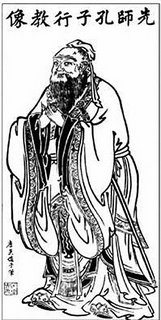

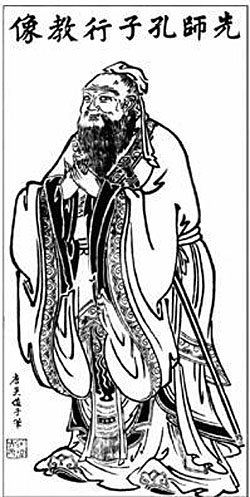
An old Chinese woodblock print of a statue of Confucius similar to that at Tokyo's Yushima Seido

"Correct" means above all, "benevolent." Benevolence is easy: "Is benevolence really far away? No sooner do I desire it than it is here." But the desire for it, judging by its rarity, is difficult. It commits a ruler above all, but also human beings in general, to the quest for moral perfection, to a "return to the observance of the rites through overcoming the self."

Few rulers in any era are up to such standards, and Confucius' impatience with those who are not is apparent in his advice to a disciple who asked how best to serve a prince: "Tell him the truth even if it offends him."

As for the rulers of his own day, "Oh," said Confucius, "they are of such limited capacity that they hardly count."

* * * * *

Almost alone among the ancient teachers of mankind, Confucius (K'ung Ch'iu in Chinese; Koshi in Japanese) was neither god nor prophet nor, in sharp contrast to his Taoist near-contemporary Lao-tzu, mystic.

"Chi-lu asked how the spirits of the dead and the gods should be served," we read in "The Analects."
"The Master said, 'You are not able even to serve man. How can you serve the spirits?' "

"May I ask about death?"
"You do not even understand life. How can you understand death?"

Revere the gods and spirits, he taught, "but keep them at a distance." They are not man's immediate concern. Moral perfection, whose outward manifestation is "work[ing] for the things the common people have a right to," is its own reward. There is no hint in his teaching of any other reward, natural or supernatural.

* * * * *

The China into which Confucius was born in 551 B.C. was not really China. That name derives from the imperial Ch'in dynasty, whose harsh though brief militarist, legalist, bureaucratic rule three centuries later (221-207 B.C.) represented everything Confucius abhorred. Confucius was a relatively humble citizen of the "state" of Lu, an eastern backwater, one of the least among 12 semi-independent, strife-ridden dukedoms of the tottering Chou dynasty.

It was the Chou dynasty's golden age, 500 years before his birth, that Confucius looked back to with longing, and dreamed of reviving.

"I transmit but do not innovate," he said. What he sought to transmit were the rites, music and poetry that had prevailed in a time, semi-mythical perhaps, when rites, music and poetry -- primarily the poetry preserved in the "Book of Odes," originating in the golden age and expressing the innocence to which Confucius aspired -- in effect ruled, because sage-kings like King Wen, King Wu and the Duke of Chou, the dynastic founders, were virtuous and wise.

"When those above are given to the observance of the rites," Confucius taught, "the common people will be easy to command." Force is unnecessary. Law is superfluous. "There was nothing for him to do," said Confucius of the ruler of a state in which the Way of the sage-kings prevailed, "but to hold himself in a respectful posture and to face due south" in accord with the traditions of ancient cosmology.

It was not the Way, however, but conditions approaching anarchy that prevailed in Confucius' own time. His father was a soldier, a daring and conspicuous figure in the numerous wars of the period. Confucius was orphaned early.

"I was of humble station when young," he later told his disciples. "That is why I am skilled in many menial things. Should a gentleman be skilled in many things? No, not at all."

Very little is known of his childhood, but "at 15," he said, "I set my heart on learning." What the impetus was we don't know, but his absorbing interest, the special focus of his studies, was li -- "the rites." It is a problematic term. No English word quite does it justice, scholars say, and a tendency to translate it as "ritual" has helped fuel modern impatience with Confucius.

Some of the li-soaked sections of "The Analects" are undeniably tiresome to our thinking.

"On going through the outer gates to his lord's court, [Confucius] drew himself in, as though the entrance was too small to admit him. When he stood, he did not occupy the center of the gateway; when he walked, he did not step on the threshold. When he went past [his lord's empty throne], his face took on a serious expression . . . When he lifted the hem of his robe to ascend the hall, he drew himself in, stopped inhaling as if he had no need to breathe . . . "

And so on -- it's a long passage, and there are many others like it.

But, as David Hall and Roger Ames point out in an essay published in "Confucianism for the Modern World" (see accompanying story), " 'The Analects' does not provide us with a catechism of prescribed formal conducts, but rather with the image of a particular historical person [i.e., Confucius] striving with imagination to exhibit the sensitivity to ritualized living that would ultimately make him the teacher of an entire civilization."

The outward manifestation matters less than the spirit animating it. "Appropriately performed," say Hall and Ames, "li elevates the commonplace and customary into something elegant and profoundly meaningful."

* * * * *
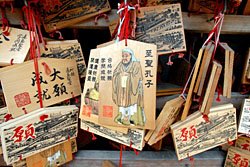

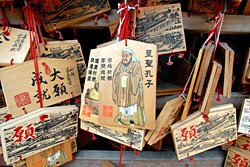
A votive ema plaque of Confucius left at Yushima Seido in Tokyo by someone who signed the back, wishing for exam success.
YOSHIAKI MIURA PHOTO

* * * * *

Once a disciple asked Confucius what he would do first if he were ever a ruler. "If something has to be put first," Confucius replied, "it is, perhaps, the rectification of names."

The disciple thought Confucius was joking; it seemed rather a trivial thing -- though it shouldn't to us, living as we do in an age of government by spokespersons and spin-doctors. Confucius (with some asperity at the disciple's "boorishness") explained: "When names are not correct, what is said will not sound reasonable; when what is said does not sound reasonable, affairs will not culminate in success; when affairs do not culminate in success, rites and music will not flourish; when rites and music do not flourish, punishments will not fit the crimes; when punishments do not fit the crimes, the common people will not know where to put hand and foot."

Note the absence of any mention, in connection with crime and punishment, of law.

Confucius was profoundly distrustful of laws. "If you use laws to direct the people," he said, "and punishments to control them, they will merely try to evade the laws, and will have no sense of shame. But if by virtue you guide them, and by the rites you control them, there will be a sense of shame, and of right" -- and social harmony will prevail.

Contemporaneous with Confucius were philosophers called Legalists. Their doctrine -- the rule of law -- seems, in light of future history, progressive, while Confucius' notion of the rule of "rites and music" strikes us as quaint, if not hopelessly reactionary.

But some modern psychologists are learning from the horrors of our time a new respect for Confucius. Simon Leys, in an accompanying commentary to his translation of "The Analects," quotes French psychologist Boris Cyrulnik: "When families are no longer able to generate rites that can interpret the surrounding world and transmit the parental culture, children find themselves cut off from reality, and they have to create their own culture -- a culture of archaic violence . . .

"Incidences of incest are increasing," Cyrulnik continues, "because too many men no longer feel that they are fathers. As family relationships have weakened and roles have changed, individuals do not see clearly what their proper place is. This is the symptom of a cultural breakdown."

* * * * *

"Can I not, perhaps," mused Confucius, "create another Chou in the east?" This was his life's mission, to recreate in the east -- in his home state of Lu -- his no doubt misty-eyed image of the golden age of the Chou dynasty founded by King Wen, King Wu and the Duke of Chou.

Intermittently, he assumed official positions under unsavory usurpers in order to further his goal. He gathered round him disciples -- 77 are known by name -- who might in a sense be called co-conspirators. The conspiracy, in which trickery figured more than violence, was an attempt to undermine the usurpers and return power to the legitimate heirs of the House of Chou. It came undone, and Confucius fled. He spent most of his last years in exile in neighboring states, returning to Lu shortly before his death in 479 B.C.

"For 2,000 years," says Leys, "Confucius was canonized as China's First and Supreme Teacher. This is a cruel irony. Of course, Confucius devoted much attention to education, but he never considered teaching as his first and real calling. His first vocation was politics. He had a mystical faith in his political mission."

It failed. Never has the world known a Confucian state, if by that we mean what Confucius meant -- a state governed by family relationships, nourished by benevolence and regulated by the poetry, music and rites of ancient sage-kings.


Manuscripts burned

Korea under the Choson dynasty (1392-1910) is often said to have come closest, but what much of Asia got instead was imperial Confucianism, a creation of China's Han dynasty (202 B.C.-A.D. 220). The Ch'in dynasty, which the Han overthrew, had burned manuscripts associated with Confucius, but some survived to be favored by a leading Han court philosopher -- who, circa 196 B.C., provoked his emperor's impatience by vigorously advocating their official adoption.

"I conquered my empire on horseback," snapped the emperor, "and I will rule my empire on horseback." Replied the philosopher: "Your Majesty, one may conquer an empire on horseback but one may never rule an empire on horseback."

Very much struck by that, the emperor proceeded to offer the first official sacrifice -- of an ox -- to the tomb of Confucius. This may be said to mark the birth of official Confucianism, an unwieldy collage of Confucian principle, later reinterpretation and imperial expediency. It had an awesome future ahead of it, spreading its influence well beyond China's borders and becoming one of the most extensive and durable systems of government in all history -- but it generally fell short when it came to benevolence.

"Confucius," says Leys bluntly, "was certainly not a Confucianist."

Indeed, the sage apparently died suspecting such would be the case. "I suppose I should give up hope," he sighed. "I have yet to meet the man who is as fond of virtue as he is of beauty in women."
© The Japan Times

:::::::::::::::::::::::::::::::::::::::::::::::::::::::::::::::::::::::::::::::::::::::::::::::::::::

Many more PHOTOS !


Confucian Scholars


Confucian Scholar

Click on the photos to see more of Confucius !

:::::::::::::::::::::::::::::::::::::::::::::::::::::::::::::::::::::::::::::::::::::::::::::::::::::
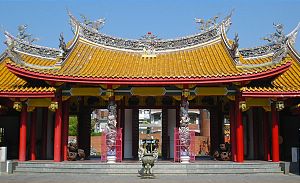


Nagasaki's Koshi-byo 孔子廟(こうしびょう)
is one of the few shrines dedicated to the Chinese philosopher Confucius in Japan.
This particular Confucian Shrine was built by Chinese residents of Nagasaki in 1893 and now contains the Museum of Chinese History.
kooshibyoo koshibyo
© Japan Guide Com


Click on the PHOTO below for more pictures of
Confucius Mausoleums!


:::::::::::::::::::::::::::::::::::::::::::::::::::::::::::::::::::::::::::::::::::::::::::::::::::::

NEXT - Confucius 02  
CONFUCIUS : A man in the soul of Japan
East and West echo the sage: 'The ideal society is like a family'

NEXT - Confucius 03  
Neo-Confucianism in the Edo period
Hokku by Yosa Buson


Shizutani School, Shizutani Gakkoo 閑谷学校 (しずたにがっこう)in Okayama Pref.
A place for Confucian Learning in the Edo Period


Hiraga Gennai, a Confucian Scholar


- and an external LINK
Confucius and Japanese Art
Mark Schumacher


......................................................


... which was called Tao by Lao Tzi, Infinite Nirvana by Sakyamuni and Infinite Emptiness by Confucius.

Read more !
Confucius and DaMo Quigong

:::::::::::::::::::::::::::::::::::::::::::::::::::::::::::::::::::::::::::::::::::::::::::::::::::::


.................................................................................


spring cleaning
Confucius enjoys the ethics
of humanity


Don Baird


::::::::::::::::::::::::::::::::::::::::::::::::::::::::::::::::::::::::::::::::::::::::::::::::::::: 


CLICK for more photos
SEKITEN - celebration of Confucius
Big Ceremony of Confucius Worship
sekiten ceremony (memorial rites for Confucius)


kigo for late spring

Sekiten 釈奠 (せきてん) Confucius
Kooshi sai, kooshisai 孔子祭(こうしさい)Confucius Festival
okimatsuri おきまつり / Sekisai 釈菜(せきさい)

last Sunday in April

This is held in many places in Japan, where a Chinese community is living.
It is also celebrated in China, Korea and other places where a Chinese community is living.

.................................................................................


kigo for mid-autumn

aki no Sekiten 秋の釈奠 (あきのせきてん)
Confucius (festival) in autumn

aki no okimatsuri 秋のおきまつり(あきのおきまつり)
28th day of the eighth lunar month,
now celebrated on September 28.
Famous in Nagasaki.


Reference : Sekiten


.................................................................................


“The first reference to the sekiten in a Japanese context appears in the Shoku Nihongi, and is dated 701. The sekiten was initially held twice a year (in the second and eighth months) at the University, as mandated by the relevant section of Taiho Code. Althought imperial interest in the sekiten laspsed in the eighth century; it made a resurgence in the ninth, during a period of great enthusiasm for Chinese culture in general. The Japanese sekiten at this time was, as it had been in China (and would be again when revived by the Tokugawa bakufu), a large-scale, formal, official event.”
(Anne Commons, Hitomaro: Poet as God, p. 99)

And Tokugawa Confucian education exerted great influence on haikai poets.

sekiten rite --
I see father’s face
in the mirror


The use of a mirror in China has a long history, dating back to at least 3500 years ago. Most mirrors in ancient China were made of bronze with two sides, a reflective side and a decorative back side.

The use of a mirror in writing would evoke the following remark:

One may use bronze as a mirror to straighten one's clothes and cap;
antiquity as a mirror to understand the rise and fall of states;
a man as a mirror to correct one's judgment.
--Tang Taizong


And Chinese politicians love to use the mirror metaphor to comment on political affairs:

Here is an example taken from History as a Mirror, the Future as a Window: Japan’s China Debate by David Fouse

"...A summit meeting between Prime Minister Koizumi and China’s new President Hu Jintao in St. Petersburg, Russia on May 31, 2003 emphasized many of these new positive developments. At the meeting, Hu Jintao broke with his predecessor by stating that Japan-China relations in the new century should “take history as a mirror, look toward the future, take a long-term perspective and give consideration to a broad picture.”
The idea of “taking history as a mirror and looking forward to the future” was carried to Japan again by new Chinese foreign minister Li Zhaoxing on August 11, and appears to be the new catchphrase in Sino-Japanese relations."


Chen-ou Liu
August 2010


::::::::::::::::::::::::::::::::::::::::::::::::::::::::::::::::::::::::::::::::::::::::::::::::::::: 
. Chinese origin of Japanese kigo .


. WASHOKU
Chinese Food in Japan

中華街 Chuukagai, Chukagai, Chinatown in Japan


[ . BACK to WORLDKIGO . TOP . ]
[ . BACK to DARUMA MUSEUM TOP . ]

:::::::::::::::::::::::::::::::::::::::::::::::::::::::::::::::::::::::::::::::::::::::::::::::::::::