. Asakusa 浅草 district in Edo .
:::::::::::::::::::::::::::::::::::::::::::::::::::::::::::::::::::::::::::::::::::::::::::::::::::::
Asakusa Kannon 浅草観音

Tsuchiya Koitsu (1870-1949)
Sanja Matsuri 三社祭 - see below
Temple Sensooji 浅草寺 Sensoji, Senso-Ji
One of my favorite templel in Tokyo.
Of course I bought my first little Daruma talisman there.
The other day I got an email from a person looking for a Daruma to give as a present to a friend for the opening of a new office. Sometimes they are sold at the Folk Art sections in big department stores or in the streets leading to a famous temple or shrine like Asakusa Kannon.
The special Daruma markets are usually only held during the New Year season.
So here is a list of stores where you can shop for Daruma san online all year long!
- Daruma Markets and Fuku Darumal
.......................................................................
Here is an article from the Japan Times. http://www.japantimes.co.jp/cgi-bin/getarticle.pl5?fe20050107se.htm Old Asakusa lives on .. By SUMIKO ENBUTSU Asakusa is a magnet for those who love old-time Tokyo. Like a theater full of excitement and festivity in praise of old Edo, Asakusa Kannon Temple and the surrounding business district are vibrant year-round, attracting on average 35 million people a year. This two-part article will take an in-depth look at Asakusa's glorious past and provide a guide to its current attractions. A typical monzen machi, meaning a town in front of the gate of a Buddhist temple or Shinto shrine, Asakusa has expanded around Asakusa Kannon, known as Senso-ji, into a far larger area. Given the physical devastation the area repeatedly suffered during its thousand-year history, Asakusa's ongoing vivacity is remarkable. And despite its continued prosperity, Senso-ji has remained a people's temple true to its legendary founding by local fishermen. The oldest Buddhist temple in Tokyo, Senso-ji 浅草寺 originated with a castaway statue netted by two fisherman brothers while fishing in what is now called the Sumida River. The date of this event is said to be 628 A.D., only 90 years after the official introduction of Buddhism to Nara in 538. The head of the fishermen's village recognized the rare find as an image of Kannon, the Buddhist deity of compassion for human suffering, and enshrined it in his home. Well-established by medieval times, the fame of Senso-ji spread throughout the Kanto region. Among the powerful rulers who recognized the temple's significance is Minamoto-no Yoritomo (1147-99), founder of the Kamakura Shogunate, who requested Senso-ji's help in the building of the great Tsurugaoka Hachiman-gu shrine in Kamakura in 1180. Tokugawa Ieyasu, arriving in Edo in 1590, designated Senso-ji as his family's prayer temple, granting it a sizable estate to contribute to its revenue. Successive shoguns followed suit with handsome donations from time to time. Despite being a temple patronized by the elite, Senso-ji continued to be open to the populace, embracing pilgrims and sightseers, as well as offering services and entertainment in the temple precincts. The area acquired a reputation for nightlife when the Yoshiwara -- the officially licensed red-light district -- and the Kabuki theater quarter moved in from central Edo to the temple's environs in 1657 and 1841, respectively. Senso-ji in the 19th century The prosperity of Senso-ji was depicted by the Edo artist Hasegawa Settan (1778-1843) in a 12-page piece, the largest in the whole book of Edo that Meisho Zue published in 1834-36. Shown here are three pages of the work, depicting the main hall on the left and the double-roofed Nio gate in the center with the pagoda off to the right. Notice there is no incense burner as there is today in front of the main hall. Off to the right of the Nio gate, a stretch of low teahouses are where the Nakamise shopping mall now stands. The major buildings illustrated here were lost in the 1945 air raid of Tokyo's shitamachi, but they were restored after the war using the same layout and architectural style. The pagoda has changed position, however, and is now located west of the Nio gate. The pine groves are also gone, mostly replaced by scattered ginkgo. Notice two figures on a square base between the pagoda and the teahouses: These are bronze statues of bodhisattvas from 1678, which survived the 1945 air raid. Getting around Visitors to the area are recommended to take the following approach: At the Ginza Line's Asakusa station leave through Exit 4, make a U-turn right and go left on Edo-dori to Komagata-do Temple on the Sumida River. When arriving on the Toei Asakusa Line, Exit A3 is more convenient. Komagata-do, dedicated to the horse-headed guardian deity of mounted travelers, one of the many manifestations of the bodhisattva Kannon, marks the original gateway to Senso-ji, standing formerly on the threshold of the land and waters from where Kannon is said to have emerged in the ancient past. Because of this legend, the hall was originally facing the river, and fishing was forbidden as a mark of respect. Cross Edo-dori and bear right onto Namiki-dori. The straight road leading to Kaminari-mon, the front gate of Senso-ji, used to be lined with shops and inns, forming the heart of Senso-ji's monzen machi. Only the Namiki Yabu noodle restaurant has survived, while the others have been replaced by modern office buildings. Once entering through Kaminari-mon and passing the famous large lantern, go wherever your whim dictates because there is much to discover. Just before the second Nio gate, however, turn right to look for the bronze statues, the left one representing Seishi Bodhisattva and the right one, Kannon. These were donated in 1678 by Takase Zembe'e in memory of his master, a prosperous rice dealer in Edo, under whom Zembe'e had apprenticed as a young boy, but who later died in poverty. With his own business thriving, Zembe'e had these statues order-made in devotion to his former master and his son. Nearly 300 years later, a direct descendant of Zembe'e played a vital role in enhancing Senso-ji's prestige. Jiro Takase (1906-1992), posted to Sri Lanka as Japanese ambassador in 1966, was involved in the development of a cultural partnership between Senso-ji and the Isurumuniya Vihara temple in Anuradhapura, the first capital of ancient Ceylon. When Senso-ji's pagoda was rebuilt in 1973, the Isurumuniya temple sent its senior abbot to the dedication ceremony along with a granule of the Buddha's remains, a perfect gift to celebrate the completion of the new pagoda, whose main function is as a repository for the relic. An old cast-iron bell has also survived in the temple from 1692. That and much more will be explored in the second installment of this article next month. The Japan Times: Jan. 7, 2005 (C) All rights reserved http://www.japantimes.co.jp/cgi-bin/getarticle.pl5?fe20050107se.htm Ancient Asakusa still central to community By SUMIKO ENBUTSU http://www.japantimes.co.jp/cgi-bin/getarticle.pl5?fe20050204se.htm The day in Asakusa begins with the tolling of the Senso-ji bell at 6 a.m. The temple bell, located behind two bronze bodhisattva statues dating back to 1678, is one of the nine official Time Bells of Edo, established in 1692.  In old Japan, time was measured by sunrise and sunset and was announced to the public by ringing these temple bells. Today, only two such bells survive, the other belonging to Kan'ei-ji in Ueno. Also rung on New Year's Eve, the Senso-ji bell continues to set the pace of life for the local community. The morning service held in the main hall starts simultaneously with the bell in summer and a half hour later in winter. It is the most invigorating moment of the day when the chanting of sutras breaks the overnight silence in the huge hall as the smoke of incense slowly rises from the main altar dedicated to Kannon, the Buddhist Deity of Mercy. According to popular legend, the Kannon of Asakusa manifested itself in the form of a small statue netted by two fishermen. Emphasizing the deity's compassion for the poor despite their breach of the Buddhist precept of the sanctity of all life, the tale propagates an enduring, wide-spread belief that anyone can be cleansed of their sins and freed from sufferings through faithful devotion to the Kannon. Power of faith It is the power of this faith that has sustained Senso-ji in the centuries since its foundation. Among numerous miracles attributed to the Asakusa Kannon is the account of a fire in 1808, which spread from Shiba in the city's south and was about to envelop Senso-ji. In the pell-mell rush to escape the imminent threat, the Kannon shrine and statue were moved from the main hall. Just then, the wind changed direction and heavy rain extinguished the blaze. The local residents, most mid-flight, all turned to the packed-up portable shrine and began to give thanks for the wonder they had witnessed.  The wooden main hall was donated by the third shogun, Tokugawa Iemitsu, in 1650 and survived more than 60 fires during the Edo Period and withstood the great earthquake of 1923 before being reduced to ashes in the fire-bombing air raids of 1945. The holy image was undamaged, however, having been buried deep underground. Out of the rubble of war, Senso-ji rose phoenix-like, with the successive reconstruction of the majestic main hall, Kaminarimon front gate and Hozonmon Nio gate, all in ferroconcrete. The flurry of rennovation projects, from 1958 to 1964, was supported through active fundraising led by prominent businessmen. The pagoda, completed in 1973, is a fine example of traditional Buddhist architecture executed with modern materials. The wood block print shown above is from the 1830s and depicts people thronging the main hall to get Kannon paper amulets. Giving out these talismans used to be a unique practice of Senso-ji to celebrate Setsubun, an annual ceremony to dispel evil spirits. The crowd vies for talismans scattered from the high platform, while the senior abbot prepares to bless the next batch and servants toil at stirring up the air with big fans. Observed on Feb. 3 this year, the contemporary Setsubun features bean throwing by temple-appointed toshi otoko, lucky men born in the Year of the Cock, the current zodiac sign. The program, starting at 11:30 a.m. and repeated at 1:30 p.m., includes a procession of abbots and toshi otoko, rituals, bean scattering from the balcony and Fukuju-no Mai (the dance of the seven gods of fortune), which is a tradition dating back to 1964. Later in the afternoon, the local tourism promotion association invites celebrities to take center stage. Focal point of festivities On the east side of the main hall is Asakusa-jinja, dedicated to the now deified pair of fishermen who uncovered the Kannon statue and the village elder who brought the discovery to the attention of the authorities. Popularly called Sanja-sama (Three Guardians), it is a Shinto shrine which was separated from Buddhist Senso-ji in 1869. The wooden building, dating back to the mid-17th century, is another gift from Shogun Iemitsu, and is the focal point of the famous Sanja Matsuri festival held in May. Senso-ji supports numerous other shrines dedicated to dozens of other deities who, in exchange for a little devotion, will grant any wish that you may have. Many are clustered on the west side, and here, too, many people are seen praying in earnest as they make a round of visits to Amida, Yakushi, Jizo and other gods. Awashima-jinja at the far west end is famous for Hari Kuyo on Feb. 8, a women's festival to express gratitude to sewing needles by resting them on cushions of tofu.  Nearby stands a statue of Ichikawa Danjuro IX, star kabuki actor of the 1930s. In his heyday, the city's foremost theater was located behind Senso-ji, and to this day Asakusa retains strong links to the world of theater. Kabuki actor Nakamura Kankuro performed here in 2003 to universal acclaim, and enthusiastic fans hailed him again on Jan. 22 when he visited Senso-ji prior to his assumption of the historic name Nakamura Kanzaburo effective March 2005. The Japan Times: Feb. 4, 2005(C) All rights reserved http://www.japantimes.co.jp/cgi-bin/getarticle.pl5?fe20050204se.htm |
:::::::::::::::::::::::::::::::::::::::::::::::::::::::::::::::::::::::::::::::::::::::::::::::::::::
.. .. .. .. .. Yearly Events:
January 5
. Go-Oo Kaji-E 牛玉加持会
Prayer Ritual for the Deity of the Ox .
..... Sensooji go oo kaji 浅草寺牛王加持 (せんそうじごおうかじ)
observance kigo for the New Year
. Go-Oo Hooin 牛王宝印 sacred seal of the ox treasure .

Sanja Matsuri - May: one of Tokyo's three major festivals. (see below)
Hozuki-ichi (Hozuki Market) - July: Hozuki are ground cherries, a typical summer plant in Japan. Lampionflower hoozuki is a kigo for haiku.
Asakusa Samba Carnival - August
Tokyo Jidai Matsuri - November: a festival commemorating the history of Tokyo and the Edo culture.
Hagoita-ichi (Hagoita Market) - December: Hagoita is the wooden paddle used in Hanetsuki, a traditional game that resembles badminton. Click here to read more about Hanetsuki and the Hagoita Market.
http://www.japan-guide.com/e/e3001.html
:::::::::::::::::::::::::::::::::::::::::::::::::::::::::::::::::::::::::::::::::::::::::::::::::::::
Sanja Matsuri - Third Weekend in May
By Taisha Turner
The Sanja Matsuri (Festival) is one of Tokyo’s largest. It takes place in the Asakusa ward, Tokyo, Japan’s downtown area. The festival is during the third weekend in May. The three-day festival celebrates the Askusa shrine.
On the first day, one thousand paraders assemble in the street. They wear traditional Japanese attire. Musicians, performers and dancers march to the pulsating music. People line the streets, cheering and applauding on the paraders. Everything is bright and lively.
Each day, there are open-air stalls. Buddhist religious items as well as tourist trinkets are for sale to the public. Food stalls satisfy the appetites of the hungry.
On day two, a group carries a total of 100 shrines(mikoshi). Each model represents a different shrine in and around Tokyo. They meet at the Asakusa’s “Thunder Gate.” The procession proceeds down shop-lined Nakamise Street. The parade stops in front of the Asakusa’s “Hozomon Gate.” There the people pay homage to Kannon who is the goddess of mercy.
The 100 portable shrines are carried into the main complex. The shrine’s priests bless and purify them for the forth coming year. After the purification ceremony, each shrine returns to its neighborhood
The streets teem with the people who come to witness the ceremony. The crowds’ cheers fill the air. Each year about two million people watch the procession. The ceremony has taken place since the 7th century.
On the third day, the 100 Omikoshi (portable shrines) tours Tokyo. The priests bless and purify the shrines on the festival’s second day. This Omikoshi is taken from the precincts in the morning.
All day long, the Omikoshi which carries a deity is paraded in communities. Each shrine travels in different areas of Tokyo. Musicians, performers and dancers follow the shrines. People leave their homes and watch the ornate shrines travel down the street. The watchers errupt in cheers as the shrine passes along.
In the evening, the Omikoshi is returned to its precinct. This ends the festivities until the next year.
http://wwww.bellaonline.com/articles/art29677.asp
.......................................................................

Click the image to go to this great page by Wada san and listen to the music too.
http://wadaphoto.jp/maturi/san1.htm
Safekeep
http://blog.livedoor.jp/worldkigo/archives/22741614.html
:::::::::::::::::::::::::::::::::::::::::::::::::::::::::::::::::::::::::::::::::::::::::::
。。。。。。。。。。。 Haiku about the Sanja Festival
sanja matsuri 三社祭
Asakusa matsuri 浅草祭(あさくさまつり)Asakusa Festival
binzasara odori びんざさら踊(びんざさらおどり)
Binzasara dance
sanja matsuri 三社祭(さんじゃさい)
Festivals of the three shrines
kigo for early summer
. . . . .
三社祭 三本絞めて 仕舞いけり
Sanja Matsuri sanbon shimete shimaikeri
Sanja Festival -
all clapping the hands three times
then it is over
(To clap the hands three times in a group is a way to show a deal is made, a fact is agreed upon, something is now over and done with. All the participants of the festival gather and perform this on the last day.)
................
三社祭 江戸の開府も 四百年
Sanja Matsuri Edo no kaifu mo yonhyaku nen
Sanja Festival -
since the start of the Edo government
it is four hundred years !
http://www.geocities.co.jp/Bookend-Shikibu/6419/saiji/saiji2.html
xxxxxxxxxxxxxxxxxxxxxxxxxxxxxxxxxxxx
Sanja Festival -
lost in the crowds
I taste Old Edo
Gabi Greve
:::::::::::::::::::::::::::::::::::::::::::::::::::::::::::::::::::::::::::::::::::::::::::::::::::::
observance kigo for mid-summer
Edo Sengen sai 江戸浅間祭 (えどせんげんさい)
Festival at the Sengen Shrine in Edo
Asakusa Fuji moode 浅草富士詣(あさくさふじもうで)
Pilgrimage to the Asakusa Fuji
On the 30th day of the fifth lunar month and the first day of the sixth lunar month.
Now on the last day of June and the first fay of July.
The Fuji Asama Shrine in Asakusa
浅草の富士浅間神社 Fuji Sengen Jinja
Here people worship who can not make the trip to the Asama Shrine (Sengen Shrine) at Mt. Fuji. This is the place where Issa refers to in his haiku, see comments below.
There were many "Mount Fuji worship groups" in Edo, "Devotional Fuji confraternities" (fujiko(fujikoo, fujikou 富士講).
Mount Fuji gave rise to its own religion, Fujiko, which had different sects based on which direction Fuji san was viewed.
For example: worshiping the mountain from the north (modern day Tokyo) would be considered an Edo religion.
According to early Shugendo myths the mountain was first climbed by the wizard-sage En No Gyoja around 700 AD, although it’s more likely reaching the summit was made in the early twelve century. Women, however, were not allowed past the second station until 1871 because they were thought to irritate the Gods and cause bad weather.
© www.tokyonodoko.com/

Fuji Mandala for the worshippers
富士曼荼羅
Fire Festival at the shrine Fuji Sengen in Yoshida Town and Haiku
quote
O-Fuji-sama no Ueki-ichi (Potted Plant Fair)
[last Sat. & Sun. of May and June]
Ueki-ichi (Plant Fair) is held on the same day as a festival day at Sengen Shrine (popularly called O-Fuji-sama). Sengen Shrine is located at 5-3-3 Asakusa, Taito-ku and diagonally across from the Asakusa Police Station. For this reason, Ueki-ichi has become another name for the festival day. In the past, Sengen Shrine was managed separately by Shuzenin, a branch temple of Sensoji Temple, but after Shuzenin was abolished in the mid-Meiji era, Sengen Shrine came under the supervision of the chief priest of Asakusa Shrine.
The shrine is dedicated to Konohanasakuya-hime and is said to have been built upon request by Sengen Shrine located in Fuji-gun, Suruga-no-kuni during the Genroku era (1688-1703), but this is not certain. The shrine is said to be located in an unlucky direction or the "demon's gate" when viewed from Mt. Fuji, and since the shrine is on a low hill, it used to command a good view of Mt. Fuji.
Since long ago, Mt. Fuji has been the object of religious belief and devotion. Fund drives for Sengen Shrines were carried out and organizations of worshippers of Mt. Fuji ("Fuji-ko") were formed all over the country. On June 1 when Mt. Fuji opened for mountain climbers, people who were not able to climb Mt. Fuji visited one of the Sengen Shrines and worshipped there instead. In the beginning, believers purified themselves with water, put on a white hemp kimono, and began worshipping at daybreak. After the Genroku era, the number of child worshippers began to increase and they worshipped with their hair untied and loosened, as if they had purified themselves.
Long ago, the festival days were May 31 and June 1, but after the opening day of Mt. Fuji's climbing season was changed to July 1 in the Meiji era, the festival also came to be held on June 30 and July 1. It is unusual for a festival to be held for a total of four days.
Stalls selling many items line the front approach to the shrine called Fuji-dori. A potted plant fair has been held on the grounds of the former Rokugo family residence since the Meiji era. The festival coincides with the onset of the rainy season which is the best time for transplanting and the trees bought at O-fuji-sama have long been said to take root well. As a result, this fair has gradually become popular. Nowadays, on the last Saturday of May and June, about 350 nurseries set up shop mainly along Yanagi-dori, transforming it into a jungle-like environment. According to a survey by the Asakusa Police Department in 1995, the fair attracted over 330,000 people during the four days.
Snakes crafted from straw have become rare since the end of World War II. They were made by a farmer named Kihachi who lived in Komagome during the Hoei era approximately 250 years ago, who popularized them after he was told in a dream that the straw snakes would offer protection against epidemics or water poisoning. Judged to be miraculously efficacious, the snakes were sold in Asakusa as well.
As an old senryu (satirical Japanese poem) depicted, some of the snakes had tongues and others didn't, indicating that the tongues that were made of pieces of red wood easily fell off as people bumped into other. This suggests the excitement of the jostling crowds at the fair.
© www.asakusa-umai.ne.jp
................................................

fujikoo 富士講 Fujiko
groups of Mt. Fuji worshippers, Fuji pilgrims
organization for conducting a religious activities
religious circles called Fujiko
devotional Fuji confraternities
Fuji-associations
..... the Yoshida Trail and other trails starting from the northern base became even more popular with followers of Fujiko, a sect of Mt. Fuji worship started by Kakugyo Hasegawa at the end of the Muromachi Period that later became popular in and around the Edo capital during the mid-Edo Period.
source : www.fujisan-3776.jp
.................................................................................
夕立の祈らぬ里にかかる也
yuudachi no inoranu sato ni kakaru nari
violent rainstorm
hits a town
that didn't pray
Kobayashi Issa
This hokku is Issa's only hokku written on 6/2/1806, a day after the biggest festival of the year for believers in Fuji-kou (富士講), a popular religion in the Edo area in Issa's time based on worship of Mt. Fuji and its female shamanic god Konohana Sakuya Hime, who is also the god of cherry blossoms. Many small mounds in Edo were used as symbolic Mt. Fujis, up which believers "climbed" on 6/1 and worshiped the real Mt. Fuji in the distance. These mounds were shaped like Mt. Fuji and marked with the name of landmarks on Mt. Fuji.
And like Mt. Fuji, these miniature Mt. Fujis were referred to as "O-Fuji-san" or simply as "O-Fuji," with "O-" being an honorific prefix. For the truly devout, however, and for those who had enough money, a pilgrimage up Mt. Fuji and around its base was very important, and believers dreamed of climbing Mt. Fuji at least once in their lives. Mt. Fuji was opened to the public for about a month beginning on lunar 6/1 (the contemporary date is 7/8), and leaders of each local Mt. Fuji worship group, along with some ordinary believers, made climbs up the sacred mountain during this time. Issa doesn't seem to have been a member of this religion, but on the festival day of 6/1 he arrived in Uraga, a small harbor town on the Miura Peninsula on the west side of the mouth of Tokyo Bay. Uraga lay between Edo and Mt. Fuji and had a wonderful view of the mountain, so there were many Fuji-kou believers in this area. Issa, too, no doubt also wants to pay his respects to Mt. Fuji even if he's not a member of the religion.
The day before the above hokku was written, Issa's only hokku on 6/1 clearly reflects the religious meaning of the date:
涼風もけふ一日の御不二哉
suzukaze mo kyoo ichinichi no mi-fuji kana
cool breeze, too
spends the day
climbing Mt. Fuji
O-Fuji - an honorific term for Mt. Fuji indicating that one makes a pilgrimage to Mt. Fuji or to a Mt.Fuji mound and climbs it in order to worship the mountain and gain merit.
Since Issa traveled westward to Uraga on a boat that used the wind, it must be an east wind blowing his boat toward Uraga, and the same east wind keeps blowing until it reaches Mt. Fuji. All day on this 6/1 festival day, everyone, even the wind, seems to be making a pilgrimage and then climbing the sacred mountain or a miniature version of it. The fact that the wind is cool and refreshing on a hot summer day also makes it seem as if the wind were trying to cool off Mt. Fuji in order to show its respect.
In Issa's hokku on 6/2, the first hokku given above, 'nari' implies "it seems that" or "they say that," so Issa may be using an image he has heard from the local Fuji-kou believers in Uraga. It could be a general statement warning that Mt. Fuji isn't pleased by towns that have no small Fuji mound shrine and send no pilgrims, or it could be a statement about the day's extreme weather. Issa's notebook says that 6/1 was fair but that 6/2 was fair with rain in the evening, so he himself probably experienced a sudden strong cloudburst late in the day on 6/2.
A 'yuudachi' is a very strong and sudden summer storm that usually occurs late in the day or sometimes shortly after noon. The rain is hard, and it's usually accompanied by thunder, lightning, and strong wind. It often appears without much warning and ends just as suddenly. Since one of these cloudbursts passed over Uraga on 6/2, it would appear that the people there have not been praying to Mt. Fuji strongly or often enough on 6/1 and 6/2, so there may be some irony in the hokku.
Issa may even be hinting he's one of those in the town who haven't prayed to Mt. Fuji properly. Issa's own main motive for visiting Uraga seems to have been to visit a grave in a temple there on 6/3. It was the grave of a woman, and he visited on the 25th anniversary (on 6/2) of her death (an important anniversary on which special prayers were offered for the dead person's soul). Counting backwards, the woman died when Issa was 20. The editors of Issa's complete works (2:353) suggest that a memorial day visit to a distant temple after so many years probably indicates the woman was very important to the young Issa, though no records remain. Does Issa's hokku about the severe storm on 6/2 reflect his memories of this relationship and of the woman's death on 6/2 two and a half decades earlier? And does it also reflect his awareness that his primary prayers are not for Mt. Fuji but for the soul of the dead woman?
Chris Drake
.......................................................................
- Issa, suzukaze and Mount Fuji
涼風の出口もいくつ松かしは
suzukaze no deguchi mo ikutsu matsu kashiwa
pine tree, oak tree,
how does a cool breeze
get out of here?
This hokku is from the fifth month (June) of 1819, the year evoked in Issa's Year of My Life. The time is just after the beginning of the summer heat and about a month before the death of Issa's young daughter, described in Year of My Life. Issa seems to be imagining what it would be like to be a cool breeze, presumably at the end of a hot day. The breeze has blown easily and naturally into a woods, where it has swerved here and there and gradually lost its way. Now it asks some trees in the woods for directions, apparently naively assuming that the woods must have just as many ways out as it has ways in. All the while, of course, the breeze moves less and less and gradually looses its coolness and its own existence. Perhaps it will manage to find find a few small exits, perhaps not.
Somehow this half-humorous, half-tender personified scene of a new young breeze trying to learn from the old, established trees is rather moving, perhaps partly because it relies on unspoken similarities between wind and human breath and thus simply and directly becomes about mortality and about knowledge as well. It also suggests the way the people in Issa's hometown wait and wait, mostly in vain, for cool breezes.
Issa doesn't mention the exact outcome of the breeze's search for a way out, which is basically inevitable, though some breeze may find its way out of the woods. He also doesn't directly indicate who is the speaker and who is the listener, but since the cool breeze is the visitor or traveler, the breeze seems to be the speaker. This hokku seems to belong to a series of hokku by Issa that are personified, implicit dialogs between nonhuman beings and natural objects. One of the most famous, and rather similar in structure, is:
kame-dono no ikutsu no toshi zo fuji no yama
so, Mr. Turtle,
just how old are you?
Mt. Fuji
Mt. Fuji, of course, is the timeless and deathless symbol of the enduring country of Japan, and according to legend turtles are believed to live ten thousand years, that is, an indefinitely long time, that is, possibly forever, so the age of both speakers is beyond reckoning, thus increasing the humor, as if mountain and turtle were both trying to impossibly remember their own actual (indicated by zo) ages. The distance between the age of Mt. Fuji and the lifespan of the cool breeze is striking, but they both share a fragile vulnerability that keeps them from becoming static abstractions.
Chris Drake
.......................................................................
Mt. Asama and Haiku
花の木に鶏寝るや浅草寺
hana no ki ni niwatori neru ya sensooji
in the blooming tree
a sleeping chicken...
Senso Temple
Tr. David Lanoue
MORE - Issa haiku about not saying prayers
. Kobayashi Issa 小林一茶 in Edo .
:::::::::::::::::::::::::::::::::::::::::::::::::::::::::::::::::::::::::::::::::::::::::::::::::::::

observance kigo for late autumn
kiku kuyoo 菊供養 (きくくよう) memorial ritual for chrysanthemums
18th of October
At the Asakusa Temple in Tokyo.
People by one chrysanthemums offered at stalls and persent it on the altar as an offering to the Kannon deity.
Then they take a flower which had been offered by someone else and take it home. This is their amulet for warding off evil influence in the coming year.
Festivals where things are exchanged :
. Flower Exchange Festival (hanakae matsuri 花換祭) .
:::::::::::::::::::::::::::::::::::::::::::::::::::::::::::::::::::::::::::::::::::::::::::::::::::::
observance kigo for the New Year
Mooja Okuri 亡者送り Moja Okuri
Seeing Off the Dead, driving out the devil
Sensooji mooja okuri 浅草寺亡者送り (せんそうじもうじゃおくり)
Unza Darani 温座陀羅尼(うんざだらに)
On the night of the 18th of the first lunar month.
It follows the Onza Darani温座陀羅尼 Onza Hiho Darani

quote
On the 18th, Two devils, symbolizing pestilence and evil spirits, with burning torches, emerge from the darkness of the kitchen entry at around 5 pm and run around in the compound of the temple for about 15 minutes, and then disappear into the darkness near the Jizo Hall 銭塚地蔵堂.
It is believed that those who are showered by the sparks of the burning torches are assured of good health throughout the year.
source : www.wattention.com
SAIJIKI – NEW YEAR OBSERVANCES
:::::::::::::::::::::::::::::::::::::::::::::::::::::::::::::::::::::::::::::::::::::::::::::::::::::
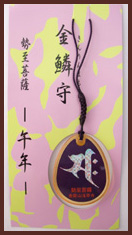
kinrin omamori 金鱗守 golden fish-scale amulet
renben omamori 蓮弁守 lotus petal amulet
sainan yoke omamori 災難除守 amulet against fire
More amulets from Asakusa Kannon:
source : omamorida.com
gankake Kannon Bosatsu 願掛け観音
. Gankake 願掛け wish-prayer, to make a wish .
. WASHOKU
Asakusa KAPPABASHI 東京都 / かっぱ河 / 合羽橋
and plastic food samples
. Hagoita 羽子板 Battledore, Shuttlecock
.................................................................................
. Yooji 楊枝 toothpicks sold in Asakusa .
observance kigo for the New Year
Yooji joosui kaji 楊枝浄水加持 Ceremony of cleaning toothpicks

Asakusa Konryuzan - Mountain of the Golden Dragon
葛飾北斎「浅草金龍山」 Katsushika Hokusai
. Hayari Jizo はやり地蔵 Hayari Jizô, Hayarijizo
"very popular Jizo" .
At Asakusa Konryuzan
:::::::::::::::::::::::::::::::::::::::::::::::::::::::::::::::::::::::::::::::::::::::::::::::::::::
観音のいらか見やりつ花の雲
Kannon no iraka miyaritsu hana no kumo
Kannon Temple:
looking off at its tiled roof
in clouds of blossoms
Tr. Barnhill
Written in 1686 - 貞亨3年.
According to Kikaku, Basho wrote this when he was ill in Bed in Fukagawa.
It seems he could see the roof of Asakusa Kannon temple from his home, which is about 3.5 km away.
MORE - hokku about temples by
. Matsuo Basho 松尾芭蕉 - Archives of the WKD .
:::::::::::::::::::::::::::::::::::::::::::::::::::::::::::::::::::::::::::::::::::::::::::::::::::::
- quote
Famed Kaminarimon lantern gets rare makeover - November 2013

The giant red lantern at Kaminarimon (Thunder Gate), which serves as the entrance to Sensoji Temple, made its first appearance after a once-in-a-decade makeover during a dedication ceremony Monday.
- source : www.japantimes.co.jp
:::::::::::::::::::::::::::::::::::::::::::::::::::::::::::::::::::::::::::::::::::::::::::::::::::::::
. Asakusa Tenmondai 浅草天文台 Asakusa Observatory .
and the astronomer
Shibukawa Shunkai 渋川春海 Shibukawa Harumi
(1639 - 1715)
:::::::::::::::::::::::::::::::::::::::::::::::::::::::::::::::::::::::::::::::::::::::::::::::::::::::
. Asakusa 浅草 district in Edo .
[ . BACK to WORLDKIGO . TOP . ]
[ . BACK to DARUMA MUSEUM TOP . ]
- #asakusakannon #asakusa -
:::::::::::::::::::::::::::::::::::::::::::::::::::::::::::::::::::::::::::::::::::::::::::::::::::::


 Posts
Posts



18 comments:
Vom Sanja Festival hatte ich noch nie zuvor gehört.
Deine links waren für mich ein kl. virtueller Ausflug nach Japan, Gabi.
Herzliche Gruesse,
A.
WHCgerman
From BLOG 句会
Gabiさま
お祭りは日本の神様のカーニバル。
浅草観音の三社祭は有名ですね。Washoi。
歌寿人
..................................
Gabiって書いてあるから、かびと冗談を言っているのかと思ったら本格的日本文化愛好者ではないですか
実は、私は英語から日本文化を学んだ変わり者なんです。
英語で書いたらって、時間かかるし、翻訳ソフトもあるが 私の日本語を簡潔、明瞭にしないと、誤訳になってしまうので そこが難しい。
市田
..................................
http://blog.livedoor.jp/senior21/archives/22731654.html#comments
Arigato!
Gabi
trampling on Asakusa's
little Fuji...
a croaking frog
asakusa no fuji wo fumaete naku kawazu
浅草の不二を踏へてなく蛙
by Issa, 1813
The highest and most sacred of Japan's peaks, Mount Fuji, was the home of the great kami-sama or gods. Buddhists believed it was a mystical gateway between earth and heaven. Climbing it was a sacred pilgrimage. However, not everyone could make the climb.
Therefore, imitation Mount Fujis (small, sculpted hills) were built at various temples so that one could reap spiritual benefit by climbing them. Issa's frog treads on one of these pseudo-mountains in Asakusa.
Tr. David Lanoue
http://cat.xula.edu/issa/
..............................
Japanese LINK with many photos about the Fujikoo (Group of believers in the Fuji Mountain religion) in Asakusa
http://www.asakusa.org/event/fuji2003-1.html
photo with Mt. Fuji
More FUJI haiku by Issa in Japanese
http://bungaku.fuji3776.net/2006/04/post_147.html
浅草や家尻の不二も鳴雲雀
asakusa ya yajiri no fuji mo naku hibari
Asakusa --
behind the house Mount Fuji
and a singing lark
Issa
Tr. David Lanoue
http://haikuguy.com/issa/
初雪や鶏の朝声浅草寺
hatsu yuki ya tori no asa-goe sensôji
first snowfall--
the rooster's morning crow
at Senso Temple
Tr. David Lanoue
Look at a haiga by Sakuo !
浅草の鶏にも蒔ん歳暮米
asakusa no tori ni mo makan seibo kome
for Asakusa's chickens, too
a end-of-year gift...
scattering rice
Kobayashi Issa
(Tr. David Lanoue)
.
Kabuki returns to its Asakusa home for special New Year's performances
As kabuki fans will already know, for more than 30 years, the Kokaido (public hall) in Asakusa has celebrated the Tokyo district's history as a thriving entertainment area by reviving the Edo Period (1603-1867) tradition of New Year's special kabuki performances. These shows have also become a great opportunity for younger actors to take on lead roles and prove themselves as rising kabuki stars.
This year, the program is led by Ichikawa Kamejiro (Takahiko Kinoshi), 36, who is followed by nine other promising young actors. Split into Parts I and II, there are two short plays — "Nanso Satomi Hakkenden (The Eight Dog Warriors)" and "Kuruwa Bunsho (A Letter From the Pleasure Quarters)" — for the morning performance, and one longer play — "Katakiuchi Tengajayamura (The Vendetta at Tengajaya)" — in the afternoon.
Part II's "Katakiuchi Tengajayamura," a classic tale of two brothers seeking revenge for their father's death, offers the opportunity to see Kamejiro as the villain Adachi Motoemon, a character often considered the highlight of the play. But if a full day of theater is a bit much for you, it is Part I, with its two plays that are entirely different in nature, that offers the audience more variety of performance.
more in the Japan Times
http://www.japantimes.co.jp/text/ft20111229a1.html?utm_source=feedburner&utm_medium=feed&utm_campaign=Feed%3A+japantimes+%28The+Japan+Times%3A+All+Stories%29
.
“Sanja Matsuri”- a dance
This dance was dramatized about a hundred and thirty years ago in connection with the festival of Sanja (Three Shrine) at Asakusa in Edo. According to tradition, the two fishermen in this dance, Hamanari and Takenari, who pulled up a statue of Kannon (a goddess of mercy) while they were casting their nets in the Miyato River, now known as the Sumida River.
The two fishermen perform
the dance “Zendama” (good spirit)
and
the dance “Akudama” (evil spirit)
because in those days there was a popular and widely read novel called the “Good and Bad (evil) spirits”.
source : www.immortalgeisha.com
.
Kabuki actor Nakamura Kanzaburo dies at 57
The Kabuki actor Nakamura Kanzaburo died in Tokyo on Wednesday morning. He was 57. Kanzaburo was hospitalized after being diagnosed with esophageal cancer in June.
He made his stage debut at the age of 3, and gained popularity as a versatile actor and dancer.
He also appeared in TV dramas, talk shows and variety programs.
Kanzaburo worked to help young people discover the traditional performing art. He headed his own troupe and gave Kabuki performances in New York.
He breathed new life into Kabuki throughout his career, starring in a new drama based on an opera, and fusing rap music with a traditional piece.
Dec. 4, 2012
NHK world news
http://www3.nhk.or.jp/daily/english/20121205_12.html
浅草の鶏にも蒔ん歳暮米
Asakusa no tori ni mo makan seibo mai
for Asakusa's chickens, too
a end-of-year gift...
scattering rice
Kobayashi Issa
(Tr. David Lanoue)
浅草や家尻の不二も鳴雲雀
asakusa ya yajiri no fuji mo naku hibari
in Asakusa
behind these houses larks
sing above Mt. Fuji
This hokku is from the first lunar month (February) of 1810, soon after Issa had moved into a tiny house in the northern part of Ueno in Edo (called Shitaya in Tokyo) found for him by a fellow haikai poet and patron. About a mile away from his house was the popular Asakusa entertainment district, where several major Buddhist temples and Shinto shrines were located. One of these shrines was the Asakusa Fuji Sengen Shrine dedicated to the female god of Mt. Fuji, Konohana-sakuya-hime, Great Woman Who Makes Trees Blossom. The shrine was and is a branch shrine of the Fujisan Hongū Sengen Taisha near the foot of Mt. Fuji. During Issa's time a new religion based on worship of Mt. Fuji had become extremely popular in Edo and the area around Edo, and it is said to have had more than 800,000 believers. Most of these believers had neither the time nor the money to visit Mt. Fuji often, so each local group, called a Fuji-kou, used the offerings of its members to send one or two members to visit Mt. Fuji each summer, when pilgrims could climb it, in order to represent the whole group. People who were not chosen were, however, able to make short pilgrimages to Mt. Fuji mounds at various Mt. Fuji shrines near them. It was believed that these small model or "bonsai" Mt. Fujis were visited by the Mt. Fuji god, and pilgrims could commune with the god by praying as they walked up and down the mound in the shrine. The mounds were designed to recreate the feeling of climbing Mt. Fuji rather than representing its outer shape and thus helped pilgrims to concentrate on their prayers. In Edo there were about eighty Fuji mounds, in the suburbs there were about thirty more, and in the wider Kanto area that includes Mt. Fuji, the Edo area, and Issa's hometown area of Shinano there were more than eight hundred Fuji mounds in all, though many have now disappeared. The small size of the mounds was not believed to represent a smaller presence by the god of Mt. Fuji, since the mounds were treated as if they were tangible manifestations of Mt. Fuji itself and its shamanic god.
In the hokku Issa seems to be visiting Asakusa, where, beyond some houses, he can glimpse part of the Mt. Fuji mound in the precincts of the Asakusa Fuji Shrine, or perhaps he is making a pilgrimage to the shrine and its mound shortly after New Year's, when Mt. Fuji is commonly worshiped. The size of the mound may be small, but the size of the Fuji god is infinite, and, even in this mixture of new and old houses that surround the mound, the mound is nevertheless believed to be an integral part of Mt. Fuji standing in the midst of crowded Edo, where it transcends the distinction between sacred and profane. Even the larks seem to know the mound is actually part of Mt. Fuji as they cry in the air above the mound, just as other larks are no doubt singing high in the sky near Mt. Fuji.
Issa wrote several hokku about Mt. Fuji mounds. He does not seem to have been a member of a Fuji-kou group, but he was obviously fascinated by the mounds. Perhaps he was aware of a certain similarity between the way the mounds manifest and recreate Mt. Fuji and the way hokku and renku often use extreme compression and suggestion. For example, this hokku:
a frog croaks
at the top of Mt. Fuji
in Asakusa
asakusa no fuji o fumaete naku kawazu (1813)
Or:
the grass
is Mt. Fuji, but the air
isn't cooler
fuji no kusa sashite suzushiku nakarikeri (1809)
For the location of the Mt. Fuji mound in these hokku see Maruyama Kazuhiko, Issa's Seventh Diary 1.23.
.
http://edoflourishing.blogspot.jp/2013/03/issa-cultural-keywords.html
.
Chris Drake
Kobayashi Issa
人鬼の天窓くだしや露時雨
hito oni no atama kudashi ya tsuyu shigure
trees dump
cold dew on the head
of a human demon
hito-oni no atama-kudashi ya tsuyu-shigure
a human as dumped right on a "shower of cold dew"
cruel as a his head falling from tree branches
demon in late autumn
This hokku is from the ninth month (October) in 1821, when Issa was living in his hometown. A "human demon" is a standard Japanese word that refers to a cruel person without compassion or sympathy who deliberately hurts or kills animals or other humans. Issa doesn't seem to be metaphorically suggesting here that all humans are ultimately demons, and in his various hokku the phrase mainly refers to hunters and violent people seen from the perspective of animals who are in danger. This hokku may be written from the point of view of an animal watching a hunter or perhaps from the point of view of Issa as a witness standing in for an animal. It is late fall, and the dew is so thick that when the wind blows the branches of the trees overhead they drop what seems to be a sudden rain shower of cold dew right onto the head of a person carrying a dead animal over his shoulder or perhaps holding a trap or a hunting rifle. Issa may be hoping the soaked person will learn a bit about what it feels like to be the hunted rather than the hunter. Is he also wondering whether the trees are somehow, in their tree-like way, trying to protect the forest animals?
Chris Drake
.
http://edoflourishing.blogspot.jp/2013/03/issa-cultural-keywords.html
.
In the compound is a sanctuary for
一言不動尊 Hitokoto Fudo Son
If you make one wish only (hitokoto), in all sincerity, then Fudo will grant your wish.
.
Hitokoto Fudo
http://gokurakuparadies.blogspot.jp/2015/02/fudo-ji-settsu-henro.html
kinun Jizoo 金運地蔵 Kin-Un Jizo for Money
銭塚地蔵尊 Asakusa Zenizuka Jizo - かんかん地蔵 Kankan Jizo
Zeniduka-Jizou
Zenizuka Jizo-do Hall
.
http://gokurakuparadies.blogspot.jp/2016/01/kinun-jizo-for-money.html
.
Legends about Asakusa Kannon :
浅草観音伝説.
https://edoflourishing.blogspot.jp/2015/10/asakusa.html
.
坂東三十三観音 Pilgrimage to 33 Kannon Temples in Bando (Kanto)
13 金龍山 浅草寺(浅草観音)Senso-Ji, Asakusa, Tokyo - Asakusa Kannon
.
https://gokurakuparadies.blogspot.com/2020/03/bando-33-kannon-pilgrimage.html
.
Asakusa densetsu 浅草伝説 Legends from Asakusa
and about Asakusa Kannon
.
https://edoflourishing.blogspot.com/2020/05/asakusa-legends.html
.
Legends about Kannon Bosatsu
.
https://gokurakuparadies.blogspot.com/2016/04/kannon-bosatsu-legends.html
.
Post a Comment