Showing posts with label kigo. Show all posts

2/20/2013

Saiganji Temple

[ . BACK to DARUMA MUSEUM TOP . ]
- Aburakake Jizō, see below
::::::::::::::::::::::::::::::::::::::::::::::::::::::::::::::::::::::::::::::::::::::::::::::::::::: 

Temple Saiganji 西岸寺

Saiganji Temple was founded in 1590 by the monk Unkai 雲海上人.
It belongs to the Jodo sect. Lit. "the Western Shore", the Paradise in the West.

It is better known as Aburakake Jizo.
Aburakake san 油懸山(あぶらかけざん)
One's prayers would be answered if one poured oil over the statue.

898 Shimo-aburakake-cho Fushimi-ku
Close to the shrine Gokoo no miya jinja 御香宮神社 Gokonomiya Jinja
at Fushimi Momoyama 伏見桃山にある神社, a shrine built by Toyotomi Hideyoshi to protect the his castle in Fushimi.


quote
Aburakake Jizō 油懸地蔵
Greasy Jizō or Oil-Covered Jizō. There are various manifestations.
Today, at Saiganji Temple 西岸寺 (a Jodō sect temple) in Kyoto's Fushimi 伏見 district, there is an Aburakake Jizō reportedly dated to the Kamakura period. In olden days, Fushimi was a hub of commerce and trade.

"Inbound cargo was unloaded on the wharves at Chūshōjima, then carried by porters another two kilometers into Kyoto.
One day, an oil vendor from Yamazaki (a place to the southwest of Kyoto known for its sesame oil) was making his way down Aburakake Dōri [lit. = oil-covered street] when he tripped and fell, spilling his precious load. He scooped up what was left and offered it to this wayside Jizō. Thereafter he prospered, and as word spread of his good fortune, others came to pray for success.
When they achieved it, they gave thanks by pouring a little bit of oil over the image.
Today shopkeepers and businessmen continue the tradition of pouring oil over the glistening 1.7-meter-high image, and offerings of ten-liter cans of oil are stacked inside the hall."
Judith Clancy
source : Mark Schumacher


秋の暮辻の地蔵に油さす
aki no kure tsuji no Jizoo ni abura sasu

autumn dusk -
I pour some oil on the Jizo
at the crossroad


- - - - - and one more about Jizo

短夜や化けそこなひし地蔵尊
mijikayo ya bakesokonaishi Jizoo son


. WKD : Yosa Buson 与謝蕪村 in Edo .


:::::::::::::::::::::::::::::::::::::::::::::::::::::::::::::::::::::::::::::::::::::::::::::::::::::


Saiganji Ninkoo 西岸寺任口 Saiganji Ninko
(1606 - 1686)
Ninkoo Shoonin 任口上人 Ninko Shonin, Saint Ninko

He was the third head priest at this temple during the time of Matsuo Basho, and he was also a famous haikai poet. His teacher was Matsue Shigeyori 松江重頼.
Basho, Ihara Saikaku 井原西鶴 and other haikai poets came to his temple to enjoy a poetry meeting.
He died in 貞享 3年4月13日, age 81, just one year after Basho had visited him.


:::::::::::::::::::::::::::::::::::::::::::::::::::::::::::::::::::::::::::::::::::::::::::::::::::::::::::::::::::::::::::

H A I K U

わが衣に伏見の桃の雫せよ
我が衣に伏見の桃の雫せよ
わがきぬにふしみの桃の雫せよ
waga kinu ni Fushimi no momo no shizuku seyo

on my robes
let there fall dewdrops from the peach blossoms
of Fushimi


A greeting hokku to his host Ninko.

. Matsuo Basho 松尾芭蕉 - Archives of the WKD .

Priest Ninko lived to a healthy 81 and kept pouring his Buddhist teachings and preachings like drops of refreshing dew on his followers.

Fushimi no momo refers to the famous trees planted there, giving Fushimi the name of "Momoyama 桃山" peach mountain.


Nozarashi Kiko 野ざらし紀行, Basho age 42
. Matsuo Basho 松尾芭蕉 - Archives of the WKD .


.............................................................................


source : grandeamore.blog

A box with sweets for the Hina Doll Festisval (Peach Blossom Festival).
The wrapper shows the hokku of Basho.


. Haiku Sweets (haika 俳菓) .


.............................................................................


Momo no Shizuku 桃の雫 peach dew

Some drinks with this hokku . . .
CLICK on the image for more samples.


. Local Rice Wine (jizake 地酒) .


::::::::::::::::::::::::::::::::::::::::::::::::::::::::::::::::::::::::::::::::::::::::::::::::::::: 


source : I.HATADA

. Jizo Bosatsu (Kshitigarbha) 地蔵菩薩 .


:::::::::::::::::::::::::::::::::::::::::::::::::::::::::::::::::::::::::::::::::::::::::::::::::::::


Fushimi is famous for the Fox shrine
. Fushimi Inari Taisha 伏見稲荷大社 .


Fushimi Castle (伏見城 Fushimi-jō), also known as
Momoyama Castle (桃山城 Momoyama-jō)
MORE - wikipedia


The Azuchi-Momoyama period (安土桃山時代 Azuchi-Momoyama jidai)
about 1573 to 1603
MORE - wikipedia

:::::::::::::::::::::::::::::::::::::::::::::::::::::::::::::::::::::::::::::::::::::::::::::::::::::::


Aburakake Jizō 油掛け地蔵
Jizo to pour oil over the body


source : facebook

at Daikakuji 大覚寺 Daikaku-Ji in Saga 嵯峨, Kyoto


source : Akiko on facebook

密蔵院 Mitsuzo-In
兵庫県明石市 3-8 Funagecho, Akashi, Hyogo

.......................................................................


abura Jizoo 油地蔵 Abura Jizo
at temple 東光寺 Toko-Ji / 壽福山
勝央町 Sho-o Cho, Okayama
花崗岩の上部を舟形におとし佛像を刻んでいる。
- source and more photos : e-tsuyama.com ...-

:::::::::::::::::::::::::::::::::::::::::::::::::::::::::::::::::::::::::::::::::::::::::::::::::::::::

. Festivals, Ceremonies, Rituals - SAIJIKI .

. Clay Dolls from Fushimi - 伏見土人形 . 


[ . BACK to WORLDKIGO  TOP . ]
[ . BACK to DARUMA MUSEUM TOP . ]
- aburakakejizo -
::::::::::::::::::::::::::::::::::::::::::::::::::::::::::::::::::::::::::::::::::::::::::::::::::::: 

1/24/2013

Shishiodoshi deer scarer

[ . BACK to DARUMA MUSEUM TOP . ]
::::::::::::::::::::::::::::::::::::::::::::::::::::::::::::::::::::::::::::::::::::::::::::::::::::: 

Shishiodoshi ししおどし  deer scarer
shishi odoshi 鹿威し


source : 東山動植物園

quote
Shishi-odoshi (鹿威し, lit. means "scare the deer" in Japanese). In a wide sense, it refers to Japanese devices made to scare away birds and beasts damaging agriculture, such as the kakashi (scarecrow), naruko (clappers) and sōzu). In a narrower sense, it is synonymous with sōzu.

Sōzu (soozu 添水)
is a type of water fountain used in Japanese gardens. It consists of a segmented tube, usually of bamboo, pivoted to one side of its balance point. At rest, its heavier end is down and resting against a rock. A trickle of water into the upper end of the tube accumulates and eventually moves the tube's centre of gravity past the pivot, causing the tube to rotate and dump out the water. The heavier end then falls back against the rock, making a sharp sound, and the cycle repeats. This noise is intended to startle any herbivores such as deer or boars which may be grazing on the plants in the garden.
© More in the WIKIPEDIA !

::::::::::::::::::::::::::::::::::::::::::::::::::::::::::::::::::::::::::::::::::::::::::::::::::::: 


google logo
Look for the shishi odoshi on the right side.


:::::::::::::::::::::::::::::::::::::::::::::::::::::::::::::::::::::::::::::::::::::::::::::::::::::::


Water in a Japanese Garden, bringing coolness to the mind.
Seeing the water (in the stone form) of the second beautiful picture Hearing the water (as a shishi-odoshi) in greenery with the sound of - KON -
Feeling water spread out by hand
And yet, on a hot day . . . .
source : Darumasan-Japan


CLICK for more photos !


Enjoy the Japanese Garden Culture !

shishi いのしし - 猪
can also be read as WILD BOAR, so maybe the farmers used this tool for real to scare away the deer and boar during harvest time of the rice? !
Now, in our area, they use electric fencing for that, how un-poetic !


::::::::::::::::::::::::::::::::::::::::::::::::::::::::::::::::::::::::::::::::::::::::::::::::::::: 

H A I K U


soozu 添水 (そうず) "animal chaser" deer scarer
Shishiodoshi, shishi odoshi 鹿威し the deer scarer
kigo for all autumn


. WKD : Deer (shika 鹿) .


::::::::::::::::::::::::::::::::::::::::::::::::::::::::::::::::::::::::::::::::::::::::::::::::::::: 


only a drip
from the shishi odoshi
green water


Deborah P. Kolodji

source : www.simplyhaiku.com 2006


::::::::::::::::::::::::::::::::::::::::::::::::::::::::::::::::::::::::::::::::::::::::::::::::::::: 


quote
Shishi Odoshi
by bobdoleorama

CLONK, GLUG, GURGLE and SPLOOSH!

This is the noise of Shishi Odoshi.
Scare deer in Japan.
A haiku is a fitting introduction to the simple instrument that is the Shishi Odoshi, or Japanese deer scarer. Consisting of running water, a long bamboo collection tube and a pivot, the instrument is an elegant demonstration of physics from a time before Newtonian Mechanics had begun to approach the theories of gravity and momentum.
source : www.instrumentionary.com


::::::::::::::::::::::::::::::::::::::::::::::::::::::::::::::::::::::::::::::::::::::::::::::::::::: 


The Deer Chaser in the Portland Japanese Garden

tender spring leaves -
the sound of hollow bamboo
striking stone


- Shared by Elaine Andre -
Haiku Culture Magazine, 2013


::::::::::::::::::::::::::::::::::::::::::::::::::::::::::::::::::::::::::::::::::::::::::::::::::::: 


. Amulets and Talismans from Japan . 


[ . BACK to WORLDKIGO  TOP . ]
[ . BACK to DARUMA MUSEUM TOP . ]
::::::::::::::::::::::::::::::::::::::::::::::::::::::::::::::::::::::::::::::::::::::::::::::::::::: 

12/25/2012

Ojo-Ji Temple

[ . BACK to DARUMA MUSEUM TOP . ]
::::::::::::::::::::::::::::::::::::::::::::::::::::::::::::::::::::::::::::::::::::::::::::::::::::: 

Oojooji 往生寺 Temple Ojo-Ji


The temple houses a statue of "Namikiri Fuko" 波切不動
carved by Kobo Daishi Kukai.

The huge bronze bell in the compound is called
yuuyake no kane 夕焼けの鐘 "The bell of Sunset".
It is said to be the model for the famous song of
Yuuyake koyake 夕焼小焼.
- Reference - yuyake koyake song -


In the back garden of the temple is the grave of Saint Karukaya.


Another building in the temple compound is the
Karukaya doo かるかや堂 / 刈萱堂 Karukaya Hall.


In memory of the legendary figures of
Saint Karukaya 刈萱上人 - 等阿法師
and his son Ishidoomaru 石堂丸 Ishidomaru


〒380-0867 長野県長野市西長野往生地1334
source : jodo.jp


quote
The story of Karukaya 
... Ishidomaru returns to Mount Koya to study under Karukaya. A few yeas later Karukaya, after seeing the Amida Buddha at Zenkoji in a dream, moves to Zenkoji, Nagano.
When Ishidomaru later learns, also in a dream ... that his teacher was no other than his father, he moves to Zenkoji.
Posthumously Karukaya and Ishidomaru became exalted as the father and son Jizo Bodhisattvas.
The pietistic layman Karukaya represents the Koya-hijiri (Holy Man of Koya) who advocated the holy order of the Mount Koya Shingon school.

Ikumi Kaminishi
source : books.google.co.jp

::::::::::::::::::::::::::::::::::::::::::::::::::::::::::::::::::::::::::::::::::::::::::::::::::::: 

quote
Karukayado Hall
Long ago, Karukaya Doshin and Ishido-maru
studied and trained in this hall for 40 years. Jizo-statues of father and the son are enshrined inside the hall. The story of Karukaya Doshin and Ishido-maru was carved and placed on the wall. The story is that Ishido-maru started on a journey with his mother to meet his father, then a monk named Karukaya Doshin. They made it all the way to Koyasan, but his mother was not allowed to enter because of the strict rule that prohibited women from entering Koyasan. So Ishido-maru took his mother to an inn in Kamuro and went back to Koyasan by himself.
While waiting for Ishido-maru to return, his mother became very sick and died. Unknown to Ishido-maru at the time, his mother's death had made him an orphan. Ishido-maru continued walking toward Koyasan to meet his father. Once he arrived in Koyasan, his father would not admit that Ishido-maru was his own son. However, they understood each other and had begun to train and practice together in Koyasan. This sad story of Karukaya Doshin and Ishido-maru is one of the more famous legends about Koyasan.
source : www.koyasan.net


Karukaya Noh Play


source : www.artic.edu/aic

Tsukioka Kogyo (1869-1927)
from the series "Pictures of No Performances (Nogaku Zue)", 1898

A well-loved theme in Noh and Kabuki

苅萱桑門筑紫 Karukaya Doshin Tsukushi no Iezuto

- Reference Karukaya Noh


石童丸人形 Ishidomaru Dolls

. Dolls from Nagano .


:::::::::::::::::::::::::::::::::::::::::::::::::::::::::::::::::::::::::::::::::::::::::::::::::::::::


. Zenkooji 善光寺 Zenko-Ji .
Nagano


. Namu Amida Butsu 南無阿弥陀仏 Amida Prayer .

for a safe passage to the Amida Paradise in the West after death
Gokuraku oojoo 極楽往生 gokuraku-ojo 


::::::::::::::::::::::::::::::::::::::::::::::::::::::::::::::::::::::::::::::::::::::::::::::::::::: 

H A I K U

. - - - - - Kobayashi Issa 小林一茶 - - - - - .

散花や長々し日も往生寺
chiru hana ya naga-nagashi hi mo ôjôji (oojooji)

cherry blossoms scatter
on a long, long day...
Ojo Temple


The name of the temple is significant; it means "Let-Go-of-Life." It is appropriate that the cherry blossoms "let go of life" here. Notto R. Thelle notes the specific meaning that ôjo has in Pure Land Buddhism: "It is a classical term for (going) to be born in the Pure Land. The evening with the setting sun,the scattering blossoms etc. obviously allude to classical images of dying, waiting for Amida Buddha to come and lead the person to new life (birth) in Amida's Pure Land." In a similar haiku about Ojo Temple, written immediately before this one in Issa's journal, the blossoms scatter "toward the setting sun."
"Blossoms" (hana) can denote cherry blossoms in the shorthand of haiku.

Tr. and comment by David Lanoue

.......................................................................


花ちるや日の入かたが往生寺
hana chiru ya hi no iru kata ga Oujouji

petals scattering --
the sun goes down
beyond Ojoji Temple


This hokku was written in the 3rd month (April) of 1818, when Issa was in what is now called Nagano City, the largest town near Issa's home village. The hokku is one of several written about a visit there to the Pure Land sect temple, pronounced Oujouji (with long o vowels), located not far from the famous Tendai and Pure Land temple Zenkoji.

The word oujou means "going and being born" and is short for "leaving this life and being born as a Buddha in the Pure Land," the basic goal of life in Pure Land Buddhism. However, the founder of the Reformed Pure Land sect, Shinran, preached that in addition to birth as a Buddha in the Pure Land after death, birth as a Buddha and the cutting of strands of karmic causation can also take place in this life, since the Pure Land is beyond time and space.

"Rebirth" is probably not the best choice as a translation, since rebirth suggests reincarnation and karmic continuity. For Issa, too, oujou seems to have a double meaning, and his many hokku sometimes suggest moments of such birth in the midst of daily life. At the same time, the back side of main hall of Ojoji Temple, which has a statue of Amida Buddha inside, faces west, since the sun is used in Pure Land sects as a metaphor for Amida's infinite light of pure compassion. Worshipers face west when they pray to Amida, and in the popular imagination this orientation was often taken to refer to a literal cosmic geography.

Issa seems to take comfort in the fact that the sun is going down in the west beyond the statue of Amida in the main hall of Ojoji Temple and that the sun's rays suggest Amida has compassion even for the myriad petals that fall gently as if filled with faith from the cherry trees, but he is not saying that the petals are falling westward. He does not seem to be looking for literal miracles. Three hokku later in Issa's diary is this humorous hokku:


散花の辰巳へそれる屁玉哉
chiru hana no tatsumi e soreru hedama kana

falling petals
stray to the southeast
because of my fart


Issa surely believes Amida feels the same compassion for the petals sent eastward by his fart as for the other petals, and his hyperbole is liberating because it refuses to take the metaphor of the west literally, though the power of the sun setting, especially amid falling cherry petals, obviously makes the metaphor valuable as an image for visualizing Amida's infinite light shining on all changing things. Issa may even be suggesting that the physical sun itself, as it falls toward the western horizon, is ultimately nothing more than a huge petal of light: no thing in the visible universe can compare with the incomparable, which is what the name Amida means.

Chris Drake


::::::::::::::::::::::::::::::::::::::::::::::::::::::::::::::::::::::::::::::::::::::::::::::::::::: 

. Japan - Shrines and Temples .

. Amulets and Talismans from Japan . 


[ . BACK to WORLDKIGO  TOP . ]
[ . BACK to DARUMA MUSEUM TOP . ]
::::::::::::::::::::::::::::::::::::::::::::::::::::::::::::::::::::::::::::::::::::::::::::::::::::: 

6/15/2012

Hata Clan

[ . BACK to DARUMA MUSEUM TOP . ]
::::::::::::::::::::::::::::::::::::::::::::::::::::::::::::::::::::::::::::::::::::::::::::::::::::: 

The Hata Clan 秦氏 Hata Uji

The Korean, Chinese and Christian connection !
keikyoo 景教 nestorianism - ネストリウス派


Descendants of the Hata dynasty 秦王朝
Shin, Quin of China
Qin, 秦朝 the first imperial dynasty of China, lasting from 221 to 207 BC.
© More in the WIKIPEDIA !


quote
The Hata clan (秦氏) was an immigrant clan active in Japan since the Kofun period, according to the epic history Nihonshoki.

Hata is the Japanese reading of the Chinese (state and dynasty) name 秦 given to the Qin Dynasty (the real family name was Ying), and given to their descendants established in Japan. The Nihonshoki presents the Hata as a clan or house, and not as a tribe; also only the members of the head family had the right to use the name of Hata.

The Hata can be compared to other families who came from the continent during the Kofun period: the descendants of the Chinese Han Dynasty, by Prince Achi no Omi, ancestor of the Yamato no Aya clan, the Sakanoue clan, the Tamura clan, the Harada and the Akizuki clan; also, the descendants of the Chinese Cao Wei Dynasty by the Takamuko clan. The descendants of Baekje Paekche (Kudara in Japanese) who sought refuge in Japan, for example the Yamato no Fubito (also called Yamato no Fubito- 和史 later given a new title, Takano no Asomi- 高野朝臣), Kudara no Konikishi clan, and the Sue clan.

The Hata are mentioned by name more often than almost any other immigrant clan in the Nihonshoki, one of Heian-period Japan's epics, combining mythology and history.

The first leader of the Hata to arrive in Japan, Uzumasa-no-Kimi-Sukune, arrived during the reign of Emperor Chūai, in the 2nd century CE. According to the epic, he and his followers were greeted warmly, and Uzumasa was granted a high government position.

Roughly one hundred years later, during the reign of Emperor Ōjin, a Hata prince called Yuzuki no Kimi visited Japan from the Kingdom of Baekje in Korea. He said he had come from Baekje, and he wanted to emigrate to Japan, but that Silla would not permit him to do so.

... They are said to have aided in the establishment of Heian-kyō (modern-day Kyoto), and of many Shinto shrines and Buddhist temples, including
Fushimi Inari Taisha, Matsunoo Taisha, and Kōryū-ji.

... In addition, many towns in Japan are named after the clan, such as Ohata, Yahata, and Hatano. The population of Neyagawa in Osaka Prefecture includes a number of people who claim descent from the Hata.

... The notion that the Hata clan were among the Lost Tribes of Israel, though far from widely accepted or even seriously considered in formal scholarship, is central to the beliefs of several Japanese New Religions...

Read all the details here:
© More in the WIKIPEDIA !

:::::::::::::::::::::::::::::::::::::::::::::::::::::::::::::::::::::::::::::::::::::::::::::::::::::


. Bull Festival of Uzumasa, 太秦の牛祭 .
Kyoto, temple Kooryuji 広隆寺 Koryu-Ji.
kigo for late autumn


Uzumasa Koryu-ji 太秦広隆寺 in Kyoto, which was established by
Hata-no-Kawakatsu (秦河勝), the leader of Hata-uji in 603 in the Asuka period.

HP of the temple : www.kyouto.net/kouryuji.html


Hata no Kawakatsu (秦河勝), sometimes called Hada no Kōkatsu, Hada no Kokatsu
© More in the WIKIPEDIA !


Plate at Uzumasa-den 太秦殿
which enshrines Hata no Kawakatsu.

- Shared by Taisaku Nogi -

.................................................................................


Shinra, the Japanese version of Silla, the Korean Kingdom.

新羅神社 Shinra Jinja in Fukui

is believed to enshrine the tutelary deity of immigrants from ancient Korean Shinra (or Shiragi, 新羅) around the 4-7 century.
Immigrants from ancient Korean were employed as technical specialists of sericulture, fabric, papermaking, ironmaking and blacksmith, which are traditional handicrafts descended from generation to generation in the Hokuriku district.

- Shared by Taisaku Nogi -
Joys of Japan, 2012


. Kara no kami  韓神 / 漢神 Deity from Korea .
and the Sonokara Futakami no Matsuri Festsival
園韓両神祭


::::::::::::::::::::::::::::::::::::::::::::::::::::::::::::::::::::::::::::::::::::::::::::::::::::: 


Konoshima Jinja 木嶋神社

mihashira torii, mitsubashira torii
三柱鳥居 three-pillar torii

sankaku torii 三角鳥居


This kind of torii has three top lintels.
The three pillars symbolise heavens, earth and mankind 天地人.
Some sources state that this was a secret symbol of the underground Christians for the Holy Trinity.
keikyou 景教 Nestorianism

. Uzumasa no Konoshima Jinja 太秦の木嶋神社 .
(Uzumasa no Kijima Jinja)
also called
Kaiko no yashiro (蚕ノ社) - Silkworm Shrine
and the Korean connection to the Hata clan (秦氏).
The Konoshima shrine explains the three pillars represent
faith, hope and charity.


The stone piles under the two three-pillar Torii at Wadatsumi Jinja are believed as the graves of deities - one is Azumi-no-Isora (安曇磯良, probably same deity as Ugayafukiaezu-no-mikoto (鵜茅葺不合命)) and the other one is
Toyotamahiko-no-mikoto (豊玉彦尊, = Wadatsumi-no-kami (綿津見神 or 海神)). It seems only male deities who have Wadatsumi's blood in their veins are enshrined in this style to be immersed into water.

According to this rule, the stone piles under the three-pillar Torii at Konoshima Jinjya must be the grave of deity who is the offspring of Wadatsumi. Among the enshrined deities at Konoshima Jinjya, there is only one deity who is the offspring of Wadatsumi. His name is Ugayafukiaezu-no-mikoto, who is the grandson of Wadatsumi and the father of Emperor Jinmu (神武天皇).


Azumi-no-Isora's grave under the three-pillar torii at Wadatsumi Jinja

- Shared by Taisaku Nogi -

. Jinmu Tenno 神武天皇 and the Wakasa connection .


. Azumi no Isora Maru 阿曇磯良丸 Isoramaru .


.................................................................................


Seven Mihashira Torii with three pillars

1. 太秦(うずまさ)の木島神社
2.三囲神社の三柱鳥居 東京都墨田区向島
3.和多都美神社の三柱鳥居 長崎県対馬
4.大神教会の三柱鳥居 奈良県桜井市
5.穂積三柱鳥居 岐阜県関市洞戸奥洞戸 栗原底津丸山山頂
6.大和町の三柱鳥居 岐阜県郡上郡大和町
7.神山町三柱鳥居 徳島県名西郡神山町
source : mkun/nazo/mihasira

.................................................................................


Mototadasu no ike 元糺の池
"
Mototadasu-no-ike pond"


"Moto" means "original" and "tadasu" means "repent one's sin".
It is said that this pond is considered as the original place of River Mitarashi (御手洗川) in Tadasu-no-mori forest (糺の森) at Shimogamo Jinja and the name was transferred to the forest at Shimogamo, suggesting a special relation between Hata-uji and Kamo-uji.
Consistently, the crests of Kamo Jinja, Konoshima Jinja and Matsuo Taisha are all Futaba Aoi.

On the midsummer day (doyoo no ushi no hi 土用の丑の日), a baptism-like ritual is held at River Mitarashi (御手洗川) in the forest Tadasu-no-mori (糺の森) at Shimogamo Jinjaa.
On the same day, the same ritual is held at Mototadasu-no-ike pond (元糺の池)


Baptism-like ritual, Ashitsuke Shinji (足つけ神事) at Shimogamo Jinja


Another baptism,

Saio-dai Gyokei-no-gi (斎王代 御禊の儀)
Shimogamo Jinja at the Aoi Festival

- Shared by Taisaku Nogi -
Joys of Japan, 2012


.................................................................................


. kinu 絹 Sericulture, silk and the Hata clan .

Kokai Jinja 蚕養神社 "silkworm shrine"
in Ibaraki, Hitachi town

Wakumusubi 稚産霊命 ワクムスビ(ワクムスヒ) 和久産巣日神
Ukemochi no kami 宇気母智命 - 保食神(うけもちのかみ)

Memyo Bosatsu 馬鳴菩薩
. Matarajin 摩多羅神 .


::::::::::::::::::::::::::::::::::::::::::::::::::::::::::::::::::::::::::::::::::::::::::::::::::::: 


Gion matsuri 祇園祭り Gion Festival in Kyoto

one of the most famous festivals in Japan.
It spans the entire month of July and is crowned by a parade, the Yamaboko Junkō (山鉾巡行) on July 17.


Niwatori-boko float's tapestry:
"Prince Troy and his wife and children"
made in Belgium and was imported to Japan in the 16 century.


Kyoto Gion Festival (祇園祭) is coming this July 17th.
Yamahoko (山鉾, floats) will be decorated by gorgeous tapestries. If you are there, you will be surprised to see most tapestries are not traditional Japanese ones and some are European, Islamic and even Judaism arts.
Here is the example, Kankoboko (函谷鉾)'s tapestry made in Belgium in the 16 century - "Rebecca giving water to Isaac", a famous scene from Hebrew Bible.

The 17th day of the seventh month
is the day that Noah's ark drifted to Ararat!

- Shared by Taisaku Nogi -
Joys of Japan, 2012


. War of Troy tapestry .
and Hasekura Tsunenaga 支倉六右衛門常長


. WKD : yababoko 山鉾(やまぼこ)Gion Festival floats .


::::::::::::::::::::::::::::::::::::::::::::::::::::::::::::::::::::::::::::::::::::::::::::::::::::: 


Shrines related to the Hata clan

. Fushimi Inari Taisha 伏見稲荷大社 Kyoto .
In 711, Hata-no-Irogu (秦伊呂具), who is considered as the brother of Hata-no-imikitori (秦忌寸都理), established this shrine by enshrining the Inari deities at Mt. Inari (稲荷山) in Kyoto.


. Hakusan shrines 白山神社 "White Mountain shrines" .
Taichoo 泰澄 (682 - 767) Shugendo priest


Kooryuuji 広隆寺 Koryu-Ji
Hatanokimi dera, Hatakimidera, Hatagimidera 秦公寺
built by Hata no Kawakatsu 秦河勝
see above


. Matsunoo Taisha 松尾大社 Matsu no O Taisha .
#Matsuo Taisha
Founded in 701 by Hata no Tori 秦都理(はたのとり).


The Kamo Clan 賀茂氏 Kamo-shi, Kamo Uji
Kamo shrine coplex, the location was once Tadasu no Mori (糺の森), the wild forest home of the exclusive caretakers of the shrine from prehistoric times.

. Shimogamo Shrine 下鴨神社
Kamigamo Shrine 上賀茂神社 .


::::::::::::::::::::::::::::::::::::::::::::::::::::::::::::::::::::::::::::::::::::::::::::::::::::: 


kamon 家紋 family crest of the Kamo clan
shinmon 神紋 crest of a Shinto shrine (in this case, the Kamo shrines)


futaba aoi 双葉葵/二葉葵 
hollyhock with two leaves

フタバアオイ - Asarum caulescens


. Aoi festival (Aoi matsuri 葵祭) .
moroha aoi 双葉葵(もろはあおい)hollyhock with two leaves
Kamo no aoi 賀茂葵(かものあおい)"hollyhock from Kamo"
kigo for early summer


. hollyhock, mallow 葵 (あおい) aoi .


:::::::::::::::::::::::::::::::::::::::::::::::::::::::::::::::::::::::::::::::::::::::::::::::::::::


The Hata clan and Prince Shotoku Taishi,
Crown Prince Umayado 厩戸皇子


Hata Kawakatsu 秦河勝  founded Kouryuji Temple at Uzumasa, Kyoto in 603 and became the most influential brain of Crown Prince Shoutoku, the regent of Emperess Suiko.
source : Yoshimura Naohiro.


Prince Shōtoku (聖徳太子, Shōtoku Taishi)
February 7, 572 – April 8, 622
also known as Prince Umayado (厩戸皇子, Umayado no ōji) or Prince Kamitsumiya (上宮皇子, Kamitsumiya no ōji), was a semi-legendary regent and a politician of the Asuka period in Japan who served under Empress Suiko.

Crown Prince Shoutoku has another name: Umayado that means
"a prince born in a stable".
The situation of the birth of Shoutoku remind us of the one of Jesus Christ.
Hata Kawakatsu founded Kooryuji Temple at Uzumasa, Kyoto in 603 and became the most influential brain of Crown Prince Shoutoku. the regent of Emperess Suiko.

. Shotoku Taishi 聖徳太子 .


:::::::::::::::::::::::::::::::::::::::::::::::::::::::::::::::::::::::::::::::::::::::::::::::::::::


yatagarasu 八咫烏 a three-legged crow
秦氏 = エルサレム教団 Hatauji, a Christian Group from Jerusalem

Tenno 「天皇=ユダ族」Yuda clan from Israel
Kamo clan 「賀茂氏=レビ族」Rebi clan from the children of Jacob
Hata Uji clan 「秦氏=ベニヤミン族」Beniamin clan from Israel
source : kemono666


The three-legged crow (raven) was the guide of emperor Jimmu (Jinmu Tenno 神武天皇) when he visited the Kumano region.
. Kumano Gongen 熊野権現 .


:::::::::::::::::::::::::::::::::::::::::::::::::::::::::::::::::::::::::::::::::::::::::::::::::::::


Echigoya, Mitsui, Mitsukoshi and the Hata clan

三越は呉服の越後屋が出身である。呉服と機織は当然、関係があるので、三越と秦氏が関係していても不思議はない。三越の屋上には三囲神社の分社が祀られている。
三囲神社は墨田区にあるが、ここにも三柱鳥居がある.

Shrine Mimeguri Jinja 三囲神社(みめぐり神社)
There is a torii gate with three pillars.
The stone lantern at this shrine also does have three openings.
source : mkun/nazo/mihasira
source : mkun/nazo


. Echigoya 越後屋 and Mitsui 三井 .


::::::::::::::::::::::::::::::::::::::::::::::::::::::::::::::::::::::::::::::::::::::::::::::::::::: 


LOST TRIBES - Japan ISRAELITES CAME TO JAPAN

Many of the traditional ceremonies in Japan seem to be the traces that the Jews and the Ten Lost Tribes of Israel came to ancient Japan.

Arimasa Kubo
Suwa Taisha and Mount Moriya san, Misakuchi festival
The Crest of the Imperial House of Japan
The Star of David Is A Symbol Also Used At Ise-jingu
Japanese Religious Priests "Yamabushi" Put A Black Box on their Foreheads Just As Jews Put A Phylactery on their Foreheads.
Japanese "Omikoshi" Resembles the Ark of the Covenant.
The Robe of Japanese Priests Resembles the Robe of Israeli Priests.
Waving the Sheaf of Harvest Is Also the Custom of Japan. Gohei
The Structure of the Japanese Shinto Shrine is the Same As God's Tabernacle of Ancient Israel.
Sacred use of Salt.
Festivals of Japan Resemble the Festivals of Ancient Israel.
Old Japanese Words Have Hebrew Origin.
Lost Tribes of Israel Came to Ancient Japan.
source : www.biblemysteries.com


::::::::::::::::::::::::::::::::::::::::::::::::::::::::::::::::::::::::::::::::::::::::::::::::::::: 

. Festivals, Ceremonies, Rituals - SAIJIKI .


[ . BACK to WORLDKIGO  TOP . ]
[ . BACK to DARUMA MUSEUM TOP . ]

:::::::::::::::::::::::::::::::::::::::::::::::::::::::::::::::::::::::::::::::::::::::::::::::::::::

12/02/2011

Suitengu Shrine

[ . BACK to DARUMA MUSEUM TOP . ]
::::::::::::::::::::::::::::::::::::::::::::::::::::::::::::::::::::::::::::::::::::::::::::::::::::: 

. Anzan o-Mamori, 安産お守り Amulets for Safe Delivery .
- Introduction -

::::::::::::::::::::::::::::::::::::::::::::::::::::::::::::::::::::::::::::::::::::::::::::::::::::: 

Suitengu 水天宮 Shrine for the Water God

Suiten 水天 God of Water


source : doushu23

Suitenguu 水天宮 Shrine of the Water God
東京都中央区日本橋蛎殻町二丁目4番1号 Tokyo

It features the mask of a Lucky Kappa, a water goblin, called
Fuku-Taroo 河童は、福を呼ぶ.
Sometimes, even a Kappa is some form of Suijinsama.
This is an amulet against water damage, fire and avoiding all evil.


. Kappa 河童 <> The Water Goblin .
- The Kappapedia -


Kappa and Haiku
Kappa ki 河童忌 Kappa Memorial Day, Akutagawa Ryunosuke


There are many Suitengu shrines all over Japan, but this one in Tokyo is most famous, and the one in Kurume, Fukuoka, is the head shrine
福岡県久留米市.


quote
In 1818, a branch of the original Suiten-gu Shrine in Kurume City, Fukuoka, was built in Edo (present day Tokyo), but it was moved to its present location in Nihombashi around 1872. This shrine embodies the Water Deity who brings smooth delivery of babies, protects children, and protects against drowning (安産・子授ける).
Like other Suiten-gu Shrines, it holds it annual spring festival on May 5th, which is its busiest day of the year. Benzaiten (the Buddhist goddess of fortune), is honored here as well. She is one of Japan's Seven Deities of Good Fortune. This shrine is also one of the sites on a local pilgrimage to the seven.

Another attraction of this shrine is its "Dog Deity," said to grant easy child delivery to those who touch it. Some say it embodies Oinari-sama, the god of rice and agriculture, whose messenger is the fox.

Suitengū Shrines 水天宮
Devoted to the Deity of Water, known as Suijin or Suiten or Mizu no Kamisama. This Shintō deity, often a goddess, protects not only fishermen but also serves as the patron saint of fertility, motherhood, and easy childbirth. She is mostly worshipped at "Suitengū" shrines throughout Japan, and votive stone markers devoted to her can be found frequently in the countryside. The Suitengū Shrine in Kurume (Fukuoka) is the main shrine of all Suitengū Shrines in Japan.

- Mark Schumacher -


Women come here on the day of the dog (inu no hi 戌の日) to pray.


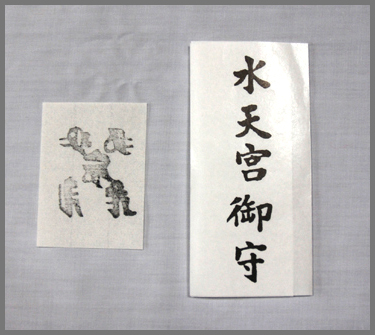
omamori 水天宮 久留米 お守り amulet with special letters

It is printed on very thin paper.


You have to carefully tear out the middle character, put it in your mouth, make a wish and swallow it with water.
That way your body will be even closer to the Deity.

For more wishes, you have to tear out the other characters in the given order:


It is also used if you do not feel well or a child is ill. Sawllowing one letter will bring healing.
It represents the Siddhaṃ script of old sanskrit letters.

.................................................................................

quote
Suitengu is a shrine located in the neighborhood of Ningyocho where you can still capture the atmosphere of Shitamachi (old Tokyo).

The shrine pavilion with its striking curving roof was built in 1967, using an architectural style known as "Gongen-zukuri". It has been gathering place for worship as the God of safe childbirth and blessing of pregnancy has resided here since the time of Edo period. Prayer for "Anzan Kigan," hoping for the safety of mother and safe birth of a baby, and "Kosazuke Kigan" for having children are mainly conducted. There are always many worshipping of couples and their families praying for safe childbirth and pregnancy blessings, paying a visit of thanks, and providing baby's first shrine visit both on weekdays and weekends.
source : www.japan-i.jp


:::::::::::::::::::::::::::::::::::::::::::::::::::::::::::::::::::::::::::::::::::::::::::::::::::::


Deity in residence

. Amenominakanushi no kami 天之御中主神 .
Ame no minaka nushi no kami / 天御中主神

. Antoku Tenno 安徳天皇 .

Ame no Mikumari no Kami 天之水分神
Kuni no Mikumari no Kami 国之水分神

Prayers for a safe delivery, protection from water damage and other catastrophies.


Amulet set with a bit of rice, cake, and an ema votive tablet with a dog


ko sazuke 子授御守 amulet for getting pregnant
This amulet must be worn on the body by husband and wife,
with daily prayers.

.................................................................................


kodakara no ishi 子宝石 stone to get pregnant
This stone must be put on the shelf of the gods (kamidana) for daily prayers.
Put on a pink cushion, it can also be placed in the bedroom, with a prayer every evening.

.................................................................................


misuzu obi 御子守帯 (みすゞおび)


鈴の緒

Before praying a bell is hit to call the deities down to hear the prayer of the mother-to-be. 鈴の緒


obi iwai 帯祝い amulet for a safe pregnancy
a belly binding ritual, buy a stomach band, bellyband
In the fifth month of a pregnancy, on the day of the dog (according to the lunar calendar) women go to a special shrine or temple to get this amulet and a bandage to wrap around the body. Usually the mother buys it for her pregnant daughter.


quote
... in her fifth month of pregnancy and on Inu-no-hi (戌の日 / Day of the Dog), the mum-to-be will perform the Obi-iwai. She will bind her tummy with the cotton sash to ensure safe and easy delivery of her child.
Interestingly, dog seems to play a big part in the sash-binding ritual. Mostly because of the belief that mummy-dogs give birth to little puppies with ease and hardly any complication. So the doggy days are considered auspicious days to do the bellyband ceremony.

More about pregnancy rituals:
source : blackcabbit.wordpress.com


.................................................................................


ema votive tablet with Benten
宝生辨財天絵馬


fuku ema to bring good luck 福絵馬 and to ward off evil

.................................................................................


mi naru kane 巳なる金 (みなるかね)
serpent to get money


Sold at the Benten Shrine in the compound. The servant of Benzaiten is the serpent.
This is a pun with the word MI (serpent, to bring fruit)
実のなる金


More amulets from the shrine:
source : www.suitengu.or.jp

:::::::::::::::::::::::::::::::::::::::::::::::::::::::::::::::::::::::::::::::::::::::::::::::::::::


Yanagawa Okinohata Suitengu 柳川市沖端水天宮


see below

:::::::::::::::::::::::::::::::::::::::::::::::::::::::::::::::::::::::::::::::::::::::::::::::::::::

. The Water God  Suijin-sama 水神様  .


. Three Female Deities of Water.
The Munakata Shrine Cult - 宗像大社


. Mikumari Jinja 御子守神社 and
Mikomori Myōjin 御子守明神. .

Komori Myōjin 子守明神, Mikomori Sannyoshin 御子守三女神
Female deities to protect the mothers.


. Anzan Daruma from the Suitengu Shrine .
水天宮の安産だるま

:::::::::::::::::::::::::::::::::::::::::::::::::::::::::::::::::::::::::::::::::::::::::::::::::::::


Kosazuke 子授けお守り amulets for pregnancy

. Shrine Tamaki Jinja 玉置神社 .
Nara prefecture

::::::::::::::::::::::::::::::::::::::::::::::::::::::::::::::::::::::::::::::::::::::::::::::::::::: 

H A I K U


kigo for early summer

. Suitenguu Matsuri 水天宮祭 Festival at Suitengu shrines .
柳川水天宮祭 festival at Shrine Suitengu in Yanagawa, Fukuoka
Okinohata Suitengu Festival 沖の端水天宮祭り
(May 13 - 15) 沖端水天宮祭り


.................................................................................

kigo for mid-winter

osame no Suitengu 納の水天宮 (おさめのすいてんぐう)
last visit to the Suitengu shrine

December 5

This is the last of the monthly prayer days (ennichi 縁日) for the year. A great fair is held and many visitors come to the shrine.

水天宮納め参りの雨となり
Suitengu osame mairi no ame to nari

Shrine Suitengu -
on the last visit of the year
it is raining


Kayama san 加山穂渓

.................................................................................


kigo for the New Year

Hatsu Suitenguu 初水天宮 (はつすいてんぐう)
first visit to the Shrine Suitengu


::::::::::::::::::::::::::::::::::::::::::::::::::::::::::::::::::::::::::::::::::::::::::::::::::::: 

. The Water God  水神様 Suijin-sama .


. Festivals, Ceremonies, Rituals - SAIJIKI .

. Amulets and Talismans from Japan . 

[ . BACK to WORLDKIGO  TOP . ]
[ . BACK to DARUMA MUSEUM TOP . ]

:::::::::::::::::::::::::::::::::::::::::::::::::::::::::::::::::::::::::::::::::::::::::::::::::::::

12/01/2011

Munakata Shrine

[ . BACK to DARUMA MUSEUM TOP . ]
::::::::::::::::::::::::::::::::::::::::::::::::::::::::::::::::::::::::::::::::::::::::::::::::::::: 

Munakata Taisha 宗像大社
Munakata Jinja 宗像神社


Munakata Shrine in Fukuoka prefecture, Munakata village
福岡県宗像郡の宗像大社, 福岡県宗像市田島2331


Munakata no Kami 宗像神 the Munakata Deity

The group of three important female deities
Tagori-hime, Tagitsu- hime and Ochikishima- hime.
see below.

.................................................................................

quote
Munakata Taisha (宗像大社) is a collection of three Shinto shrines located in Munakata, Fukuoka Prefecture, Japan. It is the head of the approximately 6,000 Munakata shrines all over the country. Although the name Munakata Taisha refers all three shrines
Hetsu-gū, Nakatsu-gū and Okitsu-gū
it is commonly used to refer to Hetsu-gū alone. As documented in Japan's second oldest book, Nihon Shoki, the shrines are devoted to the three Munakata goddesses. These kami are believed to be daughters of the god Amaterasu, the ancestor of the imperial family. Susanoo has also been worshipped there for many years as the god of mariners, and he has come to be worshipped as the god of traffic safety on land as well.

Munakata Taisha is also home to many Japanese treasures. Hetsu-gū's honden (main shrine) and haiden (main prayer hall) are both designated Important Cultural Properties. The Shinpō-kan (神寶館), the shrine's treasure hall located on the southwest corner of Hetsu-gū's grounds, houses many important relics including six National Treasures of Japan. Over 120,000 artifacts housed in the Shinpō-kan were unearthed on Okinoshima.

Three shrines
All three shrines are located in Fukuoka Prefecture, yet they are all on separate islands. The main shrine, Hetsu-gū, is located on the mainland of Kyūshū. Nakatsu-gū is established at the foot of Mt. Mitake on the island of Ōshima off the west coast of Kyūshū.

The final shrine, Okitsu-gū, is on the island of Okinoshima located in the middle of the Genkai Sea. The shrine occupies the entire island, therefore women are not allowed to set foot on the island and men must perform a purification ceremony before landing.

Hetsu-gū (辺津宮) Ichikishima Hime-no-Kami (市杵島姫神)

Nakatsu-gū (中津宮) Tagitsu Hime-no-Kami (湍津姫神)

Okitsu-gū (沖津宮) Tagori Hime-no-Kami (田心姫神)

© More in the WIKIPEDIA !

.................................................................................


quote
Munakata Shrines 宗像 and Munakata Taisha 宗像大社.
Munakata Taisha in Munakata City (Fukuoka) is the mother shrine for some 6,000 satellite Munakata shrines nationwide. Munakata shrines are dedicated to the Munakata Sannyoshin 宗像三女神 (also written 胸形三女神), the "Three Female Kami of Munakata."
These three are water goddesses, island kami, and patrons of safety at sea, bountiful fishing, guarding the nation, and protecting the imperial household. The trio appear in the Kojiki 古事記 (K) and Nihon Shoki 日本書紀 (NS), two of Japan's earliest official records of the 8th century, although the spelling of their names differ slightly.
Their worship began under the patronage of the Munakata 宗像 clan on Kyūshū (Kyushu) island, hence they are named the Three Goddesses of Munakata. In the 8th and 9th centuries, Japanese envoys to Korea and China visited Munakata Taisha before their departure to pray for safety on the sea voyage (in the Nihongi, the supreme sun goddess Amaterasu commands them to protect the sea route from northern Kyushu to the Korean Peninsula).
In the classical texts mentioned above, all three kami were formed when sun goddess Amaterasu broke Susanō's sword, chewed it in her mouth, then blew out a mist that produced the triad.

The three kami are:
Ichikishima-hime 市杵嶋姫命
Tagitsu-hime 多岐都比売命
Tagori-hime 田心姫
- Tagirihime no Mikoto, Tagiri Hime no Mikoto 田心姫命 / 多岐理比売命

- MORE : - Mark Schumacher


- - - - -These three female deities at
. Isaniwa Jinja 伊佐爾波神社 Matsuyama .


- quote
Tagorihime - Tagirihime no mikoto(Kojiki)
One of three female kami produced as a result of the trial by pledge (ukei) between Amaterasu and Susanoo. The three became known as the "three goddesses of Munakata" as a result of their enshrinement and worship at the shrine Munakata Taisha by the Munakata clan, and are thus believed to have been sea deities or tutelaries of travel on the Genkai Sea.
snip . . .
- source : Kadoya Atsushi - Kokugakuin


.................................................................................


The deity in residence of this shrine is


Ichikishima hime 市杵島姫(いちきしまひめ)
Takishi hime, Takiri Hime タキツヒメ・タキリヒメ
daughter of Amaterasu and officially celebrated at the Itsukushima shrine in Miyajima, Hiroshima.

The shrine overlooks the Genkai Nada 玄界灘 open sea off Kyushu.

People pray here for safety at sea, but also for progress in the arts and good business (kooyoo no kami 交易の神).
交易=市 explains her name.

Munakata Taisha is also called "Michinushi no Muchi" .
Muchi is noble honorific for god. Nihon-shoki describes the Munakata Daijin as the best way of god.

The Divine Message of God
"Ye three Goddesses shall descend to Michi-no-Naka, help the successive descendants,
have them hold ye in reverence."

(from the Nihon-shoki)


quote
Ichikishimahime (Kojiki)(Nihongi)
Other names: Sayoribime no mikoto (Kojiki)

One of the three female kami produced as a result of the trial by pledge (ukei) between Amaterasu and Susanoo, Ichikishimahime is enshrined at the Hetsugū, one of three shrines at the Munakata Taisha in the old province of Chikuzen (present-day Fukuoka). She is believed to have originally been a sea tutelary protecting the sea lanes in the Genkai Sea, and is later known as one of the kami enshrined at Itsukushima Jinja (Hiroshima Prefecture), where she may have been brought after the Engishiki period and enshrined as central object of worship.

At Itsukushima, Ichikishimahime was also the object of combinatory currents in the medieval period, and came to be identified variously with the daughter of the Indian dragon king Sagara or a younger sister of Empress Jingū, while alternately receiving worship as the Indian goddess Benzaiten. See also Tagorihime.
source : Kadoya Atsushi, Kokugakuin, 2005


Mede TAI 目出鯛 auspicious sea bream amulet

quote
Munakata Shinkō - Munakata shinkoo 宗像信仰
The faith related to Munakata Jinja
The faith has elements of guarding the nation and protecting the imperial house, as well as safety at sea and ensuring fishermen a bountiful catch. Munakata can also be written with the characters 胸形 or 宗形. The Jinmyōchō section of the Engishiki records that there were Munakata shrines stretching from northern Kyushu to the Kantō area. Among these, Munakata Taisha located in Fukuoka Prefecture is the most famous.

The shrine's enshrined kami's (saijin) are the "Three Female Kami of Munakata" (Munakata Sanjoshin), Ichikishimahime no kami enshrined at Hetsumiya in Genkaimachi Tashima, Munakatagun, Tagitsuhime no kami, enshrined at Nakatsumiya on the island Ōshima, located roughly ten kilometers from land, and Tagorihime no kami, enshrined at Okitsumiya on the island of Okinoshima in the center of the Genkainada sea.

That the Munakata Sanjoshin are worshipped individually at a different location is recorded at an early date in such documents as the Kojiki and the Nihonshoki, but there are variant characters for the kami's names and different locations for their enshrinement. At the approximately six thousand Munakata shrines in Japan, the respective "enshrined kamis" (saijin) worshipped vary according to each shrine's origin legend.

The Sanjoshin are said to have been born on the occasion of the "divination trial" or "contract" (ukehi) between Amaterasu and Susanoo. The original meaning of the names of each kami derives from "female mediums" (miko) (Ichikishimahime), rough water (Tagitsuhime), and fog (Tagorihime), and the Sanjoshin are deifications of miko, rough water, and fog.

In the Nihonshoki Amaterasu ōkami commands that the three kami of Munakata "descend to the middle of the route (the sea route from Northern Kyushu to the Korean Peninsula), assist the heavenly grandchild (tenson – i.e. Ninigi no mikoto) and allow yourselves to be worshipped by the heavenly grandchild." The kami was also prayed to for safe sea travel by emissaries along northern routes, such as the early envoys to China (kentōshi) and demonstrated wondrous efficacy at the time of Empress Jingū's military expedition to the Korean peninsula.

The kami developed into a guardian of the nation and protector of the imperial house, as well as a protector of sea travelers, and enjoyed the fervent faith of people from all walks of life. The Munakata clan officiated at the festival of the Sanjoshin. Along with the new system of land governance instituted during the Taika Reforms, the county Munakatagun was designated a "shrine tribute land" (shingun) and the Munakata clan simultaneously occupied the post of governor (tairyō or kōri no miyatsuko) of that county.


The Munakata clan not only had close ties to the imperial house, but established marriage connections with powerful people on the continent. Even after the Japanese government stopped sending envoys (kentōshi) to China, the clans trade with the continent continued and they were powerful with regard to rights of sea travel and trade.

Today only shrine priests (shinshoku) reside on the island of Okinoshima, which has a circumference of approximately four kilometers. The island has a tremendous "altar constructed from stones" (iwasaka) which was the subject of a fieldwork study from 1954-1972. Research revealed the remains of ceremonies and objects in the crevices of the rocks dating back to between the fourth and ninth centuries, elucidating the development of early Shinto rituals and how people worshipped.

The more than 100,000 ceremonial objects discovered originate not only in Japan, but also include objects from the Korean peninsula, China, and even Persia. Many have been designated National Treasures or Important Cultural Properties. There is a taboo against speaking about Okinoshima and against removing any objects from of the island.

source : Nogami Takahiro, Kokugakuin, 2007


. Ninigi ニニギ and Sakuyahime 花咲屋姫命 .

:::::::::::::::::::::::::::::::::::::::::::::::::::::::::::::::::::::::::::::::::::::::::::::::::::::

. Funadama 船霊 guardian deity of a boat .

市杵嶋姫神 いちきしまひめのかみ。水の神様。弁天様と習合。Ichiki Shima Hime no Kami
闇淤加美神 くらおかみのかみ。水の神・龍神様。Kura Kami no Kami
高淤加美神 たかおかみのかみ。水の神・龍神様。Takao Kami no Kami
宗像の神 むなかたのかみ。海上交通の神様。水の神様。Munakata no Kami
罔象女神 みづはのめのかみ。水を司る神。雨乞いの神。Mizuba no Me no Kami

The Munakata Deities and the Waka poet
. Kakinomoto Hitomaro 柿本人麻呂 Hitomaru 人丸 / 人麿 . .

Kakinomoto is venerated at two shrines in Fukuoka

Waka Jinja 和歌神社 Shrine of Waka Poets
in the compound of 宗像大社 Munakata Taisha, 2331 Tashima, Munakata
福岡県宗像市田島2331


source : kofunmeguriwalking.web ... munakatataisya

- - - - - and

和歌神社 Waka Jinja
福岡県宗像市大井929, Munakata City, Oi 929


- More photos :
- source : - kofunmeguriwalking.web ... wakajinja-ooi


:::::::::::::::::::::::::::::::::::::::::::::::::::::::::::::::::::::::::::::::::::::::::::::::::::::


Sato Masato writes:
Due to belief in the "Three Female Kami" (sanjoshin) of Munakata at Itsukushima Jinja, the Itsukushima kami was worshipped as a protector of fishermen and boats.

. Itsukushima Shrine 厳島神社 Itsukushima Jinja .


:::::::::::::::::::::::::::::::::::::::::::::::::::::::::::::::::::::::::::::::::::::::::::::::::::::

Amulets from the shrine


eto ittobori 干支一刀彫り zodiac animals
cut with one blade


Auspicious items for the New Year 正月縁起物


Kootsuu anzen 交通安全守 trafic safety
and more
source : www.munakata-taisha.or.jp


Munakata Taisha blesses all the good human behavior and is considered a most precious god by people. 
source : English Homepage

::::::::::::::::::::::::::::::::::::::::::::::::::::::::::::::::::::::::::::::::::::::::::::::::::::: 

H A I K U

kigo for mid-winter

Munakata sai 宗像祭 (むなかたさい) Munakata festival
koshiki sai 古式祭(こしきさい)festival in the old style

古式祭(御座)/ 鎮火祭
December 15 or a Sunday nearby


For the ceremony,which dates back more than 800 years, special food offerings are made, consisting of rice, sake, salt and water, gebasa seaweed ゲバサ藻, soy beans, and miso paste blended into a kind of salad (aemono). Kunenbo mikans 九年母 and a special kind of hishimochi ricecakes 菱餅 are also offered. After the ritual offering, the food is eaten by the participants to honor the deity, pray for a long life and give thanks for her bountiful protection.

Admission for this ceremonial feast is 1000 yen.

約800年の伝統をもち、特殊な神饌(九年母・ゲバサ藻・菱餅)を神前にお供えして、 今年最後の収穫を感謝するお祭りです。祭典に引き続き、 神様とともに一年の喜びを分かちあい、「神人和楽」を共にする”延命招福の集い”「御座」が催されます。
source : www.munakata-taisha.or.jp

.................................................................................


The Menu of the Ceremony


Deities and Men eating together

Look at more photos:
source : wakemitama

:::::::::::::::::::::::::::::::::::::::::::::::::::::::::::::::::::::::::::::::::::::::::::::::::::::

observance kigo for the New Year

Ichigami matsuri 市神祭 (いちがみまつり)
festival for the God of the Market


Celebrated in many towns of Japan, but especially at Munakata Shrine in Kyoto at the first market day, usually around January 10.
People take part to ward off evil in the coming year.


. New Year Markets .


::::::::::::::::::::::::::::::::::::::::::::::::::::::::::::::::::::::::::::::::::::::::::::::::::::: 


Kitty Chan
in the driver seat -
are you surprized ?


::::::::::::::::::::::::::::::::::::::::::::::::::::::::::::::::::::::::::::::::::::::::::::::::::::: 

. Suitengu 水天宮 Shrine for the Water God .
Deity in residence
. Amenominakanushi no kami 天之御中主神 .
Ame no minaka nushi no kami / 天御中主神
. Antoku Tenno 安徳天皇 .
Ame no Mikumari no Kami 天之水分神
Kuni no Mikumari no Kami 国之水分神


. Festivals, Ceremonies, Rituals - SAIJIKI .

. Amulets and Talismans from Japan . 

[ . BACK to WORLDKIGO  TOP . ]
[ . BACK to DARUMA MUSEUM TOP . ]

:::::::::::::::::::::::::::::::::::::::::::::::::::::::::::::::::::::::::::::::::::::::::::::::::::::