:::::::::::::::::::::::::::::::::::::::::::::::::::::::::::::::::::::::::::::::::::::::::::::::::::::
Yoshino Mountains and the Cherry Trees
Yoshinoyama - 吉野山
for kigo, see below


Yoshino valley is famous for its three thousand or maybe more cherry trees, in the three lower, middle and upper levels of the valley.
But have you ever wondered how they got there and when ?

:::::::::::::::::::::::::::::::::::::::::::::::::::::::::::::::::::::::::::::::::::::::::::::::::::::
Yoshinoyama 吉野山, the Mountains of Yoshino, has been a spot famous for cherry trees since long ago. After it became the holy tree of Gongen Zao of a Buddhist mountain sect about 1,300 years ago, it continued to be planted as an offering.
The cherry trees of Yoshinoyama were loved by writers and artists from the days of old.
Most of these are Shiroyama cherry trees, covering an area of 54 hectares with about thirty thousand trees. In spring, the 1000 trees at the foot of the mountain bloom first, and then the next thousand up the mountain, progressing upward until the last 1000 bloom nearly a month later. This place has become a popular spot for "Hanami" (a picnic held under the cherry blossoms) and many tens of thousands of people gather here each year.
http://www.maff.go.jp/soshiki/koukai/muratai/21j/english/no6/mura21.html
:::::::::::::::::::::::::::::::::::::::::::::::::::::::::::::::::::::::::::::::::::::::::::::::::::::

.. .. .. En no Gyoja 役行者
Yoshinoyama is the best spot to see cherry blossoms
By Junzo Tanaka
Those staying in Japan in April are fortunate. They can meet cherry blossoms. They can also see Japanese making merry with them. Cherry trees in the Japanese archipelago bloom from the south to the north with rises in the temperature. It is called the 'cherry-blossom front' and reported every day in weather forecasts. In pursuing the front, some people tour places noted for cherry blossoms across the country.
Among such places, Yoshinoyama is the best sightseeing spot in Japan, and nobody raises objection to it.Yoshinoyama is situated in the town of Yoshino, Yoshino-gun, Nara Prefecture, and there is a railway at its foot. All the mountain areas from in front of the station to the valley to the ridges are buried under cherry blossoms. There is no description other than a superb view.
The height of blooming rises slowly from the foot to the ridges and lasts from mid-April to the end of the month. Every year, hotels and inns in Yoshino are crowded with visitors to see cherry blossoms. The blossoms are beautiful day and night, but experts say they breathe a sigh in seeing them at dawn. They stay there for a few days to see the flowers.
This writer is hesitant to introduce such well-known Yoshinoyama again, but would like to bother to recommend it to you because the place is not a mere botanical garden for cherry trees. The trees are linked to Japan's history. Shrines and temples scattered around and with cherry trees are the stages of pathetic stories of heroes and beautiful women. Up to the present day, they have been the sources of literature and classic dramas.
If you know about the bright and dark sides of Japan's history, including a tragic love between warlord Minamoto no Yoshitsune and his mistress Shizuka Gozen, battles between the Northern and Southern dynasties, and a cherry blossom-viewing party hosted by warlord Toyotomi Hideyoshi, your understanding of Japan will rapidly deepen.
Yoshinoyama is a crystallization of Japanese feelings of love toward nature. Cherry trees there have not naturally grown. It is said En no Gyoja, a semi-legendary sorcerer of the 7th century and a monk of Shugendo, a Shinto-Buddhist cult devoted to ascetic practices and mountain worship, carved an image of Shugendo leader Zao Gongen on the trunk of a cherry tree, and Shugendo followers brought young cherry tree plants there.
This is the beginning of cherry trees on Yoshinoyama.

http://members.shaw.ca/shugendo/images/zao-statue.jpg
... ... ... Zao Gongen
En no Gyoja's achievements are in the mist of legendary, but they were written in a history book published in 699. Cherry trees have since increased gradually, and in the 14 century, Yoshinoyama's name as the best place of cherry trees was firmly established.However, Yoshinoyama is not best suited to the growth of cherry trees, which need enough sunshine and clean air. The mountain which faces the north lacks enough sunshine, although air is clean.
According to botany, if the same plant is grown and cultivated in the same place for a long time, there occurs so-called 'hate-soil phenomenon.' Yoshinoyama is said to be no exception.What is tremendous about Yoshinoyama is that it has overcome such phenomenon and has kept the status of cherry blossom's noted place. Residents in the neighborhood have taken care of cherry trees from generation to generation and are continuing to treat them with a modern 'cherry tree health-keeping' technique. The residents are thinking of cherry trees during their lifetime, and there are even officials in charge of cherry trees in the town office. Therefore, cherry blossoms have survived for as long as 1,300 years. The residents are shy, as other Japanese are, and hesitate to mention about their steady achievements.
http://www.kansai.gr.jp/KansaiWindowHtml/News/2004-e/20040331_NEWS.HTML
. Sakuramotobo 桜本坊Temple Sakuramoto-Bo .
With a statue of the Tengu
Yoshino Minasugi Kozakuraboo 吉野皆杉 小桜坊
Yoshino Minasugi Kozakura-Bo
:::::::::::::::::::::::::::::::::::::::::::::::::::::::::::::::::::::::::::::::::::::::::::::::::::::
Futari Shizuka 二人静 at Mount Yoshino 吉野山
花の陰謡に似たる旅寝哉
. hana no kage utai ni nitaru tabine kana .
Matsuo Basho feels like in a Noh play about Shizuka Gozen.
:::::::::::::::::::::::::::::::::::::::::::::::::::::::::::::::::::::::::::::::::::::::::::::::::::::
Yoshino - center of spiritual assertion
Mainichi Daily News / December 15, 2000
By Richard Humphries
Behind Yoshino's Nyoirin-ji temple lies a glade of peaceful evergreens. Within that glade is a small mound whose stone-gated protective entrance faces north towards Kyoto. The mound is the final resting place of the Emperor Go-Daigo, who died in 1339, and the orientation towards the ancient imperial capital is emblematic of both the emperor's aesthetic sense and of his profound political failure.
Go-Daigo was the last emperor in Japan to attempt with some results the direct exercise of imperial prerogatives. He achieved a temporary success in that endeavor when loyal forces overthrew the Kamakura Shogunate in 1333. The chance at direct rule was squandered through misrule, as important allies like Ashikaga Takauji soon became bitter enemies. The Emperor's allies, and in particular Kusonoki Masashige, were directed by Go-Daigo to fight a clearly unequal battle in 1336 and it was one upon which the imperial cause depended. They lost, though were later to find apotheosis in the ethos of noble failure. After many vicissitudes and even a period of imprisonment, Go-Daigo fled to Yoshino, and intransigent to the end, set up a rival Southern Court.
For 50 years the Southern Court continued, eventually giving way to its more powerful Northern rival.In a small way, Yoshino's history offers a counterpart to France's Avignon, a divisive, if small and temporary, center of spiritual and temporal assertion.
To visit in the spring and summer months, when white-frocked yamabushi (mountain monks) and other pilgrims in their thousands pass through the small settlement, is perhaps best for imagining the scale of the ex-emperor's attempt.
And there are the famous cherry trees, thousands of them, in magnificent full bloom in April. The quieter off-months, however, may be more suitable for seeing Yoshino as it really is and appreciating its history, legends, and significance in a more subdued atmosphere.Yoshino town has 700 permanent residents and the surrounding hills a few thousand more. The town center consists of essentially one main street, lined with a mix of Edo-era and more modern structures.
Kuromon, a wooden gate, signals your entrance to the town proper. A more impressive entranceway, in the form of a large bronze torii, 7.6 meters high, is a few hundred meters further on. When the sun is high, townsfolk hang white shades across the main street from the tops of buildings, giving it the feel of a covered market. On particular treat is green yomogi, a tasty dango made from rice bean paste and crushed kome leaves. At a shop by the name of Manchudo, you can see it being prepared.Yoshino has been a center of worship since antiquity, as mountains believed sacred surround it.

金峯山寺蔵王堂
Dominating the town is the Kimpusenji temple complex. This temple was founded, or so legends say, by En-no-Gyoja, a 7th century figure revered for his asceticism, and himself semi-legendary. Kimpusenji was the center for the Shugendo sect, a syncretic blend of Shinto and Buddhist beliefs based on mountain asceticism. Most of the other shrines in Yoshino once belonged to that sect but they suffered suppression by the early Meiji rulers who favored State Shinto. The main hall in Kimpusenji, Zao-do, is at 34 meters of height, the second largest wooden structure in the country. Only Nara's Toodaiji is larger.
To the west of Kimpusenji there is a flight of several hundred steps that leads downward into a small secluded valley. There, at a small shrine called Noten-o-kami, one can drink from the small spring, said to promote health, that emerges from a carved serpent's mouth. Pilgrims come to offer eggs to the shrineケs deity. Inside the shrine, the custom is to do clockwise prayer circuits, dropping wooden sticks one by one into a large bowl. One wall of the shrine's exterior is colorfully decorated with origami strips.Go-Daigo is not the only tragic figure associated with Yoshino.
Two shrines are connected with the tragic tale of Yoshitsune, who was pursued to his death by his jealous brother Yoritomo, a 12th century Kamakura Shogun. Yoshitsune, whose life is now the staple of Noh dramas, eventually met his end in northern Japan at Hiraizumi, but hid in Yoshino for a time at the Yoshimizu shrine with his lover Shizuka Gozen. One of the buildings there seems to hang, at least in part, precipitously off the side of a cliff. After Yoshitsune was found out, he fled leaving his mistress behind. She, legend has it, was forced to dance for her captor's pleasure at another small shrine on Yoshino's main street, Katte-jinja.
Pilgrims to Yoshino will generally stop at Kimpusenji and pay their respects before continuing through the town and upwards through the countryside to the base of Mt. Omine, a peak considered by devotees since ancient times to be the adobe of gods. Depending on one's strength of purpose and belief, a simple walk or a series of austere physical trials awaits. In recent years there has been much controversy over the practice of forbidding women, here considered impure, to ascend beyond a certain point near the base. Whether this will be modified and brought into concurrence with modern opinion at some later date cannot be known at present.
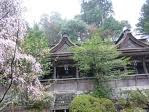
.. .. .. Mikumari Shrine 水分神社(みくまりじんじゃ)
In any event, the walk from Yoshino towards the base is very agreeable and not too steep. Thirty minutes walk after the town and past quiet farmhouses is Mikumari shrine. Mikumari, a picturesque and atmospheric structure with connecting rooms and an inner garden, is dedicated to the Ameno-mikumari, the water god. The present structure was built in the Momoyama style by Toyotomi Hideyoshi, the unifier of modern Japan, in 1604. Locally, the shrine is called Komori-san. The reason is that Mikumari became corrupted to mikomori (meaning care of a baby) and then was further reduced in the local dialect.Further on from Mikumari the houses stop and one enters an enchanting forest of tall cryptomeria.
In the summer months the noise along this route must be palpable, but in the off-season it is still and the air is unmistakably fresh. The last shrine before you, if you are male, begin the climb is Kimpu-jinja, a small wooden building and a place for ascetic exercises.About 15 minutes walk from Yoshimizu Shrine is the aforementioned Nyoirinji temple. This was built in the early 10th century and is famous for its statue of Zao Gongen, an avatar of Yoshino (and protector of one's head) who, it has been claimed, En-no-Gyoja was first able to perceive.
Go-Daigo later gave the temple a more political function as a center for people to pray for the guardianship of the nation, presumably under Go-Daigo.One unique town event deserves mention, although it takes place during the busy season.
Every July 7, Kaeru-tobi, or frog hopping takes place. A man dresses like a frog and capers about the village. This symbolizes a story that there was once an ascetic who made the mistake of mocking a local deity. The deity was clearly not amused, but the by now chastened man's life was saved by the Shugendo priests at Kimpusenji, who used their skills to change the man, first into the shape of frog, and finally back to his original human shape once it was safe to do so.
http://www2.gol.com/users/rick/article1/jaa3.html
........................................................................................
En no Gyooja, as you can see on the first picture above, is usually flanked by a couple of two demons, the husband Zenki 前鬼 and his wife Goki 後鬼。

© 2002 Heguri Town, Nara
These demons promised to En no Gyooja to protect the pilgrims of the area. They had five children, whose families in the x-th generation up to this day have five mountain huts where the pilgrims can rest during their walk from Oomine to Kumano. The business is going on for more than 1300 years now.
Gokijo 後鬼助 san, in the 61 generation, lives in Osaka now and comes back every weekend and holidays to take care of the pilgrims.
一説には634年に生まれたとされているが、伝説の色が濃く、やや信頼性が薄い。 前鬼と後鬼という夫婦の鬼を使役したと言われることから、邪法を使う者として名をおとしめられることもある。 ただしこの前鬼と後鬼だが、能の『鞍馬天狗』などでは大峰山の天狗だとされている。そこから考えると、もともと彼らは役行者と同じ山岳修験者で、行者に付き従った人間だったのだろう。他でも、鬼のような姿をしていたがれっきとした人間だったといわれている。
http://www.pandaemonium.net/menu/devil/Ozunu.html
http://sachi-n-web3122.hp.infoseek.co.jp/2003/ohmine-okugake.html
. Zenki 前鬼 and his wife Goki 後鬼 .
大峰山前鬼坊 Ominesan Zenki-Bo Tengu
:::::::::::::::::::::::::::::::::::::::::::::::::::::::::::::::::::::::::::::::::::::::::::::::::::::
.. .. .. .. .. .. .. Further Reading
About Shugendo 修験道, very extensive
Read here about En no Gyooja (En no Ozuno) and the Deity Zao Gongen.
。。。。。役行者、蔵王権現
Zao Gongen

Daruma Museum: Zao Gongen
Shugendo
... Holy Mountains, En no Gyoja, Zao Gongen
http://www.onmarkproductions.com/html/holy-mountains-sacred-shrines.html
About Mt. Omine (Oomine 大嶺山)
http://japanvisitor.com/jt/mount-omine.html
.. .. Kinpusenji
http://www.rekishikaido.gr.jp/time-trip/gengo/eng/yoshino.htm
http://www.h5.dion.ne.jp/~bangai/kinpusenji.htm
Mikumari Shrine
http://tencoo.fc2web.com/jinja/xys-mikumari.htm
Minamoto Yoshitsune (1159-1189)
Shizuka Gozen
Few samurai loom as largely in Japanese history and lore as Minamoto Yoshitsune, the brilliant general whose tactics won a string of victories for his brother Yoritomo that culminated in the demise of the Taira clan.
(Yoshitsune memorial day (Yoshitsune-Ki 義経忌)is a kigo for Haiku.)
http://www.samurai-archives.com/yoshitsune.html
Emperor Go-Daigo (1288-1339)
.. .. .. His tomb in the Yoshino Mountains
http://www.kiis.or.jp/kansaida/yoshino/yoshino06-e.html
.. .. .. WKD : The Daigo Cherry Tree
... A Cherry Tree in his Memory
Kusonoki Masashige (1294-1336)
Including the history of the Kamakura Period
http://www.samurai-archives.com/time.html
Toyotomi Hideyoshi (1536 - 1598)
One of the most remarkable men in Japanese history, Toyotomi Hideyoshi was born a peasant and yet rose to finally end the Sengoku Period.
http://www.samurai-archives.com/hideyoshi.html
Photos of Cherry Trees in Yoshino and Japan
http://www.sakura.yoshino.jp/photo.htm
http://www.sakura.yoshino.jp/sakura2002/photo.htm
http://yaccyann.cool.ne.jp/yosinoasa/
Great Collection of Wada san. Yoshino
... and Saigyo Hooshi 西行法師
http://wadaphoto.jp/sakura/yoshinosp2.htm
http://wadaphoto.jp/sakura/yoshino1.htm
http://wadaphoto.jp/sakura/yoshino2.htm
http://wadaphoto.jp/sakura/yoshino3.htm
http://wadaphoto.jp/sakura/yoshino4.htm
... and Go-Daigo Tenno
http://wadaphoto.jp/sakura/yoshinosp.htm
.. .. Sakura in Japan
http://www.asahi-net.or.jp/~jb3k-tnk/photo-g/data04/sakura.html
.. .. Shimoda Castle
http://izu-sakuraya.jp/photograph/plant/plant01/sakura01.htm
:::::::::::::::::::::::::::::::::::::::::::::::::::::::::::::::::::::::::::::::::::::::::::::::::::::
The Cherry Blossom Digest
The famous medieval age monk SAIGYO wrote the followingpoem about cherry blossom:
Could I die under
a cherry blossom tree in full bloom
on a full-moon night of spring?
. WKD : SAIGYO, Saigyoo Hooshi (西行法師)
digital 西行庵
http://www.saigyo.org/
:::::::::::::::::::::::::::::::::::::::::::::::::::::::::::::::::::::::::::::::::::::::::::::::::::::
observance kigo for late spring
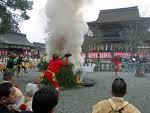
Yoshino hana eshiki Yoshino Hana Eshiki
吉野花会式 (よしののはなえしき)
Cherry Blossom Festival at Yoshino
oni odori 鬼踊(おにおどり)dance of the demons
mochikubari, mochi kubari 餅配り(もちくばり)
throwing mochi to the crowd
11-12 of April
.................................................................................
Oominesan Toake-Shiki 大峰山戸開式
Opening the doors at Yoshino, Oominesan
May 3
. . . CLICK here for Photos !
.................................................................................
observance kigo for late summer

. Yoshino no kawazutobi
吉野の蛙飛 (よしののかわずとび)
frog jumping ritual at Yoshino
frog hopping
RENGE-E 蓮華会(れんげえ) Lotus Flower Offering
Zaodoo kawazutobi 蔵王堂蛙飛(ざおうどうかわずとび)
frog jumping ritual at temple Zao-Do
. Reference .
.................................................................................
More festivals of Yoshino
Feb 1-3 Onibi Festival Campaign
Apr 3 Taue Festival
Apr 8 Flower Festival
Apr 10 Zaoudou Hanaku Senbontsuki
Apr 29 Yoshino Shrine Spring Festival
Apr 1-26 Cherry blossom festival/light up
May 3 Ominesan Opening ceremony
Jun 4 Hagatame Jizo Festival
Jul 7 Rengekai Toad Ceremony
Sep 27 Yoshino shrine autumn festival
Oct 1 Yoshino seiten autumn festival
Oct 19 Noten daijinn autumn festival
Oct 3rd Sunday Yoshinoyama autumn festival
Nov 2nd Sunday Tonanin festival
Nov 23 Dainichi temple Hiwatari walking through flames
http://www.yoshinoyama-sakura.jp/english/events.htm
:::::::::::::::::::::::::::::::::::::::::::::::::::::::::::::::::::::::::::::::::::::::::::::::::::::

Yoshinobina 吉野雛 Hina dolls from Yoshino
The dolls from Yoshino are made from the wood of the local cherry trees.
They were even introduced at the Great Exhibtion in New York in 1939.
They were first made at the shop of Ota san 大田桜花堂, now his son Toshishige 豊茂 makes them.
There are also hina dolls made from clay.
. . . CLICK here for Photos !

There are also clay bells from Yoshino. Some feature the ritual of the jumping frogs.
. Folk Toys from Nara .
:::::::::::::::::::::::::::::::::::::::::::::::::::::::::::::::::::::::::::::::::::::::::::::::::::::
. Matsuo Basho 松尾芭蕉 - Archives of the WKD .
今宵誰吉野の月も十六里
koyoi tare Yoshino no tsuki mo juuroku ri
tonight
who will look at the moon in Yoshino ?
It is 16 Ri away.
One RI is about 3,9 km.
Written in 1694 on the full moon night of the 8th lunar month
元禄7年八月十五夜, Basho age 51.
at Mumei-An 無名庵 in Iga Ueno.
From here it was just 16 Ri 里 to Mount Yoshino.
.............................................................................
待つ花や藤三郎が吉野山
matsu hana ya Toozaburoo ga Yoshinoyama
the cherry blossoms are waiting !
Too Saburo and his
Mount Yoshinoyama
Written in 1679 延宝7年, Basho age 36
Too Saburo 藤三郎 Gichiku 宜竹 (ぎちく)
was a famous Shakuhachi flute player.
Kaijo Shuurin 景徐周麟 (1440 - 1518)
A monk of the Rinzai Sect Musoo 夢窓.
Also called Hanin 半隠, Taishoo 対松.
The shakuhachi at his time was a famous Hitoyogiri 一節切.
One of his famous tunes was "Yoshinoyama". It was quite a hit in the Edo period and made Basho think of Yoshino.
吉野の山を雪かと見れば、雪ではあらで、や、
これの、花の吹雪よの
it looks like snow on Mount Yoshinoyama
but is it really snow? Behold !
this is the snow of cherry blossoms scattering !
There is another hokku about this flute player
まづ知るや宜竹が竹に花の雪
mazu shiru ya Gichiku ga take ni hana no yuki
written in 1677 延宝5年, Basho age 34
first you must know this !
Gichiku and his bamboo (flute)
bring "snow" to the cherry blossoms
or
first you must know this !
Gichiku and his bamboo (flute)
bring the cherry blossoms to fall like snow
The cherry blossoms of Yoshino are famous for "haha no fubuki" cherry blossoms scattering like snow.
. Shakuhachi, the Bamboo Flute .
.............................................................................

source : urawa328
吉野にて桜見せうぞ檜木笠
Yoshino nite sakura mishoo zo hinoki-gasa
In March of 1688. Basho with his student and very good friend:
. - Tsuboi Tokoku 坪井杜国 - .
My hat, I too will let you see
The cherry-bloom at Yoshino
Tr. Asataro Miyamori
Here we are in Yoshino
so let us look at the cherry blossoms !
My pine-bark hat.
This hat 檜笠 is rather large and protects the walking pilgrim from rain.
For pilgrims, they are a symbol of the Buddha walking with them, for some they are Kobo Daishi walking with them.
So the hat should have its part in enjoying the blossoms too.

. KASA 笠 Hats for rain and shine .
. Matsuo Basho 松尾芭蕉 - Oi no Kobumi .
.............................................................................
目に残る吉野を瀬田の蛍哉
me ni nokoru Yoshino o Seta no hotaru kana
still before my eyes -
the cherry blossoms of Yoshino
the fireflies of Seta
. Matsuo Basho at Seta, Lake Biwa .
:::::::::::::::::::::::::::::::::::::::::::::::::::::::::::::::::::::::::::::::::::::::::::::::::::::

. Ogura Hyakunin Isshu Poems 小倉百人一首 .
31 - Sakanoue no Korenori 坂上是則
94 - Sangi Fujiwara no Masatsune 参議雅経
Yoshino no Sato 吉野の里 - Miyoshi no Yama みよし野の山
:::::::::::::::::::::::::::::::::::::::::::::::::::::::::::::::::::::::::::::::::::::::::::::::::::::::
- - - - - Yosa Buson - - - - -

source : ttetsuo_2005
冬ごもり心の奥のよしの 山
fuyugomori kokoro no oku no yoshino yama
winter seclusion -
deep in my heart there is still
mount Yoshino
雲を呑んで花を吐くなりよしの山
kumo o nonde hana o haku nari yoshino yama
it swallows clouds
and spits out cherry blossoms -
mount Yoshino
みよし野のちか道寒し山桜
miyoshino no chikamichi samushi yamazakura
the shortcut
to mount Yoshino is so cold -
wild cherry blossoms

source : www.rakanneko.jp
銭 買 て入るやよしのの山ざくら
zeni katte hairu ya yoshino no yamazakura
I buy some change
to go and see - the wild cherry blossoms
at mount Yoshino
People needed small change to pay to the tea stalls on the way when resting and to give some offerings to the many temples of the region.
The cut marker YA is in the middle of line 2.
. Yosa Buson 与謝蕪村 in Edo .
:::::::::::::::::::::::::::::::::::::::::::::::::::::::::::::::::::::::::::::::::::::::::::::::::::::::
. - Kobayashi Issa 小林一茶 in Yoshino - .
:::::::::::::::::::::::::::::::::::::::::::::::::::::::::::::::::::::::::::::::::::::::::::::::::::::::
My Photo Album about Sakura 桜
Sakura Photo Album
.Noten Okami 脳天大神 .
at 龍王院 Ryuo-In - Dragon God Shrine, Yoshino, Kinpusenji 金峯山寺
[ . BACK to WORLDKIGO . TOP . ]
[ . BACK to DARUMA MUSEUM TOP . ]
:::::::::::::::::::::::::::::::::::::::::::::::::::::::::::::::::::::::::::::::::::::::::::::::::::::


 Posts
Posts




6 comments:
木の葉散る桜は軽し檜木笠
konoha chiru sakura wa karushi hinokigasa
falling leaves
of the cherry trees so light
on my pilgrim's hat
Written in 1684, 貞享1年, Basho age 41
Matsuo Basho is making his way into the mountains of Yoshino, usually famous for the sakura blossoms in spring.
.
http://matsuobasho-wkd.blogspot.jp/2012/06/kasa-hat-of-pilgrim.html
.
Matauo Basho
花盛り山は日ごろの朝ぼらけ
hanazakari yama wa higoro no asaborake
hana-zakari
blossoms at their peak,
with the mountains as always
at daybreak
Tr. Barnhill
MORE
about Basho in Yoshino
Yosa Buson
zeni katte hairu ya yoshino no yamazakura
to buy change to enter yoshino and see the wild cherries
(Tr. Robin Gill)
coins
Yosa Buson
fuyugomori kokoro no ôku no yoshino yama
hana o nonde kumo o haku nari yoshino yama
miyoshino no chikamichi samushi yamazakura
- - miyoshino no chikamichi yukeba yamazakura
- - - TBA
Matsuo Basho and
- Tsuboi Tokoku 坪井杜国 -
. Yoshinoyama Nyosen 吉野山女仙 Female Sennin from Mount Yoshinoyama .
and
. Tenmu, Tenbu 天武天皇 Emperor Tenmu Tenno .
when he was still Prince Ōama 大海人皇子 Oama no Oji and lived in exile in Yoshino.
with his guide, Suzuka no okina 鈴鹿翁 Old Man Suzuka
.
Suzuka no Okina brought the Prince (who was also known as 清見原皇子 Prince Kiyomihara) to Yoshino ...
.
https://gokurakuparadies.blogspot.jp/2018/04/butsusen-04-suzuka-okina.html
.
Post a Comment