. Dengyo Daishi Saicho Legends .
:::::::::::::::::::::::::::::::::::::::::::::::::::::::::::::::::::::::::::::::::::::::::::::::::::::
Saicho, Dengyo Daishi 伝教大師最澄
Dengyoo Daishi, Saichoo and Tendai Daishi 天台大師
Temple Enryaku-ji 延暦寺 and Mount Hieizan, Hiei-zan 比叡山 Mount Hiei
Saicho, besides Kukai, is a remarkle figure in the development of Esoteric Buddhism in Japan. The presend exhibition (see below) was the start of this article.
"Faith and Syncretism:
Saicho and Treasures of Tendai"
May 7 , 2006 at the Tokyo National Museum
Saicho (766-822),
posthumously known as Dengyo Daishi ("Great Teacher who Transmitted the Teachings"), established the Tendai Sect in Japan in 806 (Enryaku 25), under the imperial sanction of Emperor Kanmu.
Yakushi Nyorai (Skt., Bhaisajyaguru Tathagata; Medicine Buddha)

Heian period, dated 993
Zensui-ji Temple, Shiga
Saicho had statues of Yakushi in each of the four ships on his way to and from China and prayers were said for a safe trip.
Tokyo National Museum Exhibition 2006
:::::::::::::::::::::::::::::::::::::::::::::::::::::::::::::::::::::::::::::::::::::::::::::::::::::

Tendai Daishi (Ch. Zhiyi)
Curtesy of
(C) The Japan Times: Thursday, April 6, 2006
http://search.japantimes.co.jp/cgi-bin/fa20060406a1.html
An art born of Saicho's syncretism
By MICHAEL DUNN
This year marks the 1,200th anniversary of the founding of the Buddhist Tendai sect in Japan, when Priest Saicho (767-822), posthumously known as Dengyo Daishi, received court permission to establish a school of religious study and training at Enryaku-ji Temple on Mount Hie to the northeast of Kyoto.
The purpose of the center was to train spiritual leaders, since -- according to Saicho's book "Essential Teachings for the Priests of the Tendai Hokke Sect" -- "one who can illuminate even one corner in the world . . . is a National Treasure."
In commemoration, a major exhibition, "Faith and Syncretism: Saicho and Treasures of Tendai," is at the Tokyo National Museum till May 7, showing sculptures, paintings, calligraphy and other religious objects selected mainly from temples throughout the country.
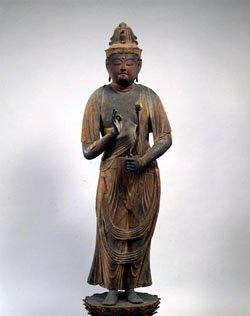
Standing Sho Kannon
Saicho's connection with Mount Hie dates from when he was 19 years old, at which time -- disgusted with the degenerate state of the Buddhist clergy at temples in and around the old capital of Nara -- he built a cottage on the mountain and devoted himself to the ascetic study of original Buddhist teachings. Two or three years later, he established a temple on Mount Hie, just shortly before the Imperial Court moved to Kyoto.
Thereafter, for religious, and possibly political, reasons he managed to attract Imperial patronage, and in 802 was sent to study at Mount Tiantai in southwest China.
There, Saicho immersed himself in the study of the Lotus Sutra (considered the ultimate teaching of the historic Buddha, but probably written sometime after his death), together with Esoteric Buddhism and Zen. On returning to Mount Hie, he unified what he had learned with local Shinto beliefs, and from this syncretism (meaning "the unification of various religious beliefs") he developed a new form of Tendai Buddhism more suitable for Japanese followers.
Despite the bewildering complexity of Tendai philosophy and practice, its central belief is that all sentient beings are bodhisattvas who can become enlightened Buddhas and gain entrance to Paradise. This revelation had a tremendous effect on Buddhism during the Heian Period (794-1185), as religious hope and opportunity -- which previously had been considered almost exclusive to the clergy and court ranks -- became accessible to everyone.
Saicho's syncretism was nevertheless far from final, and religious debate continued during his life and after his death. The Tendai sect spread throughout Japan, inspiring artists and craftsmen to produce a huge variety of adornments for temples and sculptural and pictorial images for didactic purposes.
It also provided an intellectual and spiritual environment that spawned further new sects with their own interpretations of Saicho's teachings, including Jodo and Nichiren -- which emphasized ritual, prayer and religious practice -- and Soto and Rinzai Zen -- which stressed a personal spiritual search through meditation. These sects in turn refined religious doctrines to suit their own ideals, and are still extant today.

Yellow Fudo
The original Tendai complex on Mount Hie grew in time to the size of a small city that, at its peak, supported some 3,000 sub-temples and an army of militant warrior-monks famed for challenging political and religious opponents at every opportunity. The complex is now a designated World Heritage Site and still serves as the Tendai headquarters for more than 19 million members who follow "the perfect teaching" of native beliefs mixed with the Buddhism that Saicho studied in China.
Most of the temples that can be seen today date from the late 16th and early 17th century, having been rebuilt after the daimyo Oda Nobunaga destroyed the Enryaku-ji complex in 1571 in an attempt to unite the country by eliminating all his rivals.
In the exhibition, several paintings, and a beautiful small wooden sculpture from the Kannon-ji Temple, portray Saicho himself. All show him full-fleshed and round-faced with downcast eyes, and just a trace of a furrow at his brow to suggest concern for the enormous job he shouldered. Other sculptural highlights include a standing figure of Kannon clutching a lotus bud from Enryaku-ji, with a serene expression and a third eye of inlaid crystal -- as well as a rarely revealed, seated, gilded Buddha of Healing from Zensui-ji Temple. Both of these masterpieces are being shown away from their temples for the first time.
The diversity of Tendai religious images is extraordinary and reveals an all-embracing reverence of Buddhas, bodhisattvas and guardian deities, as well as members of the native Shinto pantheon that were already long established. One of the delights is a 12th-century crouching monkey carved in wood that represents a "Messenger of the Gods of the Mount Hie Shrines."
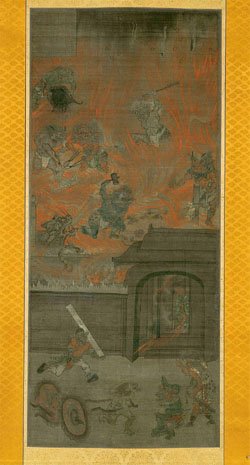
Rokudo-e (The Six Paths)
Other images are more fearful, and serve to warn of what can happen to those who stray from the path. A Heian Period painting of Fudo Myo shows the muscled "immovable" guardian of Buddha's doctrine, wide-eyed and grimacing, sword at the ready, in strange uplighting to emphasize his otherworldly nature. And if his warning isn't sufficient, graphic scenes of Hell's torments should serve to nudge the criminally inclined back to the straight and narrow path.
Nevertheless, hope and salvation is the underlying message of Tendai, and one recurring painted image is that of the enlightened Amida Raigo swooping down on a cloud, surrounded by attendant deities -- sometimes accompanied by a heavenly orchestra -- to pluck a deserving soul from Earth "in the blink of an eye."
To fully understand the symbolism and meaning of the objects displayed in this exhibition would take lengthy study, and for the nonspecialist much would be lost in translation. Many of them are, however, artistically sublime and can be appreciated subjectively for their beauty alone.
Many of the exhibits are rarely shown at all, and some have been rediscovered as a result of a special study of Tendai by scholars at the Kyoto National Museum. A few are now designated "National Treasures," but for Priest Saicho, such words described not esteemed art works ranked by bureaucrats, but those early masters of Tendai who devoted their lives to trying to shed light in the shadowy corners of spiritual fate.
(C) The Japan Times: Thursday, April 6, 2006
:::::::::::::::::::::::::::::::::::::::::::::::::::::::::::::::::::::::::::::::::::::::::::::::::::::
Stone Fudo on the way to Hieizan

- shared by Bradford Pomeroy, facebook - 2014
:::::::::::::::::::::::::::::::::::::::::::::::::::::::::::::::::::::::::::::::::::::::::::::::::::::

Mount Hiei (比叡山, Hiei-zan)
is a mountain to the northeast of Kyoto, lying on the border between the Kyoto and Shiga prefectures, Japan. For much of Japanese history, Mt. Hiei has been off-limits to women.
The temple of Enryaku-ji, the first Japanese outpost of Tendai sect of Buddhism, was founded atop Mount Hiei by Saichō in 788. Both Nichiren and Honen studied at the temple before leaving to start their own practices. The temple complex was razed by Oda Nobunaga in 1571 to quell the rising power of the Tendai's warrior monks (sōhei), but it was rebuilt and remains the Tendai headquarters to this day.
© More in the WIKIPEDIA !

Temple Enryaku-ji (延暦寺, Enryaku-ji)
is a Tendai monastery located on Mount Hiei, overlooking Kyoto. It was founded during the early Heian period. The temple complex was established by Saichō (767–822), also known as Dengyō Daishi, who introduced the Tendai sect of Mahayana Buddhism to Japan from China.
© More in the WIKIPEDIA !
:::::::::::::::::::::::::::::::::::::::::::::::::::::::::::::::::::::::::::::::::::::::::::::::::::::
Kiyomizu Kannon 清水観音 in Miyama town, みやま市
Fukuoka prefecture
One day in the year 806 the priest Dengyo Daishi Saicho, on his way home from China, saw a golden light east of the Ariake Sea. He climbed the East Mountain to find this sacred light deep in the forest. On his way he encountered great hardship and even lost his way. Suddenly, a male pheasant came by and showed him the way. Saicho found a shining "silk tree" nemu no ki 合歓木, carved a Kannon Bosatsu with 1000 arms into this tree and build a temple nearby.
This is the origin of the pheasant toy at the temple.
. Kiji-guruma きじ車 pheasant on wheels
:::::::::::::::::::::::::::::::::::::::::::::::::::::::::::::::::::::::::::::::::::::::::::::::::::::
"The Path to Tendai Buddhism:
In Quest of the Eternal Shakyamuni"
at the Miho Museum, Autumn 2011
. "What is national treasure?" .
wrote Saicho (767-822), the founding monk of Tendai Buddhism, in his 818 "The Essential Teachings for Tendai Lotus Sect Priests," which he presented to Emperor Saga to bolster the standing of his esoteric order. His answer was pursuing the Buddhist path, and that
"shining light into one corner is itself a national treasure."
:::::::::::::::::::::::::::::::::::::::::::::::::::::::::::::::::::::::::::::::::::::::::::::::::::::
kigo for the New Year
. Hatsu Hiei 初比叡 First View of Mount Hiei
.................................................................................
kigo for mid-summer
Dengyoo e 伝教会 (でんぎょうえ)
Dengyo Memorial Ceremony
Saichoo ki 最澄忌(さいちょうき)Saicho Memorial Day / June 4
... Dengyoo Daishi ki 伝教大師忌(でんぎょうだいしき)
choogoo e 長講会(ちょうごうえ)
sange e 山家会(さんげえ)
.................................................................................
kigo for early autumn
Tozu Seppoo 戸津説法
Explaining the Buddhist Law at Tozu
At the temple Tonan-Ji 東南寺 (Toonanji) in the town of Otsu, Shiga prefecture, at
Totsugahama 戸津ヶ浜
August 21 - 25
Dengyo Daishi has been given lectures about the Lotus Sutra and performed rituals for his parents.
He used 13 days for the celebrations, which was later shortened to 10 days and after the Meiji period to only 5 days.

Nowadays the priest in charge sits at a special high podest and talks to the laypeople.
.................................................................................
kigo for mid-winter
. Hieizan hokke e 比叡山法華会
Great Ceremony at Mount Hieizan
Memorial day for the third patriarch, Tendai Daishi, Tendai Daishi Ki (Ch. Zhiyi, 538-597)
Tendai Daishi Ki 天台大師忌(てんだいだいしき)
:::::::::::::::::::::::::::::::::::::::::::::::::::::::::::::::::::::::::::::::::::::::::::::::::::::
. WKD : Kobayashi Issa 小林一茶 in Edo .
なむ大師しらぬも粥にありつきぬ
namu daishi shiranu mo kayu ni aritsukinu
I bow low to you, Saint --
even those who don't know
eat your festival rice
Tr. Chris Drake
This hokku was written late in the 11th month (December) in 1814, a few months after Issa had gotten married, while he was on a trip back to Edo to say farewell to his poet friends there before moving to his hometown for good.
There were various celebrations on 11/23-24, but there was a difference between those for believers in the Tendai-school of Buddhism and for those who celebrated a more general Saints' Festival. In Tendai-school Buddhist temples in Japan 11/24 is celebrated as the memorial day of the Chinese founder of the Tiantai school of Buddhism, Zhiyi (538-97). Early in the 9th century this school was transmitted to Japan by Saint Dengyo and called Tendai, and in Japan Zhiyi, called Chigi in Japanese, was most commonly referred to as Tendai Daishi (Saint Tendai).
On 11/23-24 (late December) many different beliefs intersected in a way that made the special watery rice gruel with red beans and sometimes noodles in it that Issa writes about more than simply a part of a memorial service for a single saint. Japanese folk religion is unabashedly syncretistic and vigorously incorporates various different elements into contradictory yet vibrant systems of belief and ritual performance. The most important celebration on this day was a festival called Daishi-kou (大師講), or Saints' Festival.
The festival began with supper on 11/23, when special rice gruel with red beans in it called "Saint's gruel (daishi-gayu)" was served, and this festival rice was also served on the 24th. Outside of Tendai temples, other Buddhist saints, such as Saint Kobo, Saint Sangan, and Shotoku Taishi, were also worshiped, though their memorial dates were at other times of the year, and in some areas a one-legged god was worshiped instead of a Buddhist saint. In Edo and in northern Honshu, the festival also often included prayers said at the time of the winter solstice, and the festival rice gruel was believed to strengthen people and protect them from the big snowstorms which usually began around the time of the winter solstice and the Saints' Festival.
It's not clear whether Issa is addressing only Saint Tendai in the hokku or whether he is addressing all the various saints for whom Saints' Festival rice gruel was cooked. The hokku before this hokku in Issa's diary seems to address the god of snow, who is believed to visit during the Saints' Festival:
azuki-gayu daishi no yuki mo furinikeri
red-bean rice gruel --
even the saints' snow
is falling
And in the hokku before this hokku about snow is a hokku in which the gruel itself is regarded as the manifestation of the saint being worshiped:
けふの日やするする粥もおがまるる
kyoo no hi ya suru-suru kayu mo ogamaruru
on this day
even smooth gruel
is worshiped
Issa's diary doesn't mention stopping at a temple on 11/23 or 11/24, and the context of the hokku doesn't suggest a Tendai temple. However, Issa surely knows who Saint Tendai was, because both Honen and Shinran, the founders of the two schools of Pure Land Buddhism in Japan, began as Tendai-school monks who were later expelled as heretics. Issa may even have read some of Saint Tendai's lectures on meditation and higher wisdom, the famous Maka-shikan (摩訶止観), although the True Pure Land Sect did not stress the crucial importance of meditation. In any case, Issa does not feel that his knowledge gives him deeper insight into the meaning of the festival. Issa no doubt saw many people simply eating the rice gruel with red beans in it on 11/23-24 and he himself was surely served some at the place where he stopped for the night. Perhaps the joy felt by the people around him eating the delicious gruel -- eating it as if they were worshiping it, even though they do not know the doctrines of Saint Tendai and the other saints worshiped on this day -- reminds Issa of the "other-power" that is the source of all movement toward the Pure Land. Since Issa doesn't practice any specific meditation or claim to have any special wisdom, perhaps he includes himself among those who "don't know."
Chris Drake
"Gruel for Priest Chi-E", Chie gayu, Chi-E-gayu 智慧粥
"Great Master's Gruel", Daishi gayu 大師粥
gruel on the 18th day, juuhachi gayu 十八粥
fuguri gayu ふぐり粥(ふぐりがゆ
kigo for mid-winter
. WKD : Rice gruel (kayu 粥) .
- - - - -
鳥の巣も鬼門に立つや日枝の山
tori no su mo kimon ni tatsu ya Hie no yama
the bird's nest, too
in the unlucky direction...
Mount Hie
Tr. David Lanoue
:::::::::::::::::::::::::::::::::::::::::::::::::::::::::::::::::::::::::::::::::::::::::::::::::::::
In the Daruma Museum:
The KIMON for the city of Kyoto was the double-peaked Mt. Hiei.
比叡山延暦寺 (Hieizan Temple Enryakuji)
. Kimon, the "Demon Gate" 鬼門
Sennichi Kaihoogyoo 千日回峰行
. The Marathon Monks at Mt. Hiei
Kobo Daishi, Kukai 弘法大師 空海
Daruma Pilgrims in Japan: Kentooshi Embassies to China 遣唐使, including Saicho
Folk toys and legends
. uzuraguruma うずら車 quail car toy .
Miayazaki, Temple Hokedake Yakush-ji 法華嶽薬師寺
Temple Hisamine Kannon 久峰観音
. Hokedake-Ji, Hokkedakeji 法華嶽寺 Hokedake Yakushi-Ji .
:::::::::::::::::::::::::::::::::::::::::::::::::::::::::::::::::::::::::::::::::::::::::::::::::::::

おほけなくうき世の民におほふかな
わがたつそまに墨染の袖
Okenaku Ukiyo no tami ni Ou kana
Waga tatsu soma ni Sumizome no sode
From the monastery
On Mount Hiei I look out
On this world of tears,
And though I am unworthy,
I shield it with my black sleeves.
Tr. Clay MacCauley
95 - Abbot Saki no Daisojo Jien 前大僧正慈円
. Ogura Hyakunin Isshu Poems 小倉百人一首 .
:::::::::::::::::::::::::::::::::::::::::::::::::::::::::::::::::::::::::::::::::::::::::::::::::::::
At the temple Enryaku-Ji on Mount Hieizan in Kyoto there is an "eternal flame" and all lanterns are kept alight since more than 1000 years.
The lanters use oil flames for light,
and the oil 油 YU should not be "cut off" 断 DAN,
so the flame could continue to light the temple and show the way to enlightenment for the visitors.
This is the origin of the saying
yudan taiteki 油断大敵 Do not be inattentive.
Don't be too sure of yourself!
Overconfidence [ Carelessness] can be very dangerous.
Unpreparedness is one's greatest enemy.
Idleness is the devil's workshop.
. yudan taiteki 油断大敵 - amulet .
:::::::::::::::::::::::::::::::::::::::::::::::::::::::::::::::::::::::::::::::::::::::::::::::::::::
千鳥立ち更け行く初夜の日枝颪
chidori tachi fuke-yuku shoya no hieoroshi
chidoritachi fuke yuku shoya no Hie oroshi
plovers flying away -
as the evening passes on
wind blows down from Mount Hieizan
Written in 1690 in Kyoto. Most probably as an inscription on a painting.
shoya (soya) 初夜 , lit. "first night", refers to the "double-hour of the dog" 戌の刻, now about 9 in the evening.
As the night grows deeper, the wind grows stronger and the plovers have flown away.
It can also mean the "first night" of a newly-wedded couple.
. WKD : oroshi 颪. おろし WIND in various kigo .
MORE - hokku about first things by
. Matsuo Basho 松尾芭蕉 - Archives of the WKD .
..........................................................................
Oohie, Ô-Hie 大比叡 O-Hie refers to Mount Hiei-zan in general and also to the higher peak of the two main mountain ranges.
大比叡やしの字を引いて一霞
Oo-Hie ya shi no ji o hiite hito kasumi
this large mount Hiei -
a whiff of mist
like the letter SHI
Here Basho is most probably referring to a story about priest Ikkyu.
In the collection of stories about Ikkyu (Ikkyuu banashi 一休咄) there is one where Ikkyu had encouraged the monks of the famous monastery at Mount Hieizan to imagine the letter SHI し to be written in one brave stroke from the top of the mountain down to the town of Sakamoto at its foot.
Written in 延宝5年, Basho age 34
. Ikkyū (一休宗純, Ikkyū Sōjun, Ikkyu Sojun .
(1394-1481)
..........................................................................
海は晴れて比叡振り残す五月哉
umi wa harete Hie furinokosu satsuki kana
sunshine on lake Biwako
but Mount Hiei still in the rain
of Satsuki . . .
The month of satsuki, the fifth lunar month, now famous for both the rainy season rain (samidare 五月雨) and the few spells of fine weather (satsuki-bare 五月晴).
Now it is the weather of July/beginning of June.
Written the fifth lunar month in 1688 貞亨5年5月.
The cut marker KANA is at the end of line 3.
Basho had most probably been invited to the estate of Namura Saida 苗村宰陀 by the lake side.
umi 海 refers to the lake Biwako, the biggest lake of Japan.
Basho in Oomi 近江 - 89 poems written in Omi, Shiga 滋賀 - 志賀 -
. Matsuo Basho 松尾芭蕉 - Archives of the WKD .
:::::::::::::::::::::::::::::::::::::::::::::::::::::::::::::::::::::::::::::::::::::::::::::::::::::
. Dengyo Daishi Saicho Legends .
[ . BACK to WORLDKIGO . TOP . ]
[ . BACK to DARUMA MUSEUM TOP . ]
- #dengyodaish #saicho #saicholegends -
:::::::::::::::::::::::::::::::::::::::::::::::::::::::::::::::::::::::::::::::::::::::::::::::::::::


 Posts
Posts



23 comments:
beautiful statues.
Thanks for introducing the KIMON !
雲のみね今のは比叡に似た物か
kumo no mine ima no wa Hie ni nita mono ka
a peak of clouds -
this one looks just
like Mount Hieizan
Enomoto Shidoo 槐本之道 Shido
Tookoo - 東湖 - Toko "East Lake"
In ancient Japan, the term Yase Doji referred to the people who lived in the Yase district of Kyoto and worked for the area's Enryaku temple.
Despite their plebeian status, Yase Doji were prosperous and maintained strong connections with those in power, including emperors, aristocrats and shogun. After the Meiji Era, they were even entrusted by the government to be the imperial koshi (palanquin) bearers.
In 2010, some historical records that detailed the development of Yase Doji were designated as Important Cultural Properties。。。
http://www.japantimes.co.jp/text/fa20121213o2.html
.
八瀬童子
大比叡やしの字を引いて一霞
Ô-Hie ya / shi no ji o hii te / hito kasumi
Matsuo Basho
海は晴れて比叡振り残す五月哉
umi wa harete / Hie furi nokosu / satsuki kana
Matsuo Basho
Yosa Buson
比叡にかよふ麓の家の砧かな - Hiei ni kayou roku no ie no kinuta kana
kinuta - fulling block
Amida Raigo zu 阿弥陀来迎図
and Fudo Myo-O
at temple Kuroda Mudooji 黒田無動寺 Kuroda Mudo-Ji
.
http://fudosama.blogspot.jp/2008/07/fudo-and-death.html
The Heian Period
平安時代 Heian jidai (794 - 1185)
http://heianperiodjapan.blogspot.jp/
.
founded
Hokedake-Ji, Hokkedakeji 法華嶽寺 Hokedake Yakushi-Ji
宮崎県東諸県郡国富町大字深年4050 / Fukadoshi, Kunitomi, Higashimorokata District
.
http://gokurakuparadies.blogspot.jp/2015/09/hokedake-hokkedake-yakushi-temple.html
Kani Yakushi 蟹薬師 "Crab Yakushi"
大寺山願興寺 Daiji San, Ganko-Ji
Mitake no Kani Yakushi 御嵩の蟹薬師
岐阜県南部,可児(かに)the district of Kani in Gifu
岐阜県可児郡御嵩町御嵩1377-1 / Mitake town
In 815, 伝教大師(最澄) Dengyo Daishi Saicho dedicated the statue of Yakushi.
.
MORE
http://gokurakuparadies.blogspot.jp/2015/12/kani-yakushi-gifu.html
.
He carved the Fudo Myo-O statue at
Soojoogadani Fudoo Doo 僧正ガ谷不動堂
Fudo Hall in Sojogatani
京都市左京区鞍馬本町 / 1074 Kurama Honmachi, Sakyo-ku, Kyoto
.
http://fudosama.blogspot.jp/2016/07/sojogatani-fudo.html
.
比叡山法性坊 - Hoseibo, Hieizan - Kyoto
A Tengu from Hieizan.
and
Jirooboo, Jirōbō 次郎坊 / 二郎坊 Jirobo Tengu
- 比良の次郎坊 Hira no Jirobo / 比良治郎坊
Jirobo first lived at Mount Hieizan 比叡山 (see below) but was driven away from by priest Saicho and the stronger mountain priests and moved on to 比良山 Hirasan in Shiga.
.
http://gokurakuparadies.blogspot.jp/2016/08/jirobo-tengu.html
.
Zegaiboo, Zegai-bô 是害坊 Zegai-Bo, Zegaibo Tengu
Zenkaibo, Zenkai-Bo
He came all the way from China to challenge the Tengu of Japan.
First he went to 愛宕山 Atagoyama to see Nichiraboo 日羅坊 Nichira-Bo, Nichirabo (Taroboo 太郎坊 Taro-Bo).
Nichira-Bo told him this would not work, so Zengai-Bo went further to Mount Hieizan (Hiei-zan). There lived
比叡山 法性坊 - Hosei-Bo and others.
They were much more powerful then Zegai-Bo, and he was beaten very strongly by a young novice. He even burned his wings. He was hurt badly but the kind Tengu eventually tried to heal him in a hot bath in Kamogawa 加茂川に湯屋.
When he was better, they even organized a large good-bye party for him.
Then he returned to China.
(As told in the Konjaku Monogatari legends.)
.
http://gokurakuparadies.blogspot.jp/2016/09/zegaibo-tengu.html
.
Tengu
Kakukaiboo 覚海坊 Kakukai-Bo
横川覚海坊 - Kakukaibo, Yokogawa from Kyoto
He was priest 覚海 Kakukai (1142 - 1223) at 比叡山 Hieizan and turned into a Tengu.
Junichiro Tanizaki wrote a short story entitled "Kakukai Shoin Tengu ni naru koto".
.
https://kappapedia.blogspot.jp/2017/01/tengu-less-known.html
.
Akasaka Fudo
- 智剣山 Chikenzan 威徳寺 Itoku-Ji
港区赤坂4-1-10 / Minato ward, Akasaka 4-1-10 Tokyo
.
When priest Dengyo Daishi was on his way back from China, his ship experienced strong wind and rain. He carved a statue of Fudo Myo-o with the prayer to save the boat and threw it into the waters. He arrived safely in Japan (and later founded the Tendai sect). The statue was picked up on the beach of 越後出雲崎 Izumosaki in Echigo in 858.
.
https://gokurakuparadies.blogspot.jp/2017/04/gofunai-temples-74-and-75.html
.
Fudo Legend Kyoto 延暦寺 Enryaku-Ji
Shortly before his death, Fudo told priest Ryuusen 隆暹 Ryusen in a dream that he would soon go to paradise.
.
https://fudosama.blogspot.jp/2017/09/fudo-legends-05-kagawa.html
.
Tokyo
Saranuma Fudo 皿沼不動 永昌院 Eisho-In
Saranuma (swamp of plates) is located in the North-East of Arakawa and has been under the control of the Edo Bakufu Government.
The temple 東叡山寛永寺 was erected in 1625
as The Hieizan of the East
and the whole swamp was under its protection. Around it many other temples were soon built too.
The center of the cult was 阿弥陀仏 Amida Buddha and the 念仏講 Nenbutsu chanting.
With the greater popularity of Narita Fudo they got a statue of Fudo standing in front 御前立不動明王 for prayers.
.
https://fudosama.blogspot.com/2018/07/saranuma-fudo-adachi-tokyo.html
.
Moriyamadera 東門院 守山寺 Tomon-In, Shiga
founded in 794 by the priest Saicho,
.
https://gokurakuparadies.blogspot.com/2020/01/moriyamadera-tomonin.html
.
Daifuku-Ji 大福寺
室田之滝不動尊 Murota no Taki Fudo Waterfall
.
Founded most probably by 最澄伝教大師 Saicho Dengyo Daishi when he traveled in the area.
Saicho carved the statue of Fudo Myo-O and built the hall to shelter it. Then he held a ritual to purify the statue and took one of his ritual tools, the dokko 独鈷 thunderbolt, and threw it outside at the rock, where the waterfall started to flow. Saicho said:
「滝に沐浴すれば総じて苦悩を洗い、
去りて秘境の極に至ることこの清泉に勝るものなし」
The present-day hall was built in 1802.
.
https://fudosama.blogspot.com/2020/02/daifukuji-muro-taki-waterfall.html
.
A statue of Bishamonten carved by Dengyo Daishi is in the temple
Ryudaiji Fudo 龍台寺不動 Fudo from Temple Ryudai-Ji
命府山 Seifuzan 理生院 Rio-In 龍台寺 Ryudai-Ji
.
川崎市高津区久本2-12-23 / Kanagawa, Kawasaki city, Takatsu ward, Hisamoto
.
https://gokurakuparadies.blogspot.com/2020/05/ryudaiji-fudo-hisamoto.html
.
Legend from Aichi, 名古屋市 Nagoya city 守山区 Moriyama ward
.
. ryuujo 竜女と伝説 / 龍女 Ryujo- Legends about female dragons .
When 伝教大師 Priest Dengyo Daishi was visiting 熱田の宮 the Shrine of Atsuta, 竜女 a female dragon appeared.
She told him she was living in the pond of 竜泉寺 temple Ryusen-Ji and wanted him to come there too and get a special blessing.
When Dengyo Daishi came to the temple Ryusen-Ji the female dragon showed up to teach her something special.
From then on, whenever there was a drought, she would bring rain if people prayed here.
. Saicho, Dengyo Daishi 伝教大師最澄 (766 - 822) .
. Atsuta Jingu 熱田神宮 Atsuta Shrine .
.
https://gokurakuparadies.blogspot.com/2020/12/ryusenji-temples-legends.html
.
Hieizan Temple Legends
.
https://gokurakuparadies.blogspot.com/2020/12/hieizan-temple-legends.html
.
Post a Comment