7/30/2005

Kobori Enshuu

[ . BACK to Worldkigo TOP . ]
::::::::::::::::::::::::::::::::::::::::::::::::::::::::::::::::::::::::::::::::::::::::::::::::::::: 

Kobori Enshu 小堀遠州 (1579 - 1647)


He was a famous landscape gardener and I had a chance to visit one of his gardens at the Temple Raikyuu-Ji in Takahashi in July 2005.

岡山県、高梁市、頼久寺

慶長5年(1600年)小堀新介正次が、備中国に1万石余を領したが、慶長9年に逝去したので一子作介政一(遠州)が遺領を継いだ。その頃の松山城は備中兵乱で非常に荒廃していたため遠州は頼久寺を仮の館とし、またよく本寺を外護され、元和5年(1619年)までこの地にいた。本庭園はその頃の遠州の策定になるもので、蓬莱式枯山水庭園で愛宕山を借景し、白砂敷の中央に鶴島、後方に亀島の二つの低い築山状の島を置いて石を組み、書院左手の山畔に沿ってサツキの大刈込みで青海波を表現した庭園である。

このような築庭様式は、桃山から江戸初期に好まれたもので、現在まで旧体のまま保存されていることは、歴代城主の帰依の念篤きことと、歴代住職の愛山の念深きよるものであって、遠州作庭の傑作庭園と称されており、昭和49年国の名勝(庭園)指定された。尚、自筆の禁礼他遺愛品数点が保存されており、別に暦応2年12西念勧進による石灯篭がある。
http://www.optic.or.jp/takahashi-cci/kankou/kankou_c.html

Kobori designed many gardens, and many more claim to have him as originator (good for business nowadays...).
Kobori Enshu is maybe the best known garden master known inside and outside of Japan.


The temple garden in Takahashi is very quiet, with few visitors. Superbly fitted in the neighbouring mountains and slopes, to be appreciated through all the seasons.
The fine structure of the temple itself makes this a place of great restfullness and quietude.

The layout of sand, stones and shrubs exudes a fine quality of permanence and impermanence, change and non-change, action and non-action.

:::::::::::::::::::::::::::::::::::::::::::::::::::::::::::::::::::::::::::::::::::::::::::::::::::::

Enshu, Kobori

A master of tea, architecture, garden design, calligraphy and poetry, he was a multi-talented leader of early Edo culture.
Enshu was initially in the service of Hideyoshi's brother Hidenaga, but after that lord's death he aligned himself with Hideyoshi himself. Then, on Hideyoshi's death, he entered the service of Tokugawa Ieyasu.

In 1604, Enshu's father died suddenly leaving him in possession of the state of Omi, valued at 12,000 koku. He successfully completed works on the Sento Palace (the emperor's residence) and at Sunpu Castle, and was rewarded with the marshalcy of Omi. He also designed and constructed the keep of Nagoya Castle, Matsuyama Castle, and the study in the central enceinte of Fushimi Castle. Finally he built the central enceintes of the shogunal castle at Nijo-jo (in Kyoto) and of Osaka Castle.

His greatest claim to fame is as a tea master. He studied under Sen Rikyu's student Furuta Oribe, evolving a style of tea known as 'refined austerity', which aspired to fuse the classical court taste with that of the newer military elite. His role was pivotal in creation of the early modern tea ceremony, with its emphasis on self-cultivation and Confucianism.

Enshu designed many tea houses including the Hoden-seki in the subtemple of Koho-an at the Daitoku-ji, and the Mitsuan-seki at the Ryuko-in of the same temple. He was tea advisor to the shogunal family for fully 36 years.
Enshu's talents were many, and ran to garden design, architecture, calligraphy and poetry.

http://www.cartage.org.lb/en/themes/Biographies/MainBiographies/E/Enshu/enshu.htm

:::::::::::::::::::::::::::::::::::::::::::::::::::::::::::::::::::::::::::::::::::::::::::::::::::::


Kobori and the Enshu School of Tea

The founder, Lord Kobori Enshu Masakazu, was the feudal lord of Tohtoumi(now Shizuoka Prefecture) in the early Edo Era. He,along with Murata Juko, Takeno Jyoo, Senno-Rikyu, and Furuta Oribe,is renowed as one of the greatest tea masters to inherit the tradition of Japanese Sado(Tea Ceremony).

Enshu was a pivotal figure in the ruling circles, serving as the official tea instructor for the second and third Shoguns of Tokugawa, Hidetada and Iemitsu. He served as the magistrate of Fushimi in Kyoto and also as the construction commissioner in charge of building the famous castles such as Sunpu, Fushimi, Osaka, and Kyoto Nijo Castles. Such representative gardens in Kyoto as Daitokuji Kohoan, Katsura Rikyu, Nanzenji and Konchiin were built under his supervision and planning.

Enshu was also talented in calligraphy and waka, 31-syllable Japanese poetry. He originated a new style of tea ceremony, which is now called the Enshu Sado School. The spirit of Enshu Sado lies in " Kirei Sabi ", or gracefulness and simplicity. Kirei Sabi has its origin in ancient Japanese sense of beauty which is closely related to waka of the Heian period.

He also rendered great services in instructing potterymaking such as Takatori ware, Tanba ware, Shigaraki ware. Furthermore, he purchased specially designed tea utensils from China, Korea, Vietnam and the Netherlands.

COPYRIGHT (C) ENSHUSADO-SOKE
http://www.enshuryu.com/e-enshu.htm

.. .. ..

古田織部について茶をなし、江戸三代将軍徳川家光の師範となる。遠州流の始祖。造園、建築に深く貢献する。
http://www.teahyakka.com/glossary.html

:::::::::::::::::::::::::::::::::::::::::::::::::::::::::::::::::::::::::::::::::::::::::::::::::::::


Look at my photos from the temple garden, Raikyuu-Ji, Nr. A15 - A33.
.... Photo Album

Some Windows of Temples in Takahashi
Temple Window Shapes お寺の窓の形

:::::::::::::::::::::::::::::::::::::::::::::::::::::::::::::::::::::::::::::::::::::::::::::::::::::

Other gardens by Kobori Enshu in Japan:

Sento Gosho Palace
With the thing which Sento Gosho Palace commanded Kobori Enshu in the purpose that Tokugawa shogunate government pressed for abdication of the Emperor Gomizuno (1596-1680, rank 1611-29) and built, it was completed in 1630.
Now only a garden and a tea-ceremony room are left.
Sento Gosho Palace and the Omiya Imperial Palace built at the same time by expecting it are the Empress Dowager Imperial Palaces of the empress / east fortune Empress Dowager of the Emperor Gomizuno (1607-1678).
Minami Pond of Sento Gosho Palace was connected with Kita Pond that was a garden of the Omiya Imperial Palace in a canal in 1747.
In current Sento Gosho Palace, landscape gardening of Kobori Enshu does not convey an original figure faithfully.

Look at this page with many photos:
http://www.tvnet.co.jp/ai-guide/sendogosyo.html

.. .. .. .. ..

Temple Nanzen-Ji
As interesting as the Daihojo may be, it is the Shohojo that is of interest to most people for its screens (fusuma) decorated in Chinese landscapes as well as noted paintings of tigers and the kuresansui (dry garden) outside. Believed to be created by Kobori Enshu (1594-1634) it is this garden, known as the Tiger and Cubs Zen Garden, that attracts people to Nanzen-ji.

Like most Zen gardens it is not only important what is present in the garden, but what is not in the garden as well. Within the garden are three small rocks (the tigers) accompanied by three smaller rocks (the cubs) all surrounded by pure white sand (a stream). While some feel the shrubs within the garden distract the viewer from their meditative thoughts (Ryoan-ji is another dry garden with no "distractions) others view the space between the rocks and shrubs as the most important part of the garden.
Here they find the inner world and perhaps the "emptiness" of enlightenment.

"A Flower Does Not Talk"
Abbot Shibayama
http://www.yamasa.org/japan/english/destinations/kyoto/nanzenji.html
.. .. .. .. ..

Kyoto's Old Imperial Palace
Nijo Castle was built in the early seventeenth century as a temporary Kyoto residence for the Tokugawa Shogun. Its most famous garden is the one adjoining the Ninomaru Palace. Attributed to Kobori Enshu, it consists of a pond with three islands connected to the shore by bridges, the islands evoking one of the Daoist Isles of the Blest, the crane, and the turtle. Its large number of rocks has led some critics to view the garden as typical of the somewhat excessive designs of the Edo Period.
Choose a view point from the map or click Tour the Garden for more views of this garden.
http://academic.bowdoin.edu/zen/intro_template.shtml?nijo

.. .. ..

The garden at Houshi-beloved by Enshu Kobori
Enshu Kobori, a teacher of the tea ceremony to Iemitsu Tokugawa (third shogun of Tokugawa), is said to have stayed at Houshi when he visited Awazu. Whether this is true or not has never been ascertained, but it's very plausible given that Houshi's garden was created by Kobori who, in addition to being a great tea ceremony teacher, was also the originator of Enshu-style gardens. Recently, the garden artist Toemon Sano created a new garden at Houshi, which we are sure will enhance your perception of beauty when you stroll through our grounds.
http://www.ho-shi.co.jp/jiten/Houshi_E/yard.htm

.. .. ..


Imperial Villa Katsura
Daitokuji Hojo (the Chief Abbot's residence at Daitokuji Zen temple in Kyoto)
Kohoo-An (subtemple at Daitoku-Ji)


Katsura Rikyuu (桂離宮 (かつらりきゅう)
CLICK for more photos CLICK for more is famous for its various stones in the garden. They come in all colors from all over Japan. Some are left naturally, some are cut and arranged to special patterns.
The various pavillions are arranged in a way that you can enjoy moon viewing during the whole night, sometimes seeing the moon doubled in the water of the pond.
The metal decorations to open the paper sliding doors are all beautifully decorated with seasonal patterns or some related to old poetry.

quote
Buildings and gardens
The Old Shoin, Middle Shoin and New Palace are each in the shoin style, with irimoya kokerabuki (柿葺) roofs. The Old Shoin shows elements of the sukiya style in places like the veranda. A space called the moon-viewing platform protrudes even farther from the veranda, and shows that the main theme of Katsura Detached Palace was moon-viewing.
The walls of the Middle Shoin and New Palace have ink-paintings by the school of Kanō Tan'yū (狩野 探幽). The shelving in the upper room of the New Palace is considered especially noteworthy.

The strolling garden takes water from the Katsura River for the central pond, around which are the Shōkintei (松琴亭), Shōkatei (賞花亭), Shōiken (笑意軒), and Gepparō (月波楼); tea houses, hill, sand, bridge, and lanterns. There is also a Buddhist hall, Onrindō (園林堂).
© More in the WIKIPEDIA !


Another speciality is the "live" wall made out of bamboo.
Katsuragaki かつらがき【桂垣】Katsura-Hedge
"takehoogaki" 竹穂垣, hoogaki 穂垣
CLICK for more photos
made from the leaves of living bamboo. The bamboo is grown at a slope behind the woven bamboo fence and bent to hang over a woven bamboo support.
It is renewed every five years, inbetween the gardener has to select the bamboo that can stand and bend just in time to be ready for the hedge. The bend bamboo splits at the bend, but continues to be alive, this is a special kind of bamboo, hachiku 淡竹 Phyllostachys nigra (Lodd.) Munro var. henonis (Bean) Stapf.


::::::::::::::::::::::::::::::::::::::::::::::::::::::::::::::::::::::::::::::::::::::::::::::::::::


enlightenment stones
in the temple garden -
summer heat

Look at them here in Takanashi 2005

... ... ...

Read more about Japanese Gardens by Mark Schumacher.

Zen Garden Master Shunmyo Masuno 禅庭氏 増野さん


:::::::::::::::::::::::::::::::::::::::::::::::::::::::::::::::::::::::::::::::::::::::::::::::::::::


Contribution by Emile Molhuysen,
April 2008


Emile zen garden


*****************************

Back to the Daruma Museum Index

Back to the Daruma Forum

7/17/2005

Ashikaga Yoshimasa

nnnnnnnnnnnnn TOP nnnnnnnnnnnnnn

Shogun Ashikaga Yoshimasa and the Moon
足利 義政 (1436-1490)


I love
My hut
At the foot of the Moon-awaiting Mountain
And the reflection
Of the sinking sky

8th Shogun Ashikaga Yoshimasa (1436-1490)
http://www.yamasa.org/japan/english/destinations/kyoto/ginkakuji.html

Yoshimasa was the grandson of Yoshimitsu, who built the Golden Pavillion (Kinkaku-Ji) in Kyoto. During the building rush during the times of Yoshimitsu, most of the large trees had been cut down in the vivinity of Kyoto, and during the times of Yoshimasa, a new technique of buildings with lighter material and cut beams had developed.

Here is more about this temple, the Kinkaku-ji.

Yoshimasa had resigned his post as Shogun and used all his energy to build his mounain retreat in the East Mountain range Higashiyama of Kyoto. He became a Zen monk and this religion influenced his life very much.

He called normal people to his pavillion to help construct the landscape gardens, buildings and parks, also having tea with them and accepting all as fellow human beings. He spend hours in the upper story of his Silver Pavillion (Ginkaku-Ji) watching the moon and sipping tea.

He also had a small and simple room of four and a half tatamis build, which is said to be the origin of all tea rooms, with its sparce decoration and view of the landscape outside, it is a place to feel at rest for the Japanese.

During his time, the use of bean paste (miso味噌) and soy sauce (shooyu醤油) and of course tea became more widespread, tatami became a part of the room, cotton dresses found their way to the normal people.

Gold (金)represents the sun in its splendor.
Silver (銀)represents the moon in its quietude.


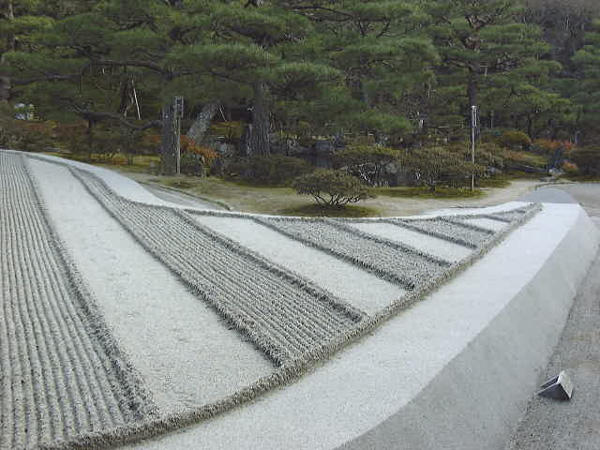
The most famous is maybe the karaesanisui garden (dry garden) called Ginshaden or the Sea of Silver Sand. The "garden" consists of a 2 foot platform of sand that covers 0.71 hectares (1.75 acres) that is meant to be viewed as a sea, though the lines are far too straight and perfect to create such a clear illusion. Despite this, it is truly a wonderful sight that you can lose yourself in.

http://www.yamasa.org/japan/english/destinations/kyoto/ginkakuji.html

Though amazing at any time of the day, the best view of the garden is said to be at night with a full moon shining on the sand, making it truly resemble a calm, peaceful, silver sea.

Next to the sea of sand you can see a cone shaped structure rising 2 meters into the air. This is called the Kogetsudai, or Moon-viewing Platform. There are several theories about this mountain shaped creation. Some believe it is meant to resemble Mount Fuji, while others say it was designed as a simple mound of sand used to replenish the walkways.

Still others say that the cones of this type (they are located in other temples in Japan) are meant to reflect divine light into the hearts of the visitors. No matter what the true purpose is, the Kogetsudai illuminates the Silver Pavilion on moonlight nights, making for a magnificent sight. In addition, it is said that from above the Silver Pavilion the Kogetsudai upon the Ginshaden resembles the silvery full moon reflected in a deep lake.

In the park, there is also a moon watching fountain (Sengetsu-sei).


The Moon Cleansing Spring
http://www.orientalarchitecture.com/kyoto/ginkakujiindex.htm


The whole compound is layed out as a tribute to the moon. It was a place for moon gazing, tea drinking, painting in black and white, arranging flowers, composing poems and enjoying traditional theater.

.. .. ..

Ashikaga Yoshimasa was a cultural person. He had a great talent at arts such as the appreciation of picture and flower arrangement and Waka (old Japanese song. In other word, classical Japanese short poem).
He made a base of Muromachi-bunka (culture), and built Ginkakuji as a symbol of Muromachi culture. After he retired from the post of Shogun, he lived at Ginkakuji Temple, and enjoyed his last life there.

Read a lot more by Hosoya, K. here:
http://muse2.doshisha.ac.jp/kkitao/library/student/97/essay/308/13-4.htm


Kobori Enshuu about a garden layout:

A cluster of summer trees,
A bit of the sea,
A pale evening moon.


:::::::::::::::::::::::::::::::::::::::::::::::::::::::::::::::::::::::::::::::::::::::::::::::::::::

References used for this text:

Ginkakuji 銀閣寺 by Declan Murphy
Shogun Ashikaga Yoshimasa / The Yamasa Institute


A great page of photos:
http://www.orientalarchitecture.com/kyoto/ginkakujiindex.htm

Spirituality and Cosmology in Asian Architecture
The waterfall thirty meters to the east of Ginkakuji, called "the moon-washing falls," can be heard from inside the pavilion.
http://fog.ccsf.edu/~jcarpent/asian_architecture_gardens.htm

:::::::::::::::::::::::::::::::::::::::::::::::::::::::::::::::::::::::::::::::::::::::::::::::::::::

Tea Ceremony and the Moon

Shuko once said that, more than a full moon shining brightly on a clear night, he would prefer to see a moon that was partially hidden by clouds.

Urasenke School of Tea
http://www.urasenke.or.jp/texte/chado/chado2.html

The Book of Tea by Kakuzo Okakura
http://www.integrativespirituality.org/postnuke/html/static-docs_Books-buddhism-tea.htm


*****************************

Back to the Daruma Forum
WHC World Kigo Database

7/08/2005

500 Arhats (gohyaku rakan)

[ . BACK to DARUMA MUSEUM TOP . ]
::::::::::::::::::::::::::::::::::::::::::::::::::::::::::::::::::::::::::::::::::::::::::::::::::::: 

Fivehundred Arhats - Gohyaku Rakan 五百羅漢

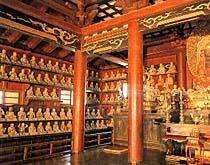
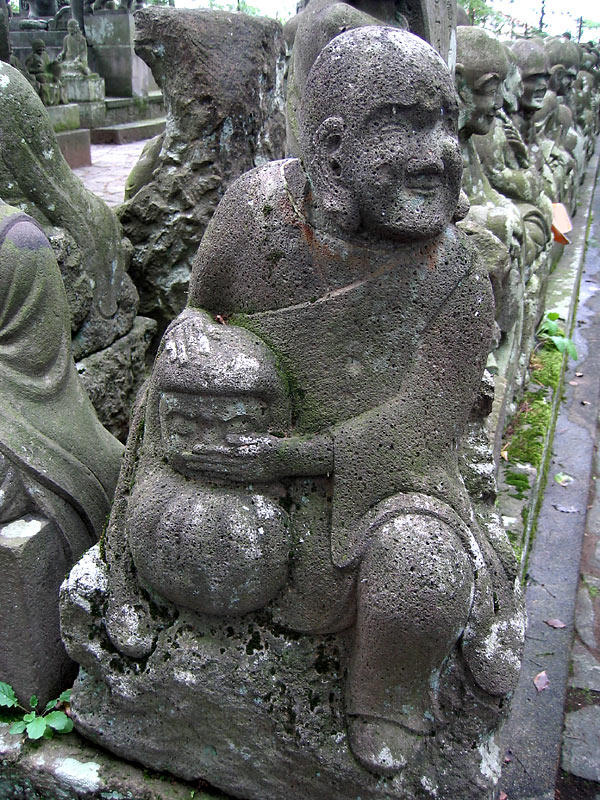
This is a group of 500 statues, sometimes more, of the disciples of the Buddha.
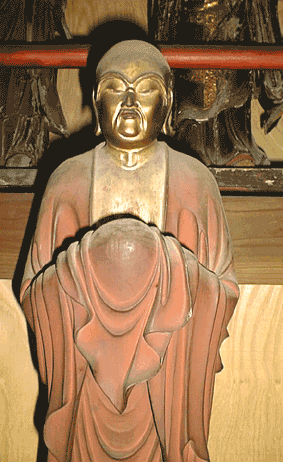
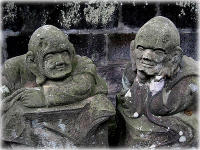
They are usually shown in very human poses, with very individual faces and expressions.
Many temples are famous for the collection of all these statues.
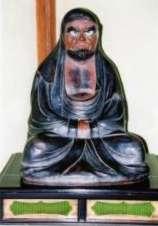
And we will even find our Daruma san amongst them.

During the Edo period there were many fires in the town and many people lost their lives. Some local lords had a temple with 500 statues erected in their district, so that the relatives could go there and find a face resembling the lost person, pray for it there and perform the proper rites.

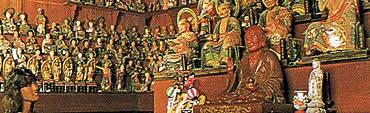
My favorites were two temples in Meguro, one with stone statues outside and one with wooden statues in a huge hall.

I will introduce some of these temples here.

The group was already famous in China, but for different reasons.
Read this story at JAANUS:
http://www.aisf.or.jp/~jaanus/deta/g/gohyakurakan.htm


Mark Schumacher has a lot of information, so I have not much to add to this:
Arakan (Rakan)

:::::::::::::::::::::::::::::::::::::::::::::::::::::::::::::::::::::::::::::::::::::::::::::::::::::

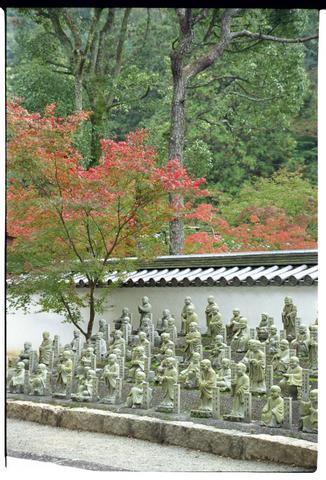
Here is a group in autumn splender, in Hiroshima prefecture, where I visited in 2004.
Read more about Buttsuu-Ji here:


三原の佛通寺と三原だるま
http://darumadollmuseum.blogspot.com/2004/11/mihara-daruma.html

:::::::::::::::::::::::::::::::::::::::::::::::::::::::::::::::::::::::::::::::::::::::::::::::::::::

Meguro Temple Rakan-Ji 目黒の羅漢寺
There are strict rules as not to take pictures. The two links will show you some aspects.


http://www.rakan.or.jp/
http://www.rakan.or.jp/kaikan/kaikan.html
.. .. .. English
http://www.rakan.or.jp/english/aramashi/aramashi1.html
Copyright(C) Rakanji 1999-2003.

An article about this temple, with instructions of how to go there.
Wander where the wise ones wink
By SUMIKO ENBUTSU

:::::::::::::::::::::::::::::::::::::::::::::::::::::::::::::::::::::::::::::::::::::::::::::::::::::

Rakanji Temple, Omori Town
A donation of the 22nd local administrator, Sekichu Dayu, the temple took 22 years to complete, finally opening in 1776.
Local administrators at the silver mine, government officials, general citizens.There are the names of people from the inner palace of Edo Castle and the those related to the Tayasu Family, the younger brother of the 9th Tokugawa shogun.
http://www.iwamigin.jp/ginshin/ginshin/e/ginzan/500rakan.html

:::::::::::::::::::::::::::::::::::::::::::::::::::::::::::::::::::::::::::::::::::::::::::::::::::::

Near Iwami Ginzan, Yunotsu hot spring

Rakan Temple, known for its 500 rakan statues, is located just outside the Iwami Silver Mine town. Cross the arched stone bridge and look into the stone cave, where 500 rakan richly expressive images are lined up. The 501 (the actual number) statues expressing people's emotions were made in the middle of the 18th century, a project taking some 20 years. "Sanbyakusui", the great water that gushes out of the stone cave, is also well-known.
http://www.iwamigin.jp/ginshin/ginshin/e/reg/r_ssr03.htm

:::::::::::::::::::::::::::::::::::::::::::::::::::::::::::::::::::::::::::::::::::::::::::::::::::::

Gyokuryuu-In, Takahata


In the Edo Era the monk Ryoo-in (Ryoin) brought from Kyoto via the Japan Sea and Sakata the 500 statues of Rakan (Arhat) that are now enshrined in Gyokuryu-in (Gyokuryu Monastery) in Takahata. It's said that each statue has a different expression.
http://www4.ocn.ne.jp/~yuko2000/okitama-r/takahata/sh/gohyaku.html

:::::::::::::::::::::::::::::::::::::::::::::::::::::::::::::::::::::::::::::::::::::::::::::::::::::::::::::::::::::::::::


source : marippe3.exblog.j

even in stone, for an eternal drink !

. Sake 酒 for rituals and festivals .

. . . CLICK here for Photos of rakan drinking sake !

:::::::::::::::::::::::::::::::::::::::::::::::::::::::::::::::::::::::::::::::::::::::::::::::::::::::::::::::::::::::::::


source : Japan Times

Rahula Rakora sonja from Fan Daosheng


- quote -
Rāhula (born c. 534 BC) was the only son of Siddhartha Gautama (Pāli Siddhattha Gotama), later known as the Buddha, and his wife Princess Yasodharā.
- - - More in the WIKIPEDIA !

:::::::::::::::::::::::::::::::::::::::::::::::::::::::::::::::::::::::::::::::::::::::::::::::::::::::::::::::::::::::::::

The 500 Buddhas of Rakan Temple in Otaru

Not nearly as famous as the Great Buddha of Kamakura or the treasures of Horyuji, but every bit as beautiful are the 500 Buddhas of Rakan Temple in Otaru. You can spend hours admiring the craftsmanship, grace, and humour exhibited in these incredible works of art. Carved in the 1800's by a priest in the Tsugaru region of Aomori in Northern Japan, these are probably the only Buddhist sculptures you will ever see that exhibit a sense of humour.

Some of the sculptures look like space aliens straight out of Star Trek while other look like stereotypical Oyaji (middle-aged men), who are much ridiculed in Japan for their bad manners and bourgeois lifestyles.

The word rakan means disciple of Buddha and these statues represent the 500 followers of Shaka, the Japanese word for the historical Buddha. The statues were carved in Aomori, and were in Morioka (Iwate) and Matsumae (near Hakodate) before coming to Otaru in 1909.

There is an interesting story behind the 500 Rakan Butsuzo.
According to local legend, in 1825 there was a young priest who, despite his age was very much respected by the people of a small Tsugaru village. On New Year's Day, he told the villagers that during the snow melt of that year, a stranger would come from Matsumae and request that he make 500 sculptures of the Rakan. He asked the villagers to go up to the mountains to cut wood in preparation and the villagers complied with his request. Because the trees were so heavy however, the villagers were unable to pull the heavy sledges and request the priest's help.

He came up to the mountain, recited a mantra, and miraculously, the heavy sledges began to move. That spring, the snow melted and, as the priest had predicted, a stranger came from Matsumae and commissioned the priest to make 500 the sculptures.

During the priest's long labours, the villagers took care of the priest, and were amazed by the astonishingly lifelike expressions on the faces of his carvings. Unfortunately, after having completed just 308 statues, the wood ran out and the priest went away. The other statues were completed at a later date.
http://www3.tky.3web.ne.jp/~edjacob/rakan.htm

:::::::::::::::::::::::::::::::::::::::::::::::::::::::::::::::::::::::::::::::::::::::::::::::::::::

Morioka and the Temple with 500 Rakan


報恩寺には、京都の仏師が造ったという木彫、漆塗の羅漢が500体納められています。なかにはマルコ・ポーロやフビライ像が見られます。
http://www2.city.morioka.iwate.jp/02kikaku/kokusai/ja/j_attractions.html

Wooden statues with laquer finish.
http://www.otarucci.jp/kankou/bunka/bunkazai/bunka006.html


:::::::::::::::::::::::::::::::::::::::::::::::::::::::::::::::::::::::::::::::::::::::::::::::::::::

Odawara, Gohyaku Rakan-Ji 玉宝寺 の五百羅漢


I visited there often. In the compounds was a statue of Daruma san made of stone, with a special face. I now have a laquer statue of Daruma san which has exactly the same kind of face、as you can see above.


Look at some more here:
http://www.pp.iij4u.or.jp/~jorbkato/rakan1.htm


玉宝寺 五百羅漢を安置する寺として知られ多くの人々は寺名を呼ばないで、多古の五百羅漢という。像は木彫りで立像のものは像長36~60、座像のものは20センチ余である。造立の始まりは享保15年(1730)で、檀家添田氏の夢枕に隣村塚原の地蔵尊が立って造立を勧めたとも、また添田氏がある時秋の洪水で大きな流木を拾おうとすると大蛇であったので殺した処、夜間に無数の小蛇に襲われた夢を見て、一念発起したともいわれる。添田兄弟のうち兄は、僧籍に入り智鉄沙弥となり七年勧進し170体を造ったが、中途で病没したので弟り真澄が後をつぎ宝暦7年(1757)に完成し、寺に安置したという。
http://www.asahi-net.or.jp/~ma6t-nsd/kanagawa/20030302.html


:::::::::::::::::::::::::::::::::::::::::::::::::::::::::::::::::::::::::::::::::::::::::::::::::::::

At the Temple Kita-In 喜多院の五百羅漢さん


source - Nobuyuki Kawamura 2003

Here is a map of their location within the temple. The shelfs are marked from a to z.
You can click on the shelfs and then on the indivitual thubnails to see them all!
On shelf l is one asleep.
- kawamura rakan

Groups of the Rakan
五百羅漢 団体写真

This one looks like Daruma san himself


- source - kawamura -

There is one Rakan trying to keep the mouth of Daruma shut
with his hand.


- source - kawamura -

だるまの口をおさえている羅漢がいる
これはまさに庶民の知恵だ。庶民はいささかおしゃべりが好きである。そしておしゃべりは、しばしば禍いを生むのである。この男も、いささか口が軽いのである。口の軽い彼は懸命にダルマの口をおさえて、無言を自らにいい聞かせるのである。口は禍いのもと、ご注意、ご注意という声が、この石像から聞こえてきそうである。
source - kita-in

:::::::::::::::::::::::::::::::::::::::::::::::::::::::::::::::::::::::::::::::::::::::::::::::::::::

five hundred friends,
waiting to touch me -
autumn deepens


Thinking of Meguro, see above, 2005

... ... ...

fivehundred friends
for eternity -
autumn draws near


2004

... ... ...

taking a nap
in the summer breeze -
his heavy head


Mittagsschlaf
in der Sommerbriese -
sein Kopf sooo schwer

My Haiku Gallery

::::::::::::::::::::::::::::::::::::::::::::::::::::::::::::::::::::::::::::::::::::::::::::::::::::: 
::::::::::::::::::::::::::::::::::::::::::::::::::::::::::::::::::::::::::::::::::::::::::::::::::::: 


Arhats (Rakan)

Als direkte Schüler des Shakyamuni sollen die Arhats übernatürliche Kräfte besitzen, um ihr Leben zu verlängern, damit sie anderen helfen können, die Erleuchtung zu erlangen. Sie werden besonders von der Tendai- und der Zen-Sekte verehrt.

Arhats haben zwar die Erleuchtung, aber sie haben keine Gelübde zur Erlösung aller Menschen abgelegt, daher stehen sie unter den Bosatsu.

Meist in Gruppen zu 16 (Juuroku Rakan) oder 500 (Gohyaku Rakan). Bei 500 Figuren sind alle verschieden und jeder Mensch findet bestimmt ein Gesicht, das einem Verstorbenen entspricht. In der Stadt Edo stiftete die Regierung nach einem großen Brand einen Tempel mit 500 Rakan-Figuren (z.B. Tempel Daionji in Meguroo, Tookyoo), weil bei einem Feuer so viele Menschen verbrannten und nicht identifiziert werden konnten. Da sie also kein indi~vidu~elles Grab hatten, konnten die Angehörigen wenigstens an so einem Tempel nach dem Gesicht des Verstorbenen suchen und dort ihre Totenrituale verrichten.

Es gibt zwei Arten von Arhat-Portraits, die von China nach Japan kamen:

1. Arhats in der Kleidung von chinesischen Laien, im Stil des Ri Ryuumin (Li Long-mian).
2. Arhats mit grotesken Formen, im Stil des chinesischen Zen-Priesters Zengetsu (Chan-yue).

Es gibt auch alte Bilder japanischer Art, z.B. die Wandgemälde der dreistöckigen Pagode des Tempels Jooruriji in Kyooto.
16 Statuen dieser Arhats befinden sich oft im zweiten Stock des Eingangstores eines Zentempels.
Bilder der 16 Arhats finden sich in China seit der Sung-Zeit und in Japan seit der Kamakura-Zeit.
Arhats haben meistens kahle Köpfe und tragen einfache Priestergewänder.

Beschreibung der 16 Arhats nach Tanaka (6):

..... 1. Hindoo Rabara Dasha.....
Auch als identisch mit Binzuru angesehen.
Weiße Augenbrauen; faltiger Hals; sitzt in einer Felshöhle und betrachtet die Wellen. Hält in beiden Händen eine Reliquien~pagode, in der sich eine Buddhastatue befindet.

..... 2. Kanaka Bassa.....
Beleibte Figur. Sitzt auf einem Felsen. In der rechten Hand einen Wedel. Neben ihm steht ein Mann aus den Westgebieten Chinas mit gefalteten Händen.

..... 3. Kanaka Hatsuri Dasha.....
Lange schwarze Haare und Augenbrauen. In den Händen einen Rosenkranz. Sitzt auf einem Sitz und betrachtet einen Wasserfall. Neben ihm steht sein Diener, ein Dämon mit drei Augen, der mit beiden Händen ein Schwert hält.

..... 4. Sobinda.....
In der rechten Hand einen Donnerkeil, in der linken eine Glocke. Sitzt auf einem Sitz. Neben ihm steht ein Mann in chinesischer Kleidung mit gefalteten Händen.

..... 5. Nakura.....
Lange weiße Haare und Augenbrauen. In der Hand einen Federwedel. Sitzt auf einem Felsen. Betrachtet Wasservögel. Neben ihm ein Diener mit einem langstieligen Räucherbecken.

..... 6. Baddara.....
Kurzes Haar und lange Augenbrauen. Sitzt auf einem Sitz. Hält einen Rosenkranz in beiden Händen.

..... 7. Karika.....
Sitzt auf einer Kiefernwurzel, das linke Bein nach unten hängend. Rechte Schulter frei. Rechte Hand zur Faust, linke berührt einen Tiger.

..... 8. Bashara Hottara.....
Rechte Schulter frei. Zieht gerade mit aller Macht einem Drachen einen Zahn.

..... 9. Jubakuka.....
Sitzt auf einem Stuhl. Hält einen Wedel. Neben ihm steht eine schöne Frau, die Pfirsische auf einem Tablett trägt.

..... 10. Handaka Sonja 半託迦 .....
Hält eine Räucherbecken in der Hand, leht an einen Wandschirm, betrachtet etwas in der Ferne. Im Hintergrund ein wilde zerklüfteter Fels. Neben ihm ein Diener mit einer Blumenvase mit Lotusblüten.


- source and more photos -


..... 11. Ragora.....
In der Hand einen Rosenkranz. Neben ihm ein Tier. An einen Zweig gelehnt ein Räucherbecken.

..... 12. Nakasaina.....
Sitzt auf einem Sitz, hält eine Sutrarolle in beiden Händen. Neben ihm ein Diener mit einem dampfenden Räucherbecken. Im Hintergrund Bananenblätter.

..... 13. Inkada.....
Sitzt auf einem Felsen. Spielt mit einem Löwenkind. Im Vordergrund Wellen.

..... 14. Banabashi.....
Sitzt auf einer Kiefernwurzel. Stützt sich auf einen langen Stab. Neben ihm ein Kind mit einem Medizinkorb.

..... 15. Ashita.....
Sitzt auf einer Wurzel. In der Hand einen Rosenkranz. An den Baum gelehnt ein Räucherbecken.

..... 16. Chuuda Hantaka.....
Im vollen Meditationssitz auf einem mit Gras bewachsenen Felsen. Um ihn herum wilde Vögel in den Falten seines Gewandes.

.................................................................................

Die 10 Großen Jünger des Shakyamuni
(Juudaideshi 十大弟子)


. . . CLICK here for Photos !

Die 10 wichtigsten Schüler des Shakyamuni. Stehen um die Figur des Shaka Nyorai. Es müssen nicht unbedingt 10 Statuen sein. Sie gehören im weitesten Sinne zu den Arhats.
Mit rasierten Köpfen, im Asketengewand oder im Priestergewand im chinesischen Stil. Mit gefalteten Händen oder mit bestimmten Gegenständen.

..... Ananda (Aananda).....
Erster mit gutem Gedächtnis und Verständ~nis der Lehre, da er sich immer neben Shakyamuni aufhielt und dessen Worte hörte (tamon daiichi). Er diktierte später die Sutras, als sie aufgeschrieben wurden. Es heißt, er sei der Cousin des Shakyamuni. Er sei besonders schön gewesen und habe einige Freundinnen gehabt.

..... Anaritsu, Ananritsu (Aniruddha).....
Erster in Einsicht des Himmelsauges. Da er von seinem Meister gescholten wurde, weil er eingeschlafen war, übte er sich Tag und Nacht, bis er blind wurde. Danach öffnete sich sein "geistiges" Auge.

..... Furuna (Puurna).....
Erster beim Predigen. Ältester der 10 Jünger. Sohn eines reichen indischen Kaufmannes. Japanisches Sprichwort: So sprachgewand wie Furuna (Furuna no ben).

..... Kasennen (Kaatyaayana).....
Erster in der Diskussion über die buddhistische Lehre. Sohn eines reichen Brahmanen in West~indien; wurde im Hirschpark von Shakyamuni bekehrt.

..... Makakashoo, Daisashoo (Mahakasyapa).....
Erster, der sich von Anhaftungen an weltliche Dinge befreit.

..... Mokkenren, Maka Mokukenren (Maudgalyaayana).....
Erster in übernatürlichen Kräften. Er erlöste die eigene Mutter, indem er selbst in die Hölle ging (Urabon-e). Später entstand das Ritual "Segaki" am 16. August, bei dem den hungernden und dürstenden Geistern Essen und Wasser gespendet wird.

..... Ragora (Rahula).....
Erster im esoterischen Buddhismus, nach strenger Askese beherrscht er alle Gebote. Es heißt, er sei als Sohn des Shakyamuni geboren worden, als dieser noch verheiratet in dieser Welt lebte. Ragora verließ wie sein Vater Haus und Familie. Beim Tod des Shakyamuni war er nicht anwesend, trug später aber wesentlich zur Aufzeichnung der Schriften bei.

..... Sharihotsu (Sariputra).....
Erster in der Weisheit.

..... Subodai, Shubodai (Subhuuti).....
Erster in Verständnis der Lehre über das NICHTS im Mahayana-Buddhismus. Arroganter Sohn eines Brahmanen, der zum Buddhismus bekehrt wurde.

..... Upari, Ubari (Upali).....
Erster im Beachten religiöser Vorschriften.


. Buddhastatuen ... Who is Who .   
Ein Wegweiser zur Ikonografie
von japanischen Buddhastatuen

Gabi Greve, 1994

Edo, the Hall of Five Hundred Rakan in Honjo 五百羅漢堂 - 本所五ツ目

:::::::::::::::::::::::::::::::::::::::::::::::::::::::::::::::::::::::::::::::::::::::::::::::::::::

. Onipedia - 鬼ペディア - Oni Demons - ABC-List - .


五百羅漢図 500 Arhats and 「六道 地獄」 Rokudo Hell
Kano Kazunobu 狩野一信  (1816 - 1863)

:::::::::::::::::::::::::::::::::::::::::::::::::::::::::::::::::::::::::::::::::::::::::::::::::::::::::::::::::::::::::::

[ . BACK to DARUMA MUSEUM TOP . ]
[ . BACK to WORLDKIGO . TOP . ]
- ##rakan ##arhats -
:::::::::::::::::::::::::::::::::::::::::::::::::::::::::::::::::::::::::::::::::::::::::::::::::::::::::::::::::::::::::::

Hoonen Shoonin

[ . BACK to WORLDKIGO  TOP . ]
::::::::::::::::::::::::::::::::::::::::::::::::::::::::::::::::::::::::::::::::::::::::::::::::::::: 

Saint Hoonen, Hoonen Shoonin, Honen
法然上人 Saint Honen (1133 - 1212)


Founder of Pure Land Buddhism

For kigo about his memorial day see below.

I live very close to the temple where Honen was born,
Tanjo-Ji in Okayama prefecture.


. Temple Tanjo-Ji in Okayama
MORE Information 誕生寺 Tanjooji


:::::::::::::::::::::::::::::::::::::::::::::::::::::::::::::::::::::::::::::::::::::::::::::::::::::

The Life of Honen Shonin


Honen Bo Genku (1133-1212), or simply Honen, is one of the most outstanding figures in the long history of Japanese Buddhism. Along with Dogen, Nichiren and Shinran, his disciple, he represents the core of the revolutionary Kamakura Buddhist movement which created the first popular and uniquely Japanese forms of Buddhism. Though not as noted in the West than these counterparts, Honen is perhaps the most pivotal of the four since he was the first to break with the established centers of Tendai (Ch. T'ien T'ai) and Shingon (tantric) patronized by the royal court and military authorities.

It was at age 43, with a deepening exposure to the Pure Land teachings of the great Chinese Master Shan-tao (Jp. Zendo), that Honen made this radical break to pursue his own spiritual vision. The rest of his life is an unfolding of his own particular and uniquely Japanese vision of Pure Land Buddhism. This second period of his life also marks the blooming of his teachings amongst the peasant classes of medieval Japan and his clashes with imperial and shogunal authority.

From his systematization of a unique Japanese Pure Land tradition, the nembutsu (念仏nenbutsu), or calling on the grace of Amida Buddha, has become the most popular form of Buddhist practice and devotion in Japan. Two of Japan's largest denominations, Jodo-shu (浄土宗 joodoshu) centered around Honen and Jodoshin-shu centered around his disciple Shinran, are further marks of his legacy.

I. A Personal Portrait
Major Biographies of Honen
II. Early Life and Training in Tendai-shu
Social and Religious Turmoil in Late Heian Japan
Syncretic Development of the Tendai School in Japan
Tendai-shu Esoteric and Exoteric Lineages
The Influence of Genshin's Ojoyoshu on Honen
III. Religious Conversion
Textual Evidence in the Biographies
IV. Persecution and Final Days
Kofuku-ji Petition (Kofuku-ji sojo)

A CHRONOLOGY OF HONEN SHONIN
1133 Born on April 7 in Mimasaka in present day Okayama Prefecture
1145 Leaves home to become a monk at the Tendai center of Mt. Hiei
1150 Moves to the Kurodani Retreat area of Mt. Hiei and studies under Eiku
1175 Has conversion experience reading Shan-tao's Commentary on the Meditation Sutra and leaves Mt. Hiei.

1186 "Ohara Debate" with group of Buddhist scholar-monks from Nara and Mt. Hiei marks seminal moment in legitimation and spread of teachings
1191 Gives series of lectures on the Three Pure Land Sutras (jodosanbukyo) to a large group of scholar monks at Todai-ji in Nara
1195 Genchi becomes the first of his major disciples

1198 Honen's magnum opus, the Senchaku Hongan Nembutsu Shu (Passages on the Selection of the Nembutsu in the Original Vow), is dictated and transcribed to his disciples Junsai, Kansai and Shoku.

1198-1206 Experiences sustained states of absorption and spontaneous visualization of the Pure Land which he chronicles in the Sanmai-hottokuki (Record of Attaining Samadhi)
1201 Shinran, the founder of Jodo Shinshu, becomes his disciple

1204 Writes the Shichikajo-kishomon (Seven Article Pledge) in response to the Genkyu Oppression by the monks of Mt. Hiei
1207 Sent into exile to Shikoku by Emperor Gotoba after two of his ladies in waiting are converted and become nuns under Honen's disciples Anraku and Juren who are subsequently beheaded.

1211 Finally is allowed to return to Kyoto four years after his pardon
1212 Writes Ichimai Kishomon (The One Sheet Document) and passes away on January 23 reciting the nembutsu
http://www.jsri.jp/English/Honen/life.html
http://www.jsri.jp/English/Main.html

.. .. .. .. ..

More details about Saint Honen .


The Memorial Statue of the Mother of Saint Honen in Mimasaka.

© Gabi Greve
http://happyhaiku.blogspot.com/2005/04/cherry-blossom-lake.html


Tanjoo-ji 誕生時

The Ceremony of the 25 Bosatsu 二十五菩薩練供養
Third Sunday in April


http://www.town.kumenan.okayama.jp/tanjoji/tanjoji.html


This temple is also famous for its huge Gingko biloba tree (another kigo).

:::::::::::::::::::::::::::::::::::::::::::::::::::::::::::::::::::::::::::::::::::::::::::::::::::::

Memorial Ceremony for Honen, April 18 to April 25

This is a kigo for late spring, category Observance. There are some variations for this kigo.

Gyoki 御忌
Hoonen-ki (Honenki) 法然忌
Enkoo-Ki 円光忌


taking part in the ceremony, gyoki moode 御忌詣で
Temple with a memorial ceremony, gyoki no tera 御忌の寺

loosening the strings of the sutras, kyoo no himotoki 経の紐解き
..... (on the first day of the seven day ceremonies)

special kimono for the gyoki ceremony, gyoki kosode 御忌小袖
..... (worn by the chique ladies of Kyoto for this ceremony)

Ceremony for Hoonen, gyoki-e 御忌会
..... (sometimes on the 25 of January)

First Lunchbox, bentoo hajime 弁当初め > Lunchbox (kigo)
..... (visitors bring their own lunchbox and enjoy it in the temple grounds)


The Gyoki Ceremony at Temple Chion-In, Kyoto

Chio-in is just north of the Yasaka Shrine and Maruyama Park.It is the head temple of the Jodo ("Pure Land") sect of Buddhism. It is one of the most important spritual places in Japan. The Jodo sect is the most popular Buddhist sect in Japan.
The 74-tons temple bell is also the largest in Japan. It takes as many as 17 monks to operate it at the New Year ceremony in which the bell is struck 108 times representing the 108 desires in the mind to be gotten rid of before the new year begins
http://www.op97.org/cyberteen/2004/winter/chionin/


Picture Scroll of his Life at the Chion-In
http://www.chion-in.or.jp/c_00/index.html
http://www.chion-in.or.jp/home.html


:::::::::::::::::::::::::::::::::::::::::::::::::::::::::::::::::::::::::::::::::::::::::::::::::::::

The Gyoki Ceremony at Kita Kogane, with many pictures
http://www.h5.dion.ne.jp/~tadataka/matsuri/gyoki.html


Great photo of the pagoda by Frantisek Staud
http://phototravels.net/japan/pcd1663/pagoda-chion-47.html


Chion-In with many pictures of the compounds.

http://www5e.biglobe.ne.jp/~hidesan/chion-in.htm

:::::::::::::::::::::::::::::::::::::::::::::::::::::::::::::::::::::::::::::::::::::::::::::::::::


分かれても まだ会える 浄土あり

Jodo Paradise -
the place where we meet again
after we part


Gabi Greve, April 2007

::::::::::::::::::::::::::::::::::::::::::::::::::::::::::::::::::::::::::::::::::::::::::::::::::::: 


. Temple Tanjo-Ji in Okayama
MORE Information 誕生寺 Tanjooji


. Tanjo-Ji in Autumn 2007   
The Huge Gingko Tree

autumn deepens -
the beauty of prayer
in stone


. . SPRING FESTIVAL 2008  
Tanjo-Ji Neirkuyo 誕生時 練り供養  


. The Big Buddha of Tanjo-Ji 2009


. O-Shichi Kannon お七観音  


. More of my PHOTOS from Temple Tanjo-Ji
Take the Slide Show !

:::::::::::::::::::::::::::::::::::::::::::::::::::::::::::::::::::::::::::::::::::::::::::::::::::::

quote
"Honen and Shinran:
Treasures Related to the Great Masters of the Kamakura Buddhism"

HEISEIKAN, TOKYO NATIONAL MUSEUM


This year sees the 800th grand memorial of Honen and the 750th of Shinran, two of the most important figures in Kamakura Buddhism.
source : Japan Times, October 2011

.......................................................................


Traversing the Pure Land Path:
A Lifetime of Encounters with Honen Shonin

Edited by Jonathan Watts and Yoshiharu Tomatsu

In establishing his own Pure Land Buddhist community in 1175, Honen (1133-1212) initiated the great Japanese Kamakura Buddhist reformation in which the great teachers Shinran, Dogen and Nichiren subsequently followed. Drawn from The Forty-Eight Fascicle Biography of Honen Shonin written around 1313, this volume chronicles the lives of the many different kinds of people whom Honen taught to find release from suffering and Birth (ojo) in the Pure Land “just as you are”. Significant new editions of Honen’s own words clarify the various interpretations that his followers took of his teachings. Also, numerous, short information boxes offer background into the history and teachings of Pure Land Buddhism.
- source : jsri.jp/English/Raft -

::::::::::::::::::::::::::::::::::::::::::::::::::::::::::::::::::::::::::::::::::::::::::::::::::::: 

[ . BACK to WORLDKIGO  TOP . ]
[ . BACK to DARUMA MUSEUM TOP . ]

:::::::::::::::::::::::::::::::::::::::::::::::::::::::::::::::::::::::::::::::::::::::::::::::::::::