Showing posts with label culture. Show all posts

4/28/2014

pokkuri Daishi

[ . BACK to DARUMA MUSEUM TOP . ]
::::::::::::::::::::::::::::::::::::::::::::::::::::::::::::::::::::::::::::::::::::::::::::::::::::::: 

pokkuri Daishi ポックリ大師 / ぽっくり大師
Kobo Daishi granting sudden death


- Read the introduction of the famous Tendai priest here :
. Kobo Daishi, Kukai 弘法大師 空海 .
(774-835)


pokkuri  ぽっくり / ポックリ to pray for a sudden death,
"drop dead" - "pop off"


".. old people want to die without suffering from long-term illness so that their family members would not have to provide care for them such as helping them to the toilet and changing diapers."
. pokkuri  ぽっくり amulets for a sudden death, .  


:::::::::::::::::::::::::::::::::::::::::::::::::::::::::::::::::::::::::::::::::::::::::::::::::::::::


Fukusenji 福泉寺 Fukusen-Ji
横浜市緑区長津田3113, Yokohama

Temple Nr. 65 of the Henro Pilgrimage of Bando (Kanto region)
関東88ヵ所霊場の第65番札所

The chant of the temple is
けさみれば つゆふくせんじ にわのこけ 
さながらるりの ひかりなりけり
- source : www.kanto88.net

This temple had been patronized by Tokugawa Ieyasu.


source : home.r07.itscom.net/hajime-k

pokuri 保久利 pokkuri - to drop dead
pokkuri Daishi ぽっくり大師


People pray first to Kannon to prevent senility, next to a statue of Yakushi Nyorai to grant general health and then to Kobo Daishi himself to help them "drop dead" in good health.
So at this temple, people pray three times

pin pin korori PPK(ピンピンコロリ)
ぴんぴん元気に長生きし、ころりと大往生
for health, health and sudden death

pinpin ピンピン means genki, good health.


Before the statue of Kobo Daishi is also some sacred sand from the Henro temple in Shikoku

. o-sunafumi, osunafumi お砂踏み
stepping on sacred sand .


- - - -

There is a Jizo to take away warts in the compound.
. ibotori Jizoo イボ取り地蔵尊 .


- Homepage of the temple
- source : www.fukusenji.jp


- - - - -


The Kannon to prevent senility
bokefuuji Kannon ぼけ封じ観音

. Boke yoke, boke-yoke ボケ除け - ぼけ除け not to become senile .
- bokefuuji ボケ封じ boke

:::::::::::::::::::::::::::::::::::::::::::::::::::::::::::::::::::::::::::::::::::::::::::::::::::::::


Hassaki Daishi Doo 泊崎大師堂 Hassaki Daishi Hall
Tsukuba town, Hassaki village つくば市泊崎(旧稲敷郡茎崎町)


The Daishi Hall is on hill, overlooking the swamp Ushiku numa 牛久沼.

The temple was famous for enmusubi 縁結び finding a good partner and praying 長寿 long life, but now is more famous for its pokkuri visitors.


Kukai visited here around 808 and performed fire rituals to appease the local deities.
In the compounds are even the nana fushigi 弘法の七不思議 seven wonders about Kobo Daishi:

一、koma no ashi-ato 駒の足跡 footprints of the horse he came
一、boke  木瓜 quince bush by the roadside did not bring fruit after Kukai had passed
一、sakamatsu, saka matsu 逆松 "upside-down pine" grew from his pine walking stick
一、suzuri mizu 硯水 water for grinding Chinese ink, to become skilfull at calligraphy
一、dokkofuji, dokko fuji 独鈷藤 wisteria looking like his dokko single-pronged vajra
一、goyoo sugi 五葉の杉 pine tree with five needles each
一、nokkoshi 法越 Kukai jumped over the river on horseback


- reference : www5b.biglobe.ne.jp/~miur

:::::::::::::::::::::::::::::::::::::::::::::::::::::::::::::::::::::::::::::::::::::::::::::::::::::::

Arakuma Jinja 荒熊神社
ぽっくり弘法大師の社 pokkuri Kobo Daishi Shrine
愛知県知多郡南知多町山海高座10番地, Aichi, Southern Chita city


Once upon a time there was a cloth merchant in Oodakachoo 大高町 in Nagoya, named Tsu no Kuniya 津の国屋. The grandmother of this store was an ardent believer in Kobo Daishi and prayed to him every day. When she felt her final day come closer she took Kobo Daishi (?his statue) by the arm, went to this shrine and asked for an amulet. Then she went home and passed on happily.

Now there are three statues of Kobo Daishi in the shrine compound
三体の弘法大師.


- Deities in residence

Arakuma Ookami 荒熊大神(あらくまおおかみ) Arakuma Okami
Kumataka Ookami 熊鷹大神(くまたか) Kumataka Okami
Chooju Aizuchi no Mikoto 長者合槌命(ちょうじゃあいづちのみこと) Choju Aizuchi no Mikoto

Arakuma Okami is also a protector of the health and people pray to get healthy soon.

- Homepage of the shrine
- source : www12.plala.or.jp/arakuma


source : park3.wakwak.com/~kyotosakkon
Arakuma Okami at a shrine in Kokyo 東山区、東三條社
Daishoogun Jinja 大将軍神社


. konya 紺屋 and aizome 藍染 deity .

......................................................................
愛知県 Aichi 南知多町 Minami Chita

arakuma no ookami 荒熊の大神 The Deity Arakuma
Once the dyer 大西 Onishi tried many times to make some 藍染 indigo dye but just did not hit it right. So he prayed to the deity 荒熊大神 for help. And indeed, the deity let him know how to prepare just the right indigo color. He could now make wonderful Yukata cloth and his reputation grew far and wide.

Arakuma Shrine in Chita 荒熊神社
- source : japannavi.co.jp/chita-


:::::::::::::::::::::::::::::::::::::::::::::::::::::::::::::::::::::::::::::::::::::::::::::::::::::::

. pokkuri  ぽっくり amulets for a sudden death .  


. Festivals, Ceremonies, Rituals - SAIJIKI .


[ . BACK to WORLDKIGO  TOP . ]
[ . BACK to DARUMA MUSEUM TOP . ]
:::::::::::::::::::::::::::::::::::::::::::::::::::::::::::::::::::::::::::::::::::::::::::::::::::::::

1/28/2013

Ama - Buddhist Nun

[ . BACK to DARUMA MUSEUM TOP . ]
. bikuni densetsu 比丘尼 伝説 Legends about Buddhist nuns .
::::::::::::::::::::::::::::::::::::::::::::::::::::::::::::::::::::::::::::::::::::::::::::::::::::: 

ama 尼 / bikuni 比丘尼 (びくに) Buddhist nun

"human fish" 人魚 (ningyo) - see below
::::::::::::::::::::::::::::::::::::::::::::::::::::::::::::::::::::::::::::::::::::::::::::::::::::: 

quote
The First Buddhist Nuns
Pajapati's Story

The historical Buddha's most famous statements on women came about when his stepmother and aunt, Maha Pajapati Gotami, asked to join the Sangha and become a nun. The Buddha initially refused her request. Eventually he relented, but in doing so he made conditions and a prediction that remain controversial to this day.

Pajapati was the sister of the Buddha's mother, Maya, who had died a few days after his birth. Maya and Pajapati were both married to his father, King Suddhodana, and after Maya's death Pajapati nursed and raised her sister's son.

Pajapati approached her stepson and asked to be received into the Sangha. The Buddha said no. Still determined, Pajapati and 500 women followers cut off their hair, dressed themselves in patched monk's robes, and set out on foot to follow the traveling Buddha.


When Pajapati and her followers caught up to the Buddha, they were exhausted. Ananda, the Buddha's cousin and most devoted attendant, found Pajapati in tears, dirty, her feet swollen. "Lady, why are you crying like this?" he asked.

She replied to Ananda that she wished to enter the Sangha and receive ordination, but the Buddha had refused her. Ananda promised to speak to the Buddha on her behalf.
- snip -
A Bhikkuni (nun) even if she was in the Order for 100 years must respect a Bhikkhu (monk) even of a day's standing.
source : buddhism.about.com


- Reference -

:::::::::::::::::::::::::::::::::::::::::::::::::::::::::::::::::::::::::::::::::::::::::::::::::::::::


Many Japanese noble women took the tonsure and lived in a monastery after their husband had died.

Many haiku poetesses are known as -ama, -ni 尼

. WKD : Japanese Haiku Poets .

amadera 尼寺 nunnery (for Buddhist nuns)

. Japan - Shrines and Temples .

quote
Shōkozan Tōkei-ji (松岡山 東慶寺), Tokei-Ji
also known as Kakekomi-dera (駆け込み寺) or Enkiri-dera (縁切り寺)),
is a Buddhist temple and a former nunnery, the only survivor of a network of five nunneries called Amagozan (尼五山), in the city of Kamakura in Kanagawa Prefecture, Japan. It is part of the Rinzai school of Zen's Engaku-ji branch, and was opened by Hōjō Sadatoki in 1285. It is best known as a historic refuge for women who were abused by their husbands.
It is for this reason sometimes referred to as the "Divorce Temple".


The temple was founded in the 8th year of Koan (1285) by nun Kakusan-ni, wife of Hōjō Tokimune (1251-1284), after her husband's death. Because it was then customary for a wife to become a nun after her husband's death, she decided to open the temple and dedicate it to the memory of her husband. She also made it a refuge for battered wives.

In an age when men could easily divorce their wives but wives had great difficulty divorcing their husbands, Tōkei-ji allowed women to become officially divorced after staying there for three years. Temple records show that, during the Tokugawa period alone, an estimated 2,000 women sought shelter there. The temple lost its right to concede divorce in 1873, when a new law was approved and the Court of Justice started to handle the cases.

The temple remained a nunnery for over 600 years and men could not enter until 1902, when a man took the post of abbot and Tōkei-ji came under the supervision of Engaku-ji. Before then, the chief nun was always an important figure, and once it even was a daughter of Emperor Go-Daigo. Tenshū-ni, the daughter and only survivor of Toyotomi Hideyori's family, son of Hideyoshi, entered Tōkei-ji following the Siege of Osaka. Such was the nunnery's prestige that its couriers did not need to prostrate themselves when they met a Daimyo's procession.
© More in the WIKIPEDIA !


::::::::::::::::::::::::::::::::::::::::::::::::::::::::::::::::::::::::::::::::::::::::::::::::::::: 


quote
Rewriting Medieval Japanese Women:
Politics, Personality, and Literary Production in the
Life of Nun Abutsu 阿仏尼  (1225–1283).

Abutsu crossed gender and genre barriers by writing the first career guide for Japanese noblewomen, the first female-authored poetry treatise, and the first poetic travelogue by a woman—all despite the increasingly limited social mobility for women during the Kamakura era (1185–1336). Capitalizing on her literary talent and political prowess, Abutsu rose from middling origins and single-motherhood to a prestigious marriage and membership in an esteemed literary lineage.

Abutsu’s life is well documented in her own letters, diaries, and commentaries, as well as in critiques written by rivals, records of poetry events, and legal documents. Drawing on these and other literary and historiographical sources, including The Tale of Genji, author Christina Laffin demonstrates how medieval women responded to institutional changes that transformed their lives as court attendants, wives, and nuns. Despite increased professionalization of the arts, competition over sources of patronage, and rivaling claims to literary expertise, Abutsu proved her poetic capabilities through her work and often used patriarchal ideals of femininity to lay claim to political and literary authority.

Christina Laffin
source : www.uhpress.hawaii.edu


::::::::::::::::::::::::::::::::::::::::::::::::::::::::::::::::::::::::::::::::::::::::::::::::::::: 


The famous Taima mandala was made by the Buddhist Nun
Chuujoo hime、中将姫 Princess Chujo、Princess Chûjô

. Taima Mandala 当麻曼荼羅  .

::::::::::::::::::::::::::::::::::::::::::::::::::::::::::::::::::::::::::::::::::::::::::::::::::::: 


source : kuwappa.livedoor.biz

heoi bikuni, he-oi bikuni 屁負比く尼 / 屁負比丘尼 / 屁負比丘
fart-pretending nuns

Girls in nun's robes walking behind the daughter of a rich merchant, pretending they did it.
Farting was rather common in Edo, with a lot of beans and sweet potatoes consumed on a daily basis.


. chin shoobai 珍商売 strange business in Edo .

.......................................................................


bikuni 比丘尼 prostitutes clad as nuns in Edo


source : sakamichi.tokyo
from the Bikunizaka 比丘尼坂 Bikuni slope in Shinjuku, Edo

They walked the streets, clad as niso 尼僧 nuns. Thus it was easy for them to be called inside to perform their trade in the back room of a rich businessman, officially doing some prayer service.
Some lived together in cheap lodgings called
- bikuni yado 比丘尼宿

Some were put on boats along the river Fukagawa for their duties, called
funabikuni 船比丘尼

uta bikuni 歌比丘尼 singing nun
begging for a living (and performing other kinds of service)


In 1743, it is said there were more than 5800 woman of this trade in Edo.

. fuuzoku, fûzoku 風俗
Fuzoku, entertainment and sex business in Edo .


::::::::::::::::::::::::::::::::::::::::::::::::::::::::::::::::::::::::::::::::::::::::::::::::::::: 


Kumano bikuni 熊野比丘尼 nun from Kumano


::::::::::::::::::::::::::::::::::::::::::::::::::::::::::::::::::::::::::::::::::::::::::::::::::::: 


sennen bikuni 千年比丘尼 a young nun for 1000 years
never growing old, because once she ate the meat of a "human-fish"


The "human fish" 人魚 (ningyo) is most probably a Dugong.
Whoever eats its meat will live for 1000 years without changing his/her features.
- source : Dugong dugon -

A young woman eats a piece of fish found in the left-overs of her father, a fisherman.
When she learns about the fact that it was a "human fish" she decides to become a nun to atone for her deed. And then . . .

There are many legends about her in many parts of Japan, after all she lived for 1000 years with the features of a beautiful woman. When she stayed at a temple for a while, people became suspicious of her never-changing beautiful features and eventually she had to leave for another place. Often she planted a walking stick in the temple compound before leaving, which sprouted to live on . . .


Yashima Kameyama 八島亀山 in Okayama 岡山
After the young woman had left her birthplace . . there was a young man from Kameyama, who visited the temple 善光寺 Zenko-Ji in Nagano, where he saw a beautiful nun in the temple and told her about Kameyama、so she became quite homesick. When he went back and told the story to the fishermen in Kameyama they went to the back of Mount Boyama 坊山 and found the remains of her old small temple. There was also an old tree, byakushin ビャクシン / 柏槙 (a kind of mountain juniper) to our day, which had sprouted from her walking stick.
This tree was then found to have a disease infecting the Japanese pear trees nearby and was cut down eventually.

In Asakuchi 浅口, Okayama in the hamlet of 貞見 Sadami
there is another tree that has sprouted from her walking stick. It has sprouted, as she had foretold, "tsue wa ikitsuku made" 杖は活き着くまで. . . and now there is another hamlet with a pun on that nearby :
Tsukuma 津熊 .
The tree that sprouted from her stick was a huge yanagi 大柳 willow tree.
It was so strong and perfect that the tree was cut down and its trunck became a beam for the famous 三十三間堂, 京都 Hall of 1000 Buddha Statues in Kyoto, Sanjusan Gendo.

. Legends about the roof beams for 三十三間堂 Sanjusan Gendo .

.......................................................................

Yao Bikuni 八百比丘尼(やおびくに)

- quote -
One of the most famous folk stories concerning ningyo is called
Yao Bikuni (八百比丘尼, "eight-hundred (years) Buddhist priestess") or
Happyaku Bikuni.
The story tells how a fisherman who lived in Wakasa Province once caught an unusual fish. In all his years fishing, he had never seen anything like it, so he invited his friends over to sample its meat.

One of the guests, however, peeked into the kitchen, noticed that the head of this fish had a human face, and warned the others not to eat it. So when the fisherman finished cooking and offered his guests the ningyo's grilled flesh, they secretly wrapped it in paper and hid it on their persons so that it could be discarded on the way home.

But one man, drunk on sake, forgot to throw the strange fish away. This man had a little daughter, who demanded a present when her father arrived home, and he carelessly gave her the fish. Coming to his senses, the father tried to stop her from eating it, fearing she would be poisoned, but he was too late and she finished it all. But as nothing particularly bad seemed to happen to the girl afterwards, the man did not worry about it for long.

Years passed, and the girl grew up and was married. But after that she did not age any more; she kept the same youthful appearance while her husband grew old and died. After many years of perpetual youth and being widowed again and again, the woman became a nun and wandered through various countries. Finally she returned to her hometown in Wakasa, where she ended her life at an age of 800 years.


Ningyo (人魚, "human fish", often translated as "mermaid")
is a fish-like creature from Japanese folklore.
Anciently, it was described with a monkey’s mouth with small teeth like a fish’s, shining golden scales, and a quiet voice like a skylark or a flute. Its flesh is pleasant-tasting, and anyone who eats it will attain remarkable longevity. However, catching a ningyo was believed to bring storms and misfortune, so fishermen who caught these creatures were said to throw them back into the sea. A ningyo washed onto the beach was an omen of war or calamity.
..... Fishmen 魚人 Gyojin
- More about ningyo Ningyo (人魚) "human fish" :
- source : wikipedia -


Yao Bikuni 八百比丘尼(やおびくに)
金川寺 Kinsen-Ji in Fukushima -
喜多方市塩川町金橋字金川
- source : bqspot.com/tohoku/fukushima -


荒海に人魚浮きけり寒の月
ara-umi ni ningyo uki-keri kan no tsuki

in the wild sea
there floats a human fish -
cold moon


Matsukoa Seira 松岡青蘿 (1740 - 1791)


...................................


Shiira bikuni シイラ比丘尼 The Nun Shiira


.......................................................................
Iwate, 釜石 Kamaishi - and Miyagi 南三陸町 Minami Sanriku

One day a fisherman went fishing near Hiraizumi, when a strange old man living in a cave gave him a strange red fish to eat.
His companion 五郎三郎 Gorosaburo did not eat the fish meat but took it home with him and told everyone not to eat it. His young daughter of 6 years named シイラ Shiira was so tempted to eat this meat, she did not listen to her father's warning and ate it.
After this Shiira never died and lived as a nun for at least 200 years. Now nobody knows where she is.
The old man is said to have been 海尊仙人 Kaison Sennin.

After the death of 平泉の秀衡 Lord Hidehira in Hiraizumi, his retainer Gorosaburo took his life to follow his master, as was the custom of the times.
The wife of Gorosaburo took their young daughter Shiira and hid at 本吉郡の竹島 Takeshima Island in the Motoyoshi district.
The Heavenly Nymph at the Cave of the same name at Takeshima island 竹島の天女洞 refers to the girl Shiira, who lived more than 250 years, always looking like a woman in her forties.


Togura 戸倉 - Takeshima 竹島
Different from the other islands in the inlay, this island is of a soft white rock.

shiira 鱰/鱪 / シイラ is the name of the common dolphin, Coryphaena hippurus.

. Hitachibo Kaison Sennin 常陸坊海尊仙人 .

..........................................................................................................

- - - - - - Continue reading here :
. bikuni densetsu 比丘尼 伝説 
Legends about Buddhist nuns .


::::::::::::::::::::::::::::::::::::::::::::::::::::::::::::::::::::::::::::::::::::::::::::::::::::: 

H A I K U

. Chiyo Ni Ki 千代尼忌
Memorial Day for the nun Chiyo .

kigo for October 2

Kaga no Chiyo 加賀千代 "Chiyo from Kaga"


::::::::::::::::::::::::::::::::::::::::::::::::::::::::::::::::::::::::::::::::::::::::::::::::::::: 


source :sasa-mi/sigakuh
Stone memorial at Otsu town, Shiga


独り尼藁屋すげなし白躑躅
hitori ama wara ya sugenashi shiro tsutsuji

a lonely nun
in her straw-thatched hut -
white azaleas

Tr. Gabi Greve

Written in 1690, 元禄3年
It is not clear where Basho stayed when he wrote this hokku.
But it expresses a deep solitude and simplicity in the life of the nun, with just some white azaleas to brighten her hut.


.............................................................................


少将の尼の咄や志賀の雪 
Shooshoo no ama no hanashi ya Shiga no yuki

these stories
about the nun general Shosho -
snow in Shiga

Tr. Gabi Greve


Shooshoo .. is the nickname of the resolute daughter of poet and painter
Fujiwara no Nobuzane 藤原信実 (?1175 - 1266) of the Kamakura period,
Sooheki Mon-In no Shooshoo 藻壁門院少将 Soheki Mon-In no Shosho


Matsuo Basho wrote this haiku to honor his host in Otsu
In the year Genroku 2 on the 12th lunar month
. Kawai Chigetsu (1634-1718) .
The Nun Chigetsu, Chigetsu-Ni 智月尼 / 知月


. Matsuo Basho 松尾芭蕉 - Archives of the WKD .


::::::::::::::::::::::::::::::::::::::::::::::::::::::::::::::::::::::::::::::::::::::::::::::::::::: 


尼達や二人かかって引大根
ama-tachi ya futari kakatte hiki daiko

these nuns -
two of them trying hard
to pull a radish


. Kobayashi Issa 小林一茶 Issa in Edo .


ama-tachi ya futari kakatte hiku daiko

working together
two nuns pull up
a long white radish

Tr. Chris Drake

This hokku is from the 10th month (November) of 1819, the year evoked by Issa in Year of My Life. Two nuns in the vegetable field of a Buddhist temple large enough to have a nunnery are working hard to pull daikon radishes out of the hardening early winter earth. Long, thick daikon radishes resemble giant carrots. Pictures of daikon made in Issa's age show them to be between a foot and two feet long and 4-5 inches around, though the varieties widely grown today tend to be a bit shorter. The radishes planted by the temple seem to be long ones, since it takes two gentle nuns, grasping the leafy stems at the top of the radish, to pull this one out of the ground.

Issa has many hokku, often humorous, about pulling up daikon radishes, but I can't help mentioning this one from 1803:

each time I pull
a long radish up
I watch the clouds


daiko-hiki ippon-zutsu ni kumo o miru

It takes so much effort to pull up a single long radish that when the radish suddenly does come out of the ground the momentum carries Issa backwards until he lands on his back in the field, giving him a nice view of the sky. I wonder if the nuns in their long robes also enjoy gazing at the clouds.

Although these long white radishes are usually called daikon ('big root') in modern Japanese, in Issa's time they were commonly called daiko, which has three syllables. This is usually the pronunciation found in haikai, since daikon is four syllables long and harder to fit into lines. Even today the old pronunciation can be found in the name of a ceremony at Ryoutokuji Temple in Kyoto to give thanks to Shinran, the founder of the temple and of the True Pure Land school of Buddhism. On Dec. 9, the Daiko-daki (Daikon Cooking) Ceremony is held, during which fresh slices of daikon radish are boiled in a broth that is given to visitors to the temple and placed before an image of Shinran.

Chris Drake

. Daikodaki (daikotaki) 大根焚 Cooking large radishes .
at Temple Sansen-In, Kyoto, Feb. 10 - 13


::::::::::::::::::::::::::::::::::::::::::::::::::::::::::::::::::::::::::::::::::::::::::::::::::::: 


凌霄の花あふれおり尼一人
noozen no hana afure-ori ama hitori

the trumpet flowers ,
so many, so many -
and one nun

Tr. Gabi Greve

Ozaki Bunei 尾崎文英


. Trumpet Creeper (noozenkazura 凌霄) .
Campsis grandiflora

::::::::::::::::::::::::::::::::::::::::::::::::::::::::::::::::::::::::::::::::::::::::::::::::::::: 

Haiku about nuns and nunneries

尼寺
くちなしの香や尼寺はこのあたり 黛 執
どこからも見ゆ尼寺の烏の巣 飯田京畔
ひらひらと秋蝶急ぐ尼寺へ 勝村茂美
一時雨一尼寺を濡らし過ぐ 村松紅花
全身で蛇死にゆくや尼寺冷え 和田悟朗
冬尼寺尾長の列の黙しすぐ 堀口星眠 営巣期

国分寺の在れば朧に国分尼寺 野見山ひふみ
国分尼寺天平の朱の草紅葉 町田しげき
国分尼寺守る杭打つ初仕事 土屋尚
国分尼寺静かに消えて白兎 攝津幸彦
寺町に尼寺一つ花御堂 松本たかし
尼一人見えぬ尼寺なれば冷ゆ 平井照敏 天上大風

尼寺が可愛らしくて赤き秋 京極杞陽 くくたち上巻

尼寺にかかる鯰絵霾晦 宮坂静生 樹下
尼寺に付け文めきし落し文 岩橋玲子(白桃)

尼寺に小人数なる万両忌 森田 峠
尼寺に小句会あり鳴雪忌 高濱虚子
尼寺に尼は住まいて女郎花 佐藤肋骨
尼寺に海棠紅き浮世かな 野村喜舟 小石川
尼寺に猫の道あり白障子 長山順子

尼寺に蕨煮る香や黄昏るる 中塚一碧楼

尼寺のあれやこれやの葱の花 柿本多映
尼寺のくぐり戸低し藪柑子 河野柏樹子
尼寺のはづれ細身の今年竹 岸田稚魚 筍流し
尼寺の什器一式茄子の花 宮坂静生 樹下
尼寺の声ひそひそと竹の秋 原裕 出雲
尼寺の大根料理ほろ苦き 川本照子
尼寺の定家葛の夜なりけり 大石悦子 聞香

尼寺の尼の総出の蓮根掘り 宮坂静生 春の鹿

尼寺の廂の深き実南天 山崎ひさを
尼寺の戒律こゝに唐辛子 高浜虚子
尼寺の早々と掃き納めけり 穂北燦々
尼寺の春の大きなひとしづく 清水径子
尼寺の暗き明るさ夕時雨 立子
尼寺の暗さ明るさ二タ時雨 星野立子
尼寺の木の芽いろいろ見て忘る 関戸靖子
尼寺の木戸に錠なし咲く紫苑 永方裕子
尼寺の松葉牡丹に尼昼寝 長谷川かな女 花寂び
尼寺の桃も桜も濃かりけり 市野沢弘子
尼寺の水屋に小さき若井桶 小林美冶子
尼寺の沢庵石にかぎろへる 飴山實 辛酉小雪
尼寺の珊瑚樹鵯に実をこぼす 大島民郎
尼寺の留守と思ひし障子開く 魚井苔石

尼寺の畳の上の花御堂 松本たかし
尼寺の畳の上の蚕かな 猪原丸申
尼寺の細きかんぬき文字摺草 橋本榮治 麦生
尼寺の編きくわんぬき文字摺草 橋本 榮治
尼寺の縁側近きもの芽かな 高浜虚子
尼寺の苔の中より秋桜 上野泰
尼寺の草と見取図暑くなる 北村きみこ
尼寺の藪が塒の稲雀 横関俊雄
尼寺の藪に仕掛けて鼬罠 橋本花風
尼寺の蝶花石蕗の光輪に 野澤節子 花 季
尼寺の褪せたりといへ濃紅梅 下村梅子
尼寺の起居つつまし寒牡丹 川口芳雨

尼寺の開祖は男山笑ふ 高橋悦男
尼寺の陽の熱量のうとましさ 飯田龍太
尼寺の隣の春田打たれけり 星野麦丘人
尼寺の雨や一葉もまだみどり 及川貞 榧の實
尼寺の飲食見えて春の昼 中戸川朝人 星辰
尼寺の鼠に春もくれにけり 許六

尼寺は桜挿木をせしばかり 山本洋子
尼寺へ京の湯葉屋の寒見舞 内山芳子

尼寺やすがれそめたる百日草 軽部烏頭子
尼寺やのこんの竹の皮脱ぎぬ 岸田稚魚 筍流し
尼寺やよき*蚊帳たるる宵月夜 蕪村
尼寺や卯月八日の白躑躅 飯田蛇笏 山廬集
尼寺や尾はとうに無き懸り凧 鍵和田[ゆう]子 飛鳥
尼寺や彼岸桜は散りやすき 夏目漱石
尼寺や月澱みいる罌粟のなか 仁平勝 花盗人
尼寺や水の匂ひの擬宝珠咲く 豊田八重子
尼寺や甚だ淡き枇杷の味 村上蚋魚
尼寺や生木くすぶる犀星忌 川越昭子
尼寺や置いては使ふ秋団扇 川崎展宏
尼寺や能き*かやたるる宵月夜 蕪村「蕪村句集」

尼寺を裸に稲を刈り終る 右城暮石 声と声
尼寺跡にしたたるひかり種を蒔く 鍵和田[ゆう]子 浮標
尼寺跡や風のかたちに紫木蓮 山崎千枝子

彼岸花は紅笄や尼寺の跡 高井北杜
待宵の平家ゆかりの小さき尼寺 有賀玲子
恋とげて尼寺の猫太りをり 越桐三枝子
拭きこめて尼寺さむき板鏡 宮坂静生 雹
摩尼寺や蝉の経ふる石の上 中村静子
日盛の尼寺ひそとあるばかり 三沢久子
春の月仰ぎて踏みて尼寺へ 植村通草
樒咲く尼寺に干す足袋二足 猿橋統流子
湯婆の袋干さるる国分尼寺 浅井陽子
滅罪の国分尼寺跡桃清ら 細見綾子 黄 瀬
滅罪の寒の夕焼法華尼寺 津田清子 二人称
百舌鳴くやあの鬱蒼が國分尼寺 佐々木六戈 百韻反故 初學
盗まれて尼寺の柿減りゆけり 津田清子 二人称
秋雨に酔ふ尼寺のたつき跡 殿村莵絲子 花寂び 以後
秋風や飛騨にはのこる国分尼寺 松尾いはほ
紫陽花や尼寺の鉦厭ふ子等 雉子郎句集 石島雉子郎
紫陽花や筧に口をそゝぐ尼 寺田寅彦
義士祭来る尼寺の黒びかり 殿村菟絲子
老梅の受身の白や尼寺の跡 川崎慶子
訪ふたびの常座や尼寺の竹床几 木村日出夫
赤松二本つののごと生え尼寺の秋 鍵和田[ゆう]子 飛鳥
長居して尼寺の蚊に喰われたり 薗田よしみ
門に萩尼寺までの男坂 荒川一圃
除夜の鐘伊予国分寺尼寺今も 田村治子
風花に囁やかれゐて尼寺へ 鈴木鷹夫 大津絵
高校野球あり国分尼寺より帰る 武田伸一

source : HAIKUreikuDB

..........................................................................


By . Masaoka Shiki 正岡子規 .


尼寺に冬の牡丹もなかりけり
amadera ni fuyu no botan mo nakari keri

in the nunnery
there is not even one
winter peony . . .


尼寺に真白ばかりの蓮哉 白蓮

尼寺の佛の花は野菊哉 野菊

尼寺の佛壇淺き落葉かな 落葉

尼寺の尼のぞきけり白木槿 木槿

尼寺の庭に井あり杜若 杜若

尼寺の留守覗ふやおそ桜 遅桜

尼寺の錠かゝりけり門の霜 霜

尼寺や向へはなびくすゝきの穗 薄

尼寺や寂莫として秋の行く

尼寺や尼がつくりし茄子畠

杜若尼寺あれて人もなし

梅か香や尼寺のぞく弱法師

- - - - - and

bikunidera 比丘尼寺 - nunnery
寒菊や修復しかゝる比丘尼寺
寒菊や修覆半ばなる比丘尼寺


:::::::::::::::::::::::::::::::::::::::::::::::::::::::::::::::::::::::::::::::::::::::::::::::::::::::::::::::::::::::::::


Women Living Zen:
Japanese Soto Buddhist Nuns

Paula Kane Robinson Arai

In this study, based on both historical evidence and ethnographic data, Paula Arai shows that nuns were central agents in the foundation of Buddhism in Japan in the sixth century. They were active participants in the Soto Zen sect, and have continued to contribute to the advancement of the sect to the present day. Drawing on her fieldwork among Soto nuns, Arai demonstrates that the lives of many of these women embody classical Buddhist ideals. They have chosen to lead a strictly disciplined monastic life instead of pursuing careers or leading an unconstrained contemporary secular lifestyle. In this, and other respects, they can be shown to stand in stark contrast to their male counterparts.

Paula has a long history of study of Japanese female religious; this is the result of fieldwork spent in a Soto Zen nunnery and historical analysis. The fieldwork was done in the context of the anthropological turn to "reflexivity," which is a swank academic way of saying that the book is sympathetic and involved. Accessible and very informative on the influence of women in the early development of zen and their subsequent marginalization.
- source : www.amazon.co.uk

:::::::::::::::::::::::::::::::::::::::::::::::::::::::::::::::::::::::::::::::::::::::::::::::::::::::::::::::::::::::::::


Preachers, Poets, Women, and the Way
Izumi Shikibu and the Buddhist Literature
of Medieval Japan

R. Keller Kimbrough


According to a sixteenth-century Japanese commentary on the Lotus Sutra, the venerable Chinsô Kashô was once preaching on the “ten wickednesses of women” when an angry old nun stepped out from the audience and shouted, “It’s not just women who are so evil—you’ve got plenty of wickedness in you, too!” Women were reviled in much of the popular Buddhist rhetoric of medieval Japan, castigated for their “filthy femininity,” but their low spiritual status was in fact frequently contested. This dispute over the place of women in Buddhism was often played out in the realm of medieval preachers’ and storytellers’ apocryphal tales of the lives, deaths, and inevitable religious awakenings of prominent female literary figures of an earlier age.

Inspired by the folklorist Yanagita Kunio’s groundbreaking work of the early 1930s, Preachers, Poets, Women, and the Way explores the ways in which such fictional and usually scandalous stories of the Heian women authors Izumi Shikibu, Ono no Komachi, Murasaki Shikibu, and Sei Shônagon were employed in the competitive preaching and fund-raising of late-Heian and medieval Japan. The book draws upon a broad range of medieval textual and pictorial sources to describe the diverse and heretofore little-studied roles of itinerant and temple-based preacher-entertainers in the formation and dissemination of medieval literary culture. By plumbing the medieval roots of Heian women poets’ contemporary fame, Preachers, Poets, Women, and the Way illuminates a forgotten world of doctrinal and institutional rivalry, sectarian struggle, and passionately articulated belief, revealing the processes by which Izumi Shikibu and her peers came to be celebrated as the national cultural icons that they are today.
- source : www.cjspubs.lsa.umich.edu -

.......................................................................


Women in Japanese Religions
Barbara R. Ambros


Scholars have widely acknowledged the persistent ambivalence with which the Japanese religious traditions treat women. Much existing scholarship depicts Japan’s religious traditions as mere means of oppression. But this view raises a question: How have ambivalent and even misogynistic religious discourses on gender still come to inspire devotion and emulation among women?

In Women in Japanese Religions, Barbara R. Ambros examines the roles that women have played in the religions of Japan. An important corrective to more common male-centered narratives of Japanese religious history, this text presents a synthetic long view of Japanese religions from a distinct angle that has typically been discounted in standard survey accounts of Japanese religions.

Drawing on a diverse collection of writings by and about women, Ambros argues that ambivalent religious discourses in Japan have not simply subordinated women but also given them religious resources to pursue their own interests and agendas. Comprising nine chapters organized chronologically, the book begins with the archeological evidence of fertility cults and the early shamanic ruler Himiko in prehistoric Japan and ends with an examination of the influence of feminism and demographic changes on religious practices during the “lost decades” of the post-1990 era. By viewing Japanese religious history through the eyes of women, Women in Japanese Religions presents a new narrative that offers strikingly different vistas of Japan’s pluralistic traditions than the received accounts that foreground male religious figures and male-dominated institutions.

- source : nyupress.org/books -

:::::::::::::::::::::::::::::::::::::::::::::::::::::::::::::::::::::::::::::::::::::::::::::::::::::::::::::::::::::::::::


. Festivals, Ceremonies, Rituals - SAIJIKI .


- - - - - Not to mix with

. ama 海女 woman divers .
lit. "woman of the sea"


. People of Japan - ABC index of persons .

[ . BACK to WORLDKIGO  TOP . ]
[ . BACK to DARUMA MUSEUM TOP . ]
::::::::::::::::::::::::::::::::::::::::::::::::::::::::::::::::::::::::::::::::::::::::::::::::::::: 

1/24/2013

Shishiodoshi deer scarer

[ . BACK to DARUMA MUSEUM TOP . ]
::::::::::::::::::::::::::::::::::::::::::::::::::::::::::::::::::::::::::::::::::::::::::::::::::::: 

Shishiodoshi ししおどし  deer scarer
shishi odoshi 鹿威し


source : 東山動植物園

quote
Shishi-odoshi (鹿威し, lit. means "scare the deer" in Japanese). In a wide sense, it refers to Japanese devices made to scare away birds and beasts damaging agriculture, such as the kakashi (scarecrow), naruko (clappers) and sōzu). In a narrower sense, it is synonymous with sōzu.

Sōzu (soozu 添水)
is a type of water fountain used in Japanese gardens. It consists of a segmented tube, usually of bamboo, pivoted to one side of its balance point. At rest, its heavier end is down and resting against a rock. A trickle of water into the upper end of the tube accumulates and eventually moves the tube's centre of gravity past the pivot, causing the tube to rotate and dump out the water. The heavier end then falls back against the rock, making a sharp sound, and the cycle repeats. This noise is intended to startle any herbivores such as deer or boars which may be grazing on the plants in the garden.
© More in the WIKIPEDIA !

::::::::::::::::::::::::::::::::::::::::::::::::::::::::::::::::::::::::::::::::::::::::::::::::::::: 


google logo
Look for the shishi odoshi on the right side.


:::::::::::::::::::::::::::::::::::::::::::::::::::::::::::::::::::::::::::::::::::::::::::::::::::::::


Water in a Japanese Garden, bringing coolness to the mind.
Seeing the water (in the stone form) of the second beautiful picture Hearing the water (as a shishi-odoshi) in greenery with the sound of - KON -
Feeling water spread out by hand
And yet, on a hot day . . . .
source : Darumasan-Japan


CLICK for more photos !


Enjoy the Japanese Garden Culture !

shishi いのしし - 猪
can also be read as WILD BOAR, so maybe the farmers used this tool for real to scare away the deer and boar during harvest time of the rice? !
Now, in our area, they use electric fencing for that, how un-poetic !


::::::::::::::::::::::::::::::::::::::::::::::::::::::::::::::::::::::::::::::::::::::::::::::::::::: 

H A I K U


soozu 添水 (そうず) "animal chaser" deer scarer
Shishiodoshi, shishi odoshi 鹿威し the deer scarer
kigo for all autumn


. WKD : Deer (shika 鹿) .


::::::::::::::::::::::::::::::::::::::::::::::::::::::::::::::::::::::::::::::::::::::::::::::::::::: 


only a drip
from the shishi odoshi
green water


Deborah P. Kolodji

source : www.simplyhaiku.com 2006


::::::::::::::::::::::::::::::::::::::::::::::::::::::::::::::::::::::::::::::::::::::::::::::::::::: 


quote
Shishi Odoshi
by bobdoleorama

CLONK, GLUG, GURGLE and SPLOOSH!

This is the noise of Shishi Odoshi.
Scare deer in Japan.
A haiku is a fitting introduction to the simple instrument that is the Shishi Odoshi, or Japanese deer scarer. Consisting of running water, a long bamboo collection tube and a pivot, the instrument is an elegant demonstration of physics from a time before Newtonian Mechanics had begun to approach the theories of gravity and momentum.
source : www.instrumentionary.com


::::::::::::::::::::::::::::::::::::::::::::::::::::::::::::::::::::::::::::::::::::::::::::::::::::: 


The Deer Chaser in the Portland Japanese Garden

tender spring leaves -
the sound of hollow bamboo
striking stone


- Shared by Elaine Andre -
Haiku Culture Magazine, 2013


::::::::::::::::::::::::::::::::::::::::::::::::::::::::::::::::::::::::::::::::::::::::::::::::::::: 


. Amulets and Talismans from Japan . 


[ . BACK to WORLDKIGO  TOP . ]
[ . BACK to DARUMA MUSEUM TOP . ]
::::::::::::::::::::::::::::::::::::::::::::::::::::::::::::::::::::::::::::::::::::::::::::::::::::: 

12/21/2012

Rashomon Gate

[ . BACK to DARUMA MUSEUM TOP . ]
::::::::::::::::::::::::::::::::::::::::::::::::::::::::::::::::::::::::::::::::::::::::::::::::::::: 

Rashomon Gate 羅生門

Rashōmon (羅城門, Rajōmon) was the gate built at the southern end of the monumental Suzaku Avenue in the ancient Japanese cities of Heijō-kyō (Nara) and Heian-kyō (Kyoto), in accordance with the Chinese grid-patterned city layout. At the other far north-end of Suzaku Avenue, one would reach the Suzakumon Gate, the main entrance to the palace zone. As of 2007, the southern end of Suzaku Avenue and the possible remainder of the equivalent gate in Fujiwara-kyō (Kashihara) are yet to be discovered.

The gate's name in modern Japanese is Rajōmon. Rajō (羅城) refers to city walls and mon (門) means "gate," so Rajōmon signifies the main city gate. Originally, this gate was known as Raseimon or Raiseimon, using alternate readings for the kanji in the name.The name Rashōmon, using the kanji 羅生門 (which can also be read Raseimon), was popularized by a noh play of the same title, written by Kanze Nobumitsu (1435–1516).


The modern name, Rajōmon, uses the original kanji (羅城門 rather than 羅生門) and employs what is now the more common reading for the second character (jō instead of sei).
© More in the WIKIPEDIA !

::::::::::::::::::::::::::::::::::::::::::::::::::::::::::::::::::::::::::::::::::::::::::::::::::::: 


羅城門の鬼、羅生門の鬼
The Demon of Rashomon


© More in the Japanese WIKIPEDIA !


. . . CLICK here for Photos !

::::::::::::::::::::::::::::::::::::::::::::::::::::::::::::::::::::::::::::::::::::::::::::::::::::: 


The story is told in the Noh play by Kanze Nobumitsu.
The hero Watanabe no Tsuna fights against a demon ((Ibaraki doji)

quote
Watanabe-no-Tsuna, one of the four followers of Minamoto-no-Raiko, heard that the ogres dwelling on Oyeyama Hill had slipped into the city of Kyoto from Rashomon and were making a lot of mischief. When he went to Rashomon himself, Tsuna was attacked by Shutendoji, the chief of the ogres. In the fight, he cut off one of the arms of Shutendoji, who, however, managed to escape.

After consulting Abe-no-Seimei, a court wizard, he put the severed arm in a strong stone chest, keeping it locked up for seven days. But on the night of the seventh day, an old woman claiming to be Tsuna's aunt came to his door and begged him to show her the ogre's arm. When Tsuna granted her wish and opened the chest, the woman grabbed the arm, instantly turned into an ogre, and ran for Oeyama Hill. Tsuna told the story to Raiko, and vowed to march to Oyeyama Hill and vanquish the ogres there someday.
source : www.kufs.ac.jp/toshokan


. Shuten Dooji Shuten-dōji 酒呑童子 .
... a mythical oni leader who lived in Mt. Ooe (大江山) of Tamba Province or Mt. Ooe (大枝) on the boundary between Kyoto and Tamba in Japan.


- - - - -


by Tsukioka YOSHITOSHI (1839 – 1892)

The demon Ibaraki of Rashomon ( a gate south of the Imperial Palace in Kyoto ) visits Watanabe no Tsuna disguised as an old woman to retrieve its severed arm. This famous story relates how Watanabe cut off the arm after camping out at the gate to rid the neighbourhood of the beast.
From Yoshitoshi manga, “Sketches by Yoshitoshi”.
source : www.japaneseprints-london.com


::::::::::::::::::::::::::::::::::::::::::::::::::::::::::::::::::::::::::::::::::::::::::::::::::::: 


Rashomon
a commemorative stone in a little playground just down from Toji

- Shared by Richard Newton -
Joys of Japan, 2012

.............................................................................


Tō-ji (東寺)To-Ji
is a Buddhist temple of the Shingon sect in Kyoto, Japan.
Its name means East Temple, and it once had a partner, Sai-ji (西寺 West Temple). They stood alongside the Rashoomon, the gate to the Heian capital. It is formally known as Kyō-ō-gokoku-ji (教王護国寺, Kyō-ō-gokoku-ji) which indicates that it previously functioned as a temple providing protection for the nation.
Tō-ji is located in Minami-ku near the intersection of Ōmiya Street and Kujō Street, southwest of Kyoto Station.

. Temple Toji (Tooji 東寺) in Kyoto.


::::::::::::::::::::::::::::::::::::::::::::::::::::::::::::::::::::::::::::::::::::::::::::::::::::: 


source : mnaves.wordpress.com

The Ibaraki Demon

Shibata Zeshin, (c. 1839-40)
the Klaus F. Naumann Collection, MET Museum, NY

The Ibaraki Demon is the demon that haunted the famous Rashomon Gate.

Zeshin had an assistant dress-up in a woman's kimono and run around the studio holding a daikon radish to stand-in for the severed arm, so he (Zeshin) could get an accurate sense of what to sketch.
source : Larry Bole


::::::::::::::::::::::::::::::::::::::::::::::::::::::::::::::::::::::::::::::::::::::::::::::::::::: 


Rashomon (羅生門 Rashōmon)
is a 1950 Japanese crime drama film directed by Akira Kurosawa, working in close collaboration with cinematographer Kazuo Miyagawa. It stars Toshiro Mifune, Masayuki Mori, Machiko Kyō and Takashi Shimura.
The film is based on two stories by Ryūnosuke Akutagawa.


The film depicts the rape of a woman and the murder of her samurai husband through the widely differing accounts of four witnesses, including the bandit/rapist, the wife, the dead man (speaking through a medium), and lastly the woodcutter, the one witness that seems the most objective and least biased.
The stories are mutually contradictory and not even the final version can be seen as unmotivated by factors of ego and face.
© More in the WIKIPEDIA !

::::::::::::::::::::::::::::::::::::::::::::::::::::::::::::::::::::::::::::::::::::::::::::::::::::: 

H A I K U

荻の穂や頭をつかむ羅生門
ogi no ho ya kashira o tsukamu Rashoomon

the plume of this reed -
it seems to grab my head
Rashomon Gate

Tr. Gabi Greve

Written in autumn of 1691 in Kyoto, 元禄4年秋
Basho captures the spooky atmosphere around the gate quite well.

This hokku has the cut marker (kireji) YA at the end of line 1,
but lines 1 and 2 belong together ...

MORE - discussion of the special use of kireji by
. Matsuo Basho 松尾芭蕉 - Archives of the WKD .


. WKD : ogi 荻 (おぎ) common reed .
Miscanthus sacchariflorus
kazakikigusa 風聞草(かざききぐさ)
nezamegusa 寝覚草(ねざめぐさ)
ogihara 荻原(おぎはら)field with common reed
hamaogi 浜荻(はまおぎ)common reed on a beach
kigo for all autumn

::::::::::::::::::::::::::::::::::::::::::::::::::::::::::::::::::::::::::::::::::::::::::::::::::::: 

ほのかなる黄鳥ききつ羅生門
ほのかなる鶯聞きつ羅生門 / / 羅城門
honoka naru uguisu kikitsu Rashoomon

fainter and fainter
I hear the bush warbler -
Rashomon Gate


. Konishi Raizan 小西来山(1654 - 1716) .

- reference -


::::::::::::::::::::::::::::::::::::::::::::::::::::::::::::::::::::::::::::::::::::::::::::::::::::: 

Rashomon Gate -
ghost stories invade
my cold attic


Gabi Greve
after having finished the above entry :o)


::::::::::::::::::::::::::::::::::::::::::::::::::::::::::::::::::::::::::::::::::::::::::::::::::::: 

[ . BACK to WORLDKIGO  TOP . ]
[ . BACK to DARUMA MUSEUM TOP . ]

:::::::::::::::::::::::::::::::::::::::::::::::::::::::::::::::::::::::::::::::::::::::::::::::::::::

12/12/2012

Gable, gables hafu

[ . BACK to DARUMA MUSEUM TOP . ]
::::::::::::::::::::::::::::::::::::::::::::::::::::::::::::::::::::::::::::::::::::::::::::::::::::: 

Gable, gables 破風 hafu


Also written 搏風. Also called hafu-ita 破風板.
A bargeboard. Straight or curved boards laid flat against the ridge ends and purlin ends on the gable sides of a building. They are finishing members in the gables of gable roof *kirizuma yane 切妻屋根 or hip-and-gable roof *irimoya yane 入母屋屋根.

They form a triangular space called the gable pediment tsumagawa 妻側. The apex formed by the joining of two bargeboards are called *hafuogami 破風拝. The bottoms of each bargeboard is called *hafu kojiri 破風木尻. The middle part is called koshi 腰 meaning hip, waist or haunch.

chidori hafu 千鳥破風,
sugaruhafu 縋破風,
irimoya hafu 入母屋破風,
chigi 千木,
aori hafu 障泥破風
source : jaanus


:::::::::::::::::::::::::::::::::::::::::::::::::::::::::::::::::::::::::::::::::::::::::::::::::::::


karahafu, kara hafu, kara-hafu 唐破風 "Chinese Gable"

An undulating bargeboard.
The shape of a karahafu flows downward from the top center with convex-curves on each side. As the roof descends the curves change direction and form concave curves that level off at the ends or turn upward to varying degrees. The lower center edge, just about where the concave curves begin has a large board that is sometimes cusped *ibara 茨.

Occasionally a gable pendant *gegyo 懸魚 is hung at the center top and called by its special name *unokedooshi 兎毛通. All the rafters curve to the same degree as the bargeboard. They are called ibaradaruki 茨垂木.

The miniature shrine *Zushi 厨子 in the *Shouryouin 聖霊院 (ca 1278) at Houryuuji 法隆寺, Nara, is believed to be the oldest extant example of karahafu.
The karahafu appeared during the Heian period and is depicted on the picture scrolls of the period as being used for corridors, gates and palanquins.

The term kara 唐 can be translated as meaning 'China' it may instead have connoted elegance and noble appearance. When the undulating gable is used at eave ends it is called nokikarahafu 軒唐破風. It appears above entrances to temple buildings, as gable ends on gates called *hirakaramon 平唐門 and when placed over a gateway entrance parallel to the ridge munagi 棟木, it is called mukaikaramon 向唐門.
Undulating gables are used on the front of a step-canopy *kouhai 向拝.
source : jaanus


::::::::::::::::::::::::::::::::::::::::::::::::::::::::::::::::::::::::::::::::::::::::::::::::::::: 

H A I K U


唐破風の入日や薄き夕涼み 
kara hafu no irihi ya usuki yuu suzumi

on the Chinese gable
the setting sun ... growing faint:
evening cool

Tr. Barnhill


Upon a Tang-style gable
The weak light of the setting sun -
Pleasant evening cool.

Tr. Nelson / Saito


Written 1629、元禄5年6月. Basho age 49

After a hot summer day Basho is slowly beginning to enjoy some evening coolness.

This hokku has the cut marker YA in the middle of line 2.


There is also another version

破風口の日影や弱る夕涼み
hafuguchi no higake ya yowaru yuu suzumi

at the end of the gable
sunlight - weakening
in the evening cool

Tr. Barnhill


. Matsuo Basho 松尾芭蕉 - Archives of the WKD .


source : kankodori.net

evening sun on the Chinese Gate of shrine Toyokuni Jinja
豊国神社唐門

::::::::::::::::::::::::::::::::::::::::::::::::::::::::::::::::::::::::::::::::::::::::::::::::::::: 


Masaoka Shiki 正岡子規 visiting Large Temples :


大寺の破風見ゆるなり夏木立
daiji no hafu miyuru nari natsu kodachi

I look at the gables
of this big temple -
trees in summer


. Daiji, ootera, oodera 大寺 large temple .


::::::::::::::::::::::::::::::::::::::::::::::::::::::::::::::::::::::::::::::::::::::::::::::::::::: 


秋風や干魚かけたる浜庇
akikaze ya hiuo kaketaru hamabisashi

autumn wind -
fish hung to dry
from the eaves of a beach houses

Tr. Gabi Greve


akebono no yane ni ya no tatsu nowaki kana

At the crack of dawn,
An arrow stuck in your roof-
A wild wind blowing.


Yosa Buson

(An arrow in the roof has two meanings.
First, it is a metaphorical way of saying, 'as quick as a wink', or 'a bolt out of the blue'.
The second comes from a legend that when the gods needed a young girl as their sacrificial victim they showed their choice by sticking an arrow with white feathers in the roof of a house.)
source : terebess.hu/english


. WKD : Yosa Buson 与謝蕪村 in Edo .


::::::::::::::::::::::::::::::::::::::::::::::::::::::::::::::::::::::::::::::::::::::::::::::::::::: 

. Demon Gable Tiles, Onigawara 鬼瓦 .


. Amulets and Talismans from Japan . 


[ . BACK to WORLDKIGO  TOP . ]
[ . BACK to DARUMA MUSEUM TOP . ]
:::::::::::::::::::::::::::::::::::::::::::::::::::::::::::::::::::::::::::::::::::::::::::::::::::::

8/09/2005

Banner (ban)

[ . BACK to Daruma Museum TOP . ]
:::::::::::::::::::::::::::::::::::::::::::::::::::::::::::::::::::::::::::::::::::::::::::::::::::::

Banner, Flag
(ban 幡(ばん)doo 幢, hata 旗
dooban 幢幡(どうばん))

Sanskrit: pataakaa > hataka > hata


... ... ... Origin

In India, flags (hata 旗) were used during a war and fight to distinguish between the fiend and the friend. Later Buddhists started using flags to demonstrate the power of the Tathaagata-Buddhas and Bodhisattvas in overcoming foes of the religion (gooma 降魔). These kinds of flags and banners are called Banners of Victory (shooban 勝幡, shoodoo 勝幢).
(There is even a temple, Shooban-Ji of this name 勝幡寺(山崎).

Banner in the meaning of BAN 幡 (S: pataakaa > J:hataka > hata) have been used in India to mark a war camp, whereas DOO 幡( (S: ketu) have been used during sports events to mark the camp of elite families. DOO is the Chinese character of the T'ang dynasty, and is often used for a banner in esoteric Buddhism.

In China, banners have been used for Buddhist ceremonies since the 6th century. In the wall paintings of Dunhuang (Tonko 敦煌) we already find these flags (hatakinugasa, bangai)


... ... ... Symbolism
To overcome the demons, especially the inner demons of a practitioner. Also to lengthen the lifespan of man. To make a flag with your own hands (especiallt the ones of cloth) helps to calm the mind and was often made by the widows of warriors.


... ... ... Function
A ritual object of decoration for the holy area in a temple. An offering from laypersons, especially for the memory of lost ones. It is hung in the inner sanctuary (naijin 内陣) beside the canopy or the seat of the priest.

:::::::::::::::::::::::::::::::::::::::::::::::::::::::::::::::::::::::::::::::::::::::::::::::::::::

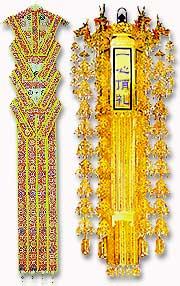
The one on the left is made from cloth, the one on the right from gilded wood.


仏様の徳をあらわす旗(標識)の一種です。たんに幡(ばん)と呼ぶこともあります。原形は布製ですが、装飾性の点から、木製で六角や八角の立体的に作られたものが多く使われています。布製の幡を和幡と呼んでいます。
http://www.tctv.ne.jp/tobifudo/newmon/butugu/butugu/butugu.html

:::::::::::::::::::::::::::::::::::::::::::::::::::::::::::::::::::::::::::::::::::::::::::::::::::::

... ... ... Form

Long small stripes, which are held together with a metal hanger (tsurikanagu釣金具, tsuriwa kanagu 吊り輪金具). The various parts of a banner in Japanese style (waban 和幡 see picture above on the left))are named like the parts of the human body.

The topmost triangular part is the banner head (bantoo 幡頭), which has a tongue (zetsu 舌) in the middle. The large rectangular part is the body (banshin 幡身). It consists of many fields (tsubo坪), which are surrounded by a band (fuchi 縁).

In case of metal banners, these fields are connected with metal hinges, the Butterfly Hinges (chootsugai蝶番). Banners from cloth can also be held together by cloth bridges or literally: dams (tsutsumi 堤).

Below the head and on the sides there are the long hands (banshu, banju 幡手), at the bottom part the feet (bansoku 幡足).These feet can also be in form of small bells.

Since the Heian period, the number of the fields is usually three and the feet are four. Before this period, these parts were not fixed.

Banners in the Chinese style (karaban 唐幡) have only one field and on both sides one long banner hand. One example is the famous banner in the Shoosoo-In in Nara, the "complex silk gauze Banner (ra ban 羅幡, ra no doojoo ban 羅道場幡(らのどうじょうばん)).


From the Nara National Museum Exhibition
奈良国立博物館
http://www.narahaku.go.jp/exhib/2003toku/shosoin/shosoin-1.htm

:::::::::::::::::::::::::::::::::::::::::::::::::::::::::::::::::::::::::::::::::::::::::::::::::::::

Banners can be divided according to the kind of material, the color, size, patterns, the place where they are hung and many others. In the following I will introduce the mosts important ones.

... ... According to the material


http://evagenji.hp.infoseek.co.jp/co-0401-00-19.htm

Cotton Banner (menban 綿幡), Silk Banner (kinuban 絹幡, hirahataヒラハタ) oder Brocade Banner (ayaban 綾幡, nishiki ban 錦幡), Goldbronze Banner (kondooban 金銅幡), Juwels Banner, Wood Banner or Paper Banner.

Banner from cloth are also called cloth stripes banners (retsuseiban, kireban). Some are delicately embroidered (shishuuban 刺繍幡). Thread banners (itobata 糸旗, shiban 刺幡)have hands and feet from bundles of silk thread.

Metal banners are often decorated with thin metal plates and fretwork (sukashibori 透かし彫り).

Jewel Banners (tama no hata, gyokuban 玉の旗、玉幡)are made from agate (menoo 瑪瑙), Lapislazuli (ruri 瑠璃), glas, mountani crystals (suishoo 水晶) and other precious stones. A precious banner has a wishfulfilling jewel at the very top.

.. .. ..

... ... According to the color

Banners of one color only (tanshoku ban 単色幡) are in white, red, yellow, green, light yellow or violett. The material can be cloth, wood or paper. They are especially used in ceremonies of the Esoteric Buddhist Sects.

Banners of many colors (zooshiki ban 雑色幡) in five, eight (hatsushikiban) or nine colors.

Banners of five colors (goshikiban 五色幡, gosaiban 五彩幡)
Often used for ceremonies when praying for the recovery of a sick person. Five here symbolizes the five inner organs (五臓). The colors are green, yellow, red, white and black. There can also be five banners in one of the colors each.

.. .. ..

... ... According to the size
Small Banner (kobata, shooban 小幡) or large banner (oobata, daiban 大旗、大幡), which could be more than ten meters long.

.. .. ..

... ... According the the place where it hangs
In a hall (dooban堂幡), in the Golden Hall (kondooban 金堂幡, chuudooban 中堂, butsudooban 仏堂幡), in the hall of veneration (raidooban 礼堂幡), in the temples of esoteric Buddhism also simply called "Hall Banner" "dooban 堂幡" "doo 堂"; in the Hall of Preaching (koodooban 講堂幡). In this case, banners of eight symbolic colors are used.

Garden banners (niwabata 庭旗, teiban 庭幡) for Rain Rituals (amagoi) 雨乞い. These are often decorated with jewels and silk thread of green color. These banners hang on a pole which has a dragon head (ryuuzu 竜頭) on the top.

Banner on a roof (okujooban 屋上幡); Banner at the seat of a priest (koozaban 講座幡); Banner on a canopy (tengaiban 天蓋幡).

.. .. ..

... ... According to the use
Banner for initiation ceremonies, Banner for life-prolonging rites, for prayers for the dead.
Banners for burials (soogiban 葬儀幡): four banners from white paper or white silk with the Sanskrit syllables of deities such as Amida Nyorai (Amitaabha), Kannon Bosatsu (Avalokitesvara) and Seishi Bosatsu (Mahaasthaamapraapta), who comes to welcome the soul to the Paradise of the West.
Banner for ceremonies for the Hungry Ghosts (segakiban 施餓鬼幡), usually during the Bon Festival (o-bon) お盆.
Banner as an expression of the veneration of the Buddhas (shinban).

.. .. ..


:::::::::::::::::::::::::::::::::::::::::::::::::::::::::::::::::::::::::::::::::::::::::::::::::::::

Japanese Links

寝殿母屋 秋好中宮主催による季の御読経『胡蝶』巻より
by 明さん

幡はもともと、武人が戦場において己の武勲を敵や味方に誇示 するために立てたもので、これが仏教に取り入れられて仏・菩薩 の降魔の威徳を示す荘厳具となりました。

柱や天蓋などに掛ける他、法要を行う庭や行道する両側に立て たりもしました。

幡は、三角形の幡頭、長方形の幡身、幡頭の下と幡身の左右から垂れる幡手、幡身の下から垂れる幡足の各部から構成されます。材質も色も大きさも図柄も用途も使う場所もさまざまで、いろ
いろな分類方法があるようですが、布製の場合は絹や綾、金襴 など豪華な布地を用いました。
http://evagenji.hp.infoseek.co.jp/co-0401-00-19.htm

.. .. .. .. ..

Q・お寺の本堂の天井に吊るしてある飾りは何ですか?

:::::::::::::::::::::::::::::::::::::::::::::::::::::::::::::::::::::::::::::::::::::::::::::::::::::


© PHOTO Kakunodate

In a Shinto shrine, a similar decoration is used, called the

Flag of Sun and Moon, nichigetsu ki
日月旗 (にちげつき)


The sun is on the right, the moon on the left side of the Shinto altar.


:::::::::::::::::::::::::::::::::::::::::::::::::::::::::::::::::::::::::::::::::::::::::::::::::::::

The above text unless links are given is mostly quoted from my book about Buddhist ritual tools. Buddhistisches Kultgeraet


I took the first photo at temple Raikyuu-Ji, Takanashi:
Daruma Pilgrims in Japan: Kobori Enshuu


.. .. .. .. .. .. My essays about related themes:

Ritual Decorations (shoogongu) 荘厳具 including:
Banner (ban)
Canopy (tengai) 天蓋
Flower Garlands (keman) 華鬘

:::::::::::::::::::::::::::::::::::::::::::::::::::::::::::::::::::::::::::::::::::::::::::::::::::::


Banner (ban, doo, hata)

Ursprung:
Fahnen (hata) dienten in Indien auf dem Kriegsschauplatz der Markierung der Feldlager, um Freund und Feind zu unterscheiden. Sie wurden bald vom Buddhismus übernommen, um die Gewalt der Tathaagata-Buddhas und Bodhisattvas bei der Überwältigung der Dämonen und Feinde der Religion (gooma) zum Ausdruck zu bringen. Diese Banner werden auch "Siegesbanner" (shooban, shoodoo) genannt.

Banner im Sinne von "ban" (S: pataakaa > J:hataka > hata) wurden in indischen Städten und bei Kriegsschauplätzen aufgehängt, während "doo" (S: ketu) außerhalb der Städte bei sportlichen Veranstaltungen der Adeligen aufgestellt wurden.
"doo" entspricht auch dem chinesischen Zeichen der Tang-Dynastie. Die Bezeichnung "doo" für ein Banner wird vor allem im esoterischen Buddhismus benutzt.

In China wurden Banner besonders häufig seit dem 6. Jh. bei buddhistischen Zeremonien aufgestellt. Abbildungen von Bannern (hatakinugasa, bangai) finden sich bereits auf den Wandgemälden der Tempelhölen in Dunhuang (Tonkoo), Nordwestchina.

Symbolik:
Überwältigung der Dämonen, besonders der inneren Feinde eines Praktizierenden. Weiterhin auch Verlängerung der Lebensspanne. Das Herstellen eines Banners diente weiterhin der "Beruhigung der Seele". Von Witwen wurden daher oft Stoffbanner gefertigt.

Funktion:
Rituelles Schmuckobjekt oder Opfergabe, besonders für Verstorbene. Hängt im Tempelraum an den Säulen, am Baldachin oder neben dem Priestersitz.

Teile eines Banners
Form:
Lange, schmale Streifen, die an einem Metall-Aufhänger (tsurikanagu , tsuriwa kanagu) befestigt sind. Die einzelnen Teile eines Banners im japanischen Stil (waban) werden wie die Teile eines menschlichen Körpers bezeichnet.

Oberer dreieckiger Teil: "Bannerkopf" (bantoo), an dem in der Mitte ein Band, die "Zunge" (zetsu) befestigt ist. Langer rechteckiger Teil: "Bannerkörper" (banshin); besteht aus mehreren Feldern (tsubo), die von einer Einfassung (fuchi) umgeben sind. Die Felder werden bei Metallbannern durch "Schmetterlings-Scharniere" (chootsugai) oder bei Stoffbannern durch Stoffbrücken, wörtlich "Damm" (tsutsumi) zusammengehalten. Am Bannerkopf und an den Seiten des Bannerkörpers befinden sich Ziergehänge, die sog. "Bannerhände" (banju, banshu), am unteren Teil des Bannerkörpers sind weitere Ziergehänge, die "Bannerfüße" (bansoku). Die Bannerfüße können auch in Form von kleinen Glocken sein.

Seit der Heian-Zeit beträgt die Anzahl der Felder im allgemeinen drei und die der Bannerfüße vier; vorher war die Anzahl dieser Teile nicht besonders festgelegt.

Banner im chinesichen Stil (karaban) bestehen aus nur einem Feld und rechts und links jeweils einer sehr langen Bannerhand. Diese Form findet sich heute noch im "Seidengaze-Banner" (ra ban) des Schatzhauses Shoosoin im Tempel Toodaiji, Nara.

Nach der Art des Materials, der Farbe, der Größe, des Musters, des Aufhängeortes u.a. gibt es zahlreiche Unterteilungen der Banner, die hier nicht alle erwähnt werden können. Ein Banner kann daher auch verschiedene Bezeichnungen haben. Es folgt eine kurze Auflistung der wichtigsten Arten von Bannern; detaillierte Angaben finden sich bei Shimizu und Sekine.

... ... Nach dem Material:
Baumwolle-Banner (menban), Seiden-Banner (kinuban, hirahata) oder Brokat-Banner (ayaban), Goldbronze-Banner (kondooban), Juwelen-Banner, Holz-Banner oder Papier-Banner.
Banner aus Stoff werden auch "Stoffstreifen-Banner" (retsuseiban, kireban) genannt. Es gibt auch bestickte Stoffbanner (shishuuban). Bei "Faden-Bannern" (shiban, itobata) sind die Hände und Füße des Banners aus geknüpften und gebündelten Seidenfäden hergestellt.
Metallbanner bestehen oft aus zahlreichen dünnen Metallplättchen mit Durchbrucharbeiten (sukashibori).
Juwelen-Banner (tama no hata, gyokuban ) sind mit Achaten (menoo), Lapislazuli (ruri), Glas, Bergkristall (suishoo, subateka) u. a. verziert. Ein "Schatz-Banner" Precious banner, ist oben mit einem Wunschjuwel versehen.

... ... Nach der Farbe:
Einfarbige Banner (tanshokuban): Weiß, rot, gelb, grün, hellgelb oder violett. Das Material kann Stoff, Holzplatten oder Papier sein. Sie werden besonders bei Zeremonien des esoterischen Buddhismus verwendet.
Mehrfarbige Banner (zooshikiban): Fünffarbig, achtfarbig (hatsushikiban) oder neunfarbig.

... ... Nach der Größe:
Kleines Banner (kobata, shooban) oder großes Banner (oobata, daiban), das über zehn Meter lang sein kann.

... ... Nach dem Aufhängungsort:
In Hallen (dooban), in der Goldenen Halle (kondooban, chuudooban, butsudooban), in der Verehrungshalle (raidooban), bei Tempeln des esoterischen Buddhismus auch kurz "dooban" oder "doo" genannt; in der Predigthalle (koodooban). Dabei werden oft achtfarbige Banner mit Symbolformen der Buddhas verwendet.

Garten-Banner (niwabata, teiban) für Zeremonien zur Regenbeschwörung. Häufig mit Juwelen oder Seidenfäden geschmückt und von grüner Farbe. Diese Banner hängen an einer Stange, die oben mit einem Drachenkopf (ryuuzu) verziert ist und sind aus Fäden oder Seidenstoff.
Banner auf dem Dach (okujooban); Banner an einem Priestersitz (koozaban); Banner an einem Baldachin (tengaiban).

... ... Nach der Verwendungsart:
Banner für Initiationszeremonien, Banner für lebensverlängernde Riten; die für den eigenen Seelenfrieden oder bei Gedenkriten (tsuizen kuyoo) für einen Verstorbenen gestiftet werden (senmooban, myoogaban)
Banner für Beerdigungen (soogiban, shihonbata): vier Banner aus weißem Papier oder weißer Seide mit den Keimsilben der Heilswesen Amida Nyorai (Amitaabha), Kannon Bosatsu (Avalokitesvara) und Seishi Bosatsu (Mahaasthaamapraapta), die der Seele des Toten aus dem Paradies des Westens entgegenkommen.
Banner für "Hungergeister-Zeremonien" (segakiban), meist während des Bon-Totenfestes im August (urabon).
Banner als Ausdruck der Verehrung der Buddhas (shinban).

... ... Nach Art des Musters (zugara):
Am häufigsten sind normale Banner aus den verschiedenartigsten Materialien, die keine der im folgenden aufgezählten Muster aufweisen:

Banner mit Figuren von Heilswesen (butsuzooban, eban) auf den einzelnen Feldern, z.B. Banner der fünf Buddhas mystischen Wissens (gochi nyoraiban), Bodhisattva-Banner (bosatsuban), Banner der Weisheitskönige (myooooban), Banner für den Weisheitskönig Fudoo (fudooban) u.a. Diese Banner sind meist aus Stoff hergestellt. Sie finden sich besonders häufig in China.

In Tempeln des esoterischen Buddhismus hängen häufig Banner mit Keimsilben (shujiban) oder Banner mit Symbolformen der Buddhas (sanmayagyooban, buppooban) an Stelle von Figuren von Heilswesen; für Kannon Bosatsu eine Lotusblüte, für Fudoo Myoooo (Acala) ein Schwert (ken) u.a.


...Besondere Typen

... ... ... ... Fahne (dooban)

Entsprechend dem Sutra-Kommentar Dainichikyoosho entspricht dem Begriff "doo" das Sanskritwort "dhvaja" und "ban" ist "ketu". Die japanische Version dieser beiden Begriffe ist eigentlich "hataboko". Ein "doo" ist in verschiedenen Farben geschmückt, während ein "ban" mit Mustern verziert ist und ursprünglich den Kriegsfahnen entspricht. Diese Fahnen hängen als rituelle Schmuckobjekte an den Säulen der Übungshallen (doojoo).
Diese Fahnen symbolisieren gleichzeitig die symbolischen Werte von Banner und Fahne.

Eine lange Stange ist oben mit einem Wunschjuwel geschmückt. Daran hängen sechs oder acht Stoffstreifen, die eine Art Röhre bilden. Selten sind die Streifen aus Holz (mokudooban) oder vergoldete Bonze.

... ... Fünffarbiges Banner (goshikiban, gosaiban, goshikisaiban)

Sie werden oft gestiftet mit der Bitte zur Heilung bei Krankheiten. Fünf bedeutet dabei die fünf Sinneserfahrungen (gogyoo) bzw. die fünf inneren Organe (gozoo), für deren Gesundheit bei lebensverlängernden Riten gebetet wird.
Entweder besteht ein Banner aus allen fünf rituellen Farben (grün, gelb, rot, weiß und schwarz) oder fünf Banner in jeweils einer Farbe bilden zusammen eine Gruppe.

Im esoterischen Buddhismus werden besonders die beiden folgenden Bannertypen verwendet:

... ... Banner für Initiationszeremonien (kanjooban)

Bei einer Initiationszeremonie des esoterischen Buddhismus wird dem Initianden als Zeichen der Aufnahme in die Gemeinde Wasser über den Kopf gegossen. Das Berühren der Bannerfüße mit dem Kopf entspricht der Berührung mit Wasser.

Diese farbigen Stoffbanner oder Goldbronze-Banner hängen an den vier Ecken eines Baldachins für Initiationszeremonien.
Die Felder enthalten Durchbrucharbeiten von Bodhisattva-Figuren, engelsartigen Himmelswesen, Löwen, chinesische Arabesken oder Geißblattranken (nindootsuru monyoo), shinobu fuyu).
Im Laufe der Zeit werden die einzelnen Felder immer kleiner, bis sie schließlich fast quadratisch werden.
Beispiel: Das Große Banner des Tempels Hooryuuji, Nara, aus dem Jahre 747.

... ... Banner für lebensverlängernde Riten (zokumyooshinban, zokumyooban, jumyooban)

Als der indische König Ashoka krank lag, wurden Banner aufgestellt und Gebete an den Buddha der Medizin, Yakushi Nyorai (Bhaishajya-guru) gesprochen. Der König wurde daraufhin wieder gesund und lebte noch 12 Jahre lang. Seit dieser Zeit wurden fünffarbige Banner für Zeremonien zur Gesundung bei schwerer Erkrankung eines Tennoo oder anderer hochstehender Persönlichkeiten verwendet. Die Gebete erfolgen an die sieben Inkarnationen eines Yakushi Nyorai (shichibutsu yakushihoo) zur Heilung von Krankheit oder für eine einfache Geburt. Bei lebensverlängernden Riten hängen an den vier Ecken des Baldachins über dem Altar jeweils zwei gelbe Banner, während bei gefügigmachenden Riten und Liebeszauber neunfarbige Banner verwendet werden.


BACK ... ZUM INHALTSVERZEICHNIS
Buddhistische Kultgegenstände Japans
Gabi Greve


Daruma Pilgrims in Japan


::::::::::::::::::::::::::::::::::::::::::::::::::::::::::::::::::::::::::::::::::::::::::::::::::::: 


. Prayer Flags and Haiku   


[ . BACK to WORLDKIGO . TOP . ]
[ . BACK to DARUMA MUSEUM TOP . ]

:::::::::::::::::::::::::::::::::::::::::::::::::::::::::::::::::::::::::::::::::::::::::::::::::::::