8/30/2005
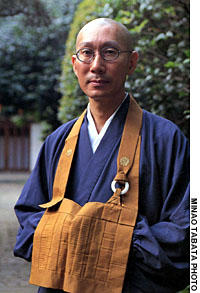
Zen Garden Master
:::::::::::::::::::::::::::::::::::::::::::::::::::::::::::::::::::::::::::::::::::::::::::::::::::::
Read my own story about
Kobori Enshuu Garden Designer, 小堀遠州
:::::::::::::::::::::::::::::::::::::::::::::::::::::::::::::::::::::::::::::::::::::::::::::::::::::
[ . BACK to DARUMA MUSEUM TOP . ]
[ . BACK to WORLDKIGO . TOP . ]
:::::::::::::::::::::::::::::::::::::::::::::::::::::::::::::::::::::::::::::::::::::::::::::::::::::
8/09/2005
Ritual Decorations (shoogongu)
[ . BACK to Daruma Museum TOP . ]
:::::::::::::::::::::::::::::::::::::::::::::::::::::::::::::::::::::::::::::::::::::::::::::::::::::
Ritual Decorations (shoogongu 荘厳具)

The concept of "shoogon (shogon, shougon, shohgon)" is already mentioned in the Lotus Sutra (Hokkekyoo, Hokekyoo 法華経; Saddharma-pundariika-suutra); it indicates "lavish embellishment" "great decoration in supreme beauty".
Buddha statues are embellished with robes and other implements.
The holy space in a temple, especially the altar area, is especially decorated with many objects, some of them are discussed in this Daruma Museum. There are special pages for example for these items:
Banner (ban) (幡)
Canopy (tengai) 天蓋
Flower Garlands (keman 華鬘)
The lavish embellishment is produced by special materials, like gold, silver, brocade and so on. It is also produced by the finest and most detailed work of the craftsman, in carving, stitching, weaving the items. Preparing an item for decoration in the temple hall was a holy, worthy deed in itself and promised a step nearer on the road to paradise.
Gabi Greve
:::::::::::::::::::::::::::::::::::::::::::::::::::::::::::::::::::::::::::::::::::::::::::::::::::::
"SHOGON" .. .. .. Solemn Decoration
The New Culture had shown up with Buddhism in Ancient Japan
Chikatsu Asuka Museum The 2001 Chikatsu Asuka Special Spring Exhibition
The word "shogon" means "to decorate Buddha with magnificence." From the time Buddhism was first brought to this country, or around the middle of the 6th century, Buddhist images were decorated in increasingly different ways.
Images that were enshrined in the main halls of Buddhist temples gleamed with the color of gold. Around them there were decorations such as lotus blossom ornaments, brilliant colored cloth and reliefs on tiles painted with green enamel called "sen."There were also brilliantly colored frescos to round off the magnificent decorations.
Towering Stupa were built where relics of the Buddha were preserved in containers and where gold and silver colored ear ornaments and neck ornaments made with blue and yellow colored beads and other glistening objects were kept.
All these things of the Buddhist world that were written in sutras are not usually displayed in present times. Through these splendid conceptual writings, people aspired to the world of Buddha.
Let us try and contemplate the Asuka-Hakuho culture that went through this period of "Shogon" of the first days of Buddhism and the beginnings of international influence were established.
Chikatsu Asuka Museum Welcome to the Special exhibit, Spring 2001
:::::::::::::::::::::::::::::::::::::::::::::::::::::::::::::::::::::::::::::::::::::::::::::::::::::
Japanese Links
Q・お寺の本堂の天井に吊るしてある飾りは何ですか?
The Sutra of Solem Decoration
大乗荘厳経(Mahayana-sutralamkara)
Store that sells tengai, ban and keman: 荘厳仏具
http://www.tctv.ne.jp/tobifudo/newmon/butugu/butugu/butugu.html
.. .. .. .. ..
荘厳仏具の紹介
【1】宮殿・須弥壇 .. Altar
【2】人天蓋 .. Canopy for Priest
【3】仏天蓋 .. Canopy for Statue
【4】護摩天蓋 .. Canopy for Ceremony
【5】幢幡 .. Banner
【6】御仏像・御仏像の修復 .. Statues
【7】五具足 .. Altar instruments
【8】前机 .. Table
【9】立焼香机 .. Incense Table
【10】登高座・円壇・護摩壇 .. Seat
http://www.yasuda-shokeido.co.jp/shogon/
.. .. .. .. ..
宗派別、仏壇の飾り方(荘厳)

Joodo Sect Buddhist Altar
http://www.web-toku.com/tisiki/shou_joudo.html
浄土宗 Joodo Sect
浄土真宗本願寺派(お西) Joodo Honganji Sect
真宗大谷派(お東) Shinshu Otani Sect
天台宗 Tendai Sect
真言宗 Shingon Sect
日蓮宗 Nichiren Sect
臨済宗各派 Rinzai Zen
曹洞宗 Sootoo Zen
http://www.web-toku.com/tisiki/shougon
:::::::::::::::::::::::::::::::::::::::::::::::::::::::::::::::::::::::::::::::::::::::::::::::::::::
The above text unless links are given is mostly quoted from my book about Buddhist ritual tools.
Buddhistisches Kultgeraet
I took the first photo at temple Raikyuu-Ji, Takanashi:
Daruma Pilgrims in Japan: Kobori Enshuu
:::::::::::::::::::::::::::::::::::::::::::::::::::::::::::::::::::::::::::::::::::::::::::::::::::::
:::::::::::::::::::::::::::::::::::::::::::::::::::::::::::::::::::::::::::::::::::::::::::::::::::::
Exhibition "Kazari: The Impulse to Decorate in Japan"
. shippoo 七宝 (しっぽう)cloisonne, enamel .
:::::::::::::::::::::::::::::::::::::::::::::::::::::::::::::::::::::::::::::::::::::::::::::::::::::
[ . BACK to WORLDKIGO . TOP . ]
[ . BACK to DARUMA MUSEUM TOP . ]
:::::::::::::::::::::::::::::::::::::::::::::::::::::::::::::::::::::::::::::::::::::::::::::::::::::
:::::::::::::::::::::::::::::::::::::::::::::::::::::::::::::::::::::::::::::::::::::::::::::::::::::
Ritual Decorations (shoogongu 荘厳具)

The concept of "shoogon (shogon, shougon, shohgon)" is already mentioned in the Lotus Sutra (Hokkekyoo, Hokekyoo 法華経; Saddharma-pundariika-suutra); it indicates "lavish embellishment" "great decoration in supreme beauty".
Buddha statues are embellished with robes and other implements.
The holy space in a temple, especially the altar area, is especially decorated with many objects, some of them are discussed in this Daruma Museum. There are special pages for example for these items:
Banner (ban) (幡)
Canopy (tengai) 天蓋
Flower Garlands (keman 華鬘)
The lavish embellishment is produced by special materials, like gold, silver, brocade and so on. It is also produced by the finest and most detailed work of the craftsman, in carving, stitching, weaving the items. Preparing an item for decoration in the temple hall was a holy, worthy deed in itself and promised a step nearer on the road to paradise.
Gabi Greve
:::::::::::::::::::::::::::::::::::::::::::::::::::::::::::::::::::::::::::::::::::::::::::::::::::::
"SHOGON" .. .. .. Solemn Decoration
The New Culture had shown up with Buddhism in Ancient Japan
Chikatsu Asuka Museum The 2001 Chikatsu Asuka Special Spring Exhibition
The word "shogon" means "to decorate Buddha with magnificence." From the time Buddhism was first brought to this country, or around the middle of the 6th century, Buddhist images were decorated in increasingly different ways.
Images that were enshrined in the main halls of Buddhist temples gleamed with the color of gold. Around them there were decorations such as lotus blossom ornaments, brilliant colored cloth and reliefs on tiles painted with green enamel called "sen."There were also brilliantly colored frescos to round off the magnificent decorations.
Towering Stupa were built where relics of the Buddha were preserved in containers and where gold and silver colored ear ornaments and neck ornaments made with blue and yellow colored beads and other glistening objects were kept.
All these things of the Buddhist world that were written in sutras are not usually displayed in present times. Through these splendid conceptual writings, people aspired to the world of Buddha.
Let us try and contemplate the Asuka-Hakuho culture that went through this period of "Shogon" of the first days of Buddhism and the beginnings of international influence were established.
Chikatsu Asuka Museum Welcome to the Special exhibit, Spring 2001
:::::::::::::::::::::::::::::::::::::::::::::::::::::::::::::::::::::::::::::::::::::::::::::::::::::
Japanese Links
Q・お寺の本堂の天井に吊るしてある飾りは何ですか?
The Sutra of Solem Decoration
大乗荘厳経(Mahayana-sutralamkara)
Store that sells tengai, ban and keman: 荘厳仏具
http://www.tctv.ne.jp/tobifudo/newmon/butugu/butugu/butugu.html
.. .. .. .. ..
荘厳仏具の紹介
【1】宮殿・須弥壇 .. Altar
【2】人天蓋 .. Canopy for Priest
【3】仏天蓋 .. Canopy for Statue
【4】護摩天蓋 .. Canopy for Ceremony
【5】幢幡 .. Banner
【6】御仏像・御仏像の修復 .. Statues
【7】五具足 .. Altar instruments
【8】前机 .. Table
【9】立焼香机 .. Incense Table
【10】登高座・円壇・護摩壇 .. Seat
http://www.yasuda-shokeido.co.jp/shogon/
.. .. .. .. ..
宗派別、仏壇の飾り方(荘厳)

Joodo Sect Buddhist Altar
http://www.web-toku.com/tisiki/shou_joudo.html
浄土宗 Joodo Sect
浄土真宗本願寺派(お西) Joodo Honganji Sect
真宗大谷派(お東) Shinshu Otani Sect
天台宗 Tendai Sect
真言宗 Shingon Sect
日蓮宗 Nichiren Sect
臨済宗各派 Rinzai Zen
曹洞宗 Sootoo Zen
http://www.web-toku.com/tisiki/shougon
:::::::::::::::::::::::::::::::::::::::::::::::::::::::::::::::::::::::::::::::::::::::::::::::::::::
The above text unless links are given is mostly quoted from my book about Buddhist ritual tools.
Buddhistisches Kultgeraet
I took the first photo at temple Raikyuu-Ji, Takanashi:
Daruma Pilgrims in Japan: Kobori Enshuu
.. .. .. .. .. .. My three essays about details of these ornaments: Banner (ban) (幡) Canopy (tengai) 天蓋 Flower Garlands (keman 華鬘) |
:::::::::::::::::::::::::::::::::::::::::::::::::::::::::::::::::::::::::::::::::::::::::::::::::::::
... ... Rituelle Schmuckobjekte (shoogongu 荘厳具) Eine Erläuterung zum Begriff des "shoogon" findet sich bereits im Lotus-Sutra (Hokkekyoo, Hokekyoo; Saddharma-pundariika-suutra) und bedeutet etwa "Schmuck in erhabener, reiner Schönheit". Sekine gibt drei Funktionen für diese "Heiligung durch Prachtfülle": 1. Tathaagata-Buddhas und Bodhisattvas schmücken sich selbst durch ihre guten Werke und Tugenden. 2. Der Körper eines Heilswesens, repräsentiert durch eine Statue (butsuzoo), wird mit verzierenden Gegenständen geschmückt. 3. Das Reich Buddhas, repräsentiert durch die Tempelhalle, wird mit schönen Gegenständen geschmückt. Im Rahmen dieser Arbeiten fuer das Daruma Museum wird ein "prächtiger, schmückender Gegenstand" der Kürze halber als "rituelles Schmuckobjekt" bezeichnet, obwohl diese Übersetzung nicht allen Nuancen dieses Begriffes gerecht wird. Zu den rituellen Schmuckobjekten für eine Statue gehören die in den folgenden Abschnitten ausführlich besprochenen Gegenstände: Baldachin, Altar-Plattform, Tabernakel u.a. Nimbus und Sockelformen sowie Schmuckstücke direkt am Körper einer Statue wurden bereits in meinem Buch über Buddhastatuen abgehandelt. Zu den rituellen Schmuckobjekten in einer Tempelhalle gehören Priestersitz und Tische, Banner, Schmuckgehänge u.a. Durch die Vergoldung und den Schmuck einer Statue, das auserlesene Material der Schmuckgehänge und Banner, die feinen Schnitzereien und Lackarbeiten eines Tempelraums wird versucht, dem Gläubigen eine möglichst naturgetreue Vorstellung vom Paradies im Westen (gokuraku joodo) zu vermitteln. Diese Bemühungen haben zur Verwendung auserlesener Materialien und der Herstelung einer Vielzahl von schmückenden Gegenständen geführt und im Laufe der Jahrhunderte Generationen von Kunst-Handwerkern beschäftigt. Diese Gesamtausstattung eines Tempelraums bezeichnen die Buddhisten mit dem Begriff shoogon, der etwa "heilige Schmuckfülle" bedeutet und ziemlich genau unserem mittelalterlichen Begriff Ornamenta ecclesiae entspricht, der ebenfalls liturgisches Gerät, Reliquiare usw. umfaßt. (Dietrich Seckel) BACK ... ZUM INHALTSVERZEICHNIS Buddhistische Kultgegenstände Japans Daruma Pilgrims in Japan |
:::::::::::::::::::::::::::::::::::::::::::::::::::::::::::::::::::::::::::::::::::::::::::::::::::::
Exhibition "Kazari: The Impulse to Decorate in Japan"
. shippoo 七宝 (しっぽう)cloisonne, enamel .
:::::::::::::::::::::::::::::::::::::::::::::::::::::::::::::::::::::::::::::::::::::::::::::::::::::
[ . BACK to WORLDKIGO . TOP . ]
[ . BACK to DARUMA MUSEUM TOP . ]
:::::::::::::::::::::::::::::::::::::::::::::::::::::::::::::::::::::::::::::::::::::::::::::::::::::
Banner (ban)
[ . BACK to Daruma Museum TOP . ]
:::::::::::::::::::::::::::::::::::::::::::::::::::::::::::::::::::::::::::::::::::::::::::::::::::::
Banner, Flag
(ban 幡(ばん)doo 幢, hata 旗
dooban 幢幡(どうばん))
Sanskrit: pataakaa > hataka > hata

... ... ... Origin
In India, flags (hata 旗) were used during a war and fight to distinguish between the fiend and the friend. Later Buddhists started using flags to demonstrate the power of the Tathaagata-Buddhas and Bodhisattvas in overcoming foes of the religion (gooma 降魔). These kinds of flags and banners are called Banners of Victory (shooban 勝幡, shoodoo 勝幢).
(There is even a temple, Shooban-Ji of this name 勝幡寺(山崎).
Banner in the meaning of BAN 幡 (S: pataakaa > J:hataka > hata) have been used in India to mark a war camp, whereas DOO 幡( (S: ketu) have been used during sports events to mark the camp of elite families. DOO is the Chinese character of the T'ang dynasty, and is often used for a banner in esoteric Buddhism.
In China, banners have been used for Buddhist ceremonies since the 6th century. In the wall paintings of Dunhuang (Tonko 敦煌) we already find these flags (hatakinugasa, bangai)
... ... ... Symbolism
To overcome the demons, especially the inner demons of a practitioner. Also to lengthen the lifespan of man. To make a flag with your own hands (especiallt the ones of cloth) helps to calm the mind and was often made by the widows of warriors.
... ... ... Function
A ritual object of decoration for the holy area in a temple. An offering from laypersons, especially for the memory of lost ones. It is hung in the inner sanctuary (naijin 内陣) beside the canopy or the seat of the priest.
:::::::::::::::::::::::::::::::::::::::::::::::::::::::::::::::::::::::::::::::::::::::::::::::::::::
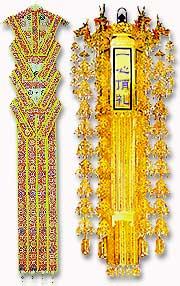
The one on the left is made from cloth, the one on the right from gilded wood.

仏様の徳をあらわす旗(標識)の一種です。たんに幡(ばん)と呼ぶこともあります。原形は布製ですが、装飾性の点から、木製で六角や八角の立体的に作られたものが多く使われています。布製の幡を和幡と呼んでいます。
http://www.tctv.ne.jp/tobifudo/newmon/butugu/butugu/butugu.html
:::::::::::::::::::::::::::::::::::::::::::::::::::::::::::::::::::::::::::::::::::::::::::::::::::::
... ... ... Form
Long small stripes, which are held together with a metal hanger (tsurikanagu釣金具, tsuriwa kanagu 吊り輪金具). The various parts of a banner in Japanese style (waban 和幡 see picture above on the left))are named like the parts of the human body.
The topmost triangular part is the banner head (bantoo 幡頭), which has a tongue (zetsu 舌) in the middle. The large rectangular part is the body (banshin 幡身). It consists of many fields (tsubo坪), which are surrounded by a band (fuchi 縁).
In case of metal banners, these fields are connected with metal hinges, the Butterfly Hinges (chootsugai蝶番). Banners from cloth can also be held together by cloth bridges or literally: dams (tsutsumi 堤).
Below the head and on the sides there are the long hands (banshu, banju 幡手), at the bottom part the feet (bansoku 幡足).These feet can also be in form of small bells.
Since the Heian period, the number of the fields is usually three and the feet are four. Before this period, these parts were not fixed.
Banners in the Chinese style (karaban 唐幡) have only one field and on both sides one long banner hand. One example is the famous banner in the Shoosoo-In in Nara, the "complex silk gauze Banner (ra ban 羅幡, ra no doojoo ban 羅道場幡(らのどうじょうばん)).

From the Nara National Museum Exhibition
奈良国立博物館
http://www.narahaku.go.jp/exhib/2003toku/shosoin/shosoin-1.htm
:::::::::::::::::::::::::::::::::::::::::::::::::::::::::::::::::::::::::::::::::::::::::::::::::::::
Banners can be divided according to the kind of material, the color, size, patterns, the place where they are hung and many others. In the following I will introduce the mosts important ones.
... ... According to the material

http://evagenji.hp.infoseek.co.jp/co-0401-00-19.htm
Cotton Banner (menban 綿幡), Silk Banner (kinuban 絹幡, hirahataヒラハタ) oder Brocade Banner (ayaban 綾幡, nishiki ban 錦幡), Goldbronze Banner (kondooban 金銅幡), Juwels Banner, Wood Banner or Paper Banner.
Banner from cloth are also called cloth stripes banners (retsuseiban, kireban). Some are delicately embroidered (shishuuban 刺繍幡). Thread banners (itobata 糸旗, shiban 刺幡)have hands and feet from bundles of silk thread.
Metal banners are often decorated with thin metal plates and fretwork (sukashibori 透かし彫り).
Jewel Banners (tama no hata, gyokuban 玉の旗、玉幡)are made from agate (menoo 瑪瑙), Lapislazuli (ruri 瑠璃), glas, mountani crystals (suishoo 水晶) and other precious stones. A precious banner has a wishfulfilling jewel at the very top.
.. .. ..
... ... According to the color
Banners of one color only (tanshoku ban 単色幡) are in white, red, yellow, green, light yellow or violett. The material can be cloth, wood or paper. They are especially used in ceremonies of the Esoteric Buddhist Sects.
Banners of many colors (zooshiki ban 雑色幡) in five, eight (hatsushikiban) or nine colors.
Banners of five colors (goshikiban 五色幡, gosaiban 五彩幡)
Often used for ceremonies when praying for the recovery of a sick person. Five here symbolizes the five inner organs (五臓). The colors are green, yellow, red, white and black. There can also be five banners in one of the colors each.
.. .. ..
... ... According to the size
Small Banner (kobata, shooban 小幡) or large banner (oobata, daiban 大旗、大幡), which could be more than ten meters long.
.. .. ..
... ... According the the place where it hangs
In a hall (dooban堂幡), in the Golden Hall (kondooban 金堂幡, chuudooban 中堂, butsudooban 仏堂幡), in the hall of veneration (raidooban 礼堂幡), in the temples of esoteric Buddhism also simply called "Hall Banner" "dooban 堂幡" "doo 堂"; in the Hall of Preaching (koodooban 講堂幡). In this case, banners of eight symbolic colors are used.
Garden banners (niwabata 庭旗, teiban 庭幡) for Rain Rituals (amagoi) 雨乞い. These are often decorated with jewels and silk thread of green color. These banners hang on a pole which has a dragon head (ryuuzu 竜頭) on the top.
Banner on a roof (okujooban 屋上幡); Banner at the seat of a priest (koozaban 講座幡); Banner on a canopy (tengaiban 天蓋幡).
.. .. ..
... ... According to the use
Banner for initiation ceremonies, Banner for life-prolonging rites, for prayers for the dead.
Banners for burials (soogiban 葬儀幡): four banners from white paper or white silk with the Sanskrit syllables of deities such as Amida Nyorai (Amitaabha), Kannon Bosatsu (Avalokitesvara) and Seishi Bosatsu (Mahaasthaamapraapta), who comes to welcome the soul to the Paradise of the West.
Banner for ceremonies for the Hungry Ghosts (segakiban 施餓鬼幡), usually during the Bon Festival (o-bon) お盆.
Banner as an expression of the veneration of the Buddhas (shinban).
.. .. ..
:::::::::::::::::::::::::::::::::::::::::::::::::::::::::::::::::::::::::::::::::::::::::::::::::::::
Japanese Links
寝殿母屋 秋好中宮主催による季の御読経『胡蝶』巻より
by 明さん
幡はもともと、武人が戦場において己の武勲を敵や味方に誇示 するために立てたもので、これが仏教に取り入れられて仏・菩薩 の降魔の威徳を示す荘厳具となりました。
柱や天蓋などに掛ける他、法要を行う庭や行道する両側に立て たりもしました。
幡は、三角形の幡頭、長方形の幡身、幡頭の下と幡身の左右から垂れる幡手、幡身の下から垂れる幡足の各部から構成されます。材質も色も大きさも図柄も用途も使う場所もさまざまで、いろ
いろな分類方法があるようですが、布製の場合は絹や綾、金襴 など豪華な布地を用いました。
http://evagenji.hp.infoseek.co.jp/co-0401-00-19.htm
.. .. .. .. ..
Q・お寺の本堂の天井に吊るしてある飾りは何ですか?
:::::::::::::::::::::::::::::::::::::::::::::::::::::::::::::::::::::::::::::::::::::::::::::::::::::

© PHOTO Kakunodate
In a Shinto shrine, a similar decoration is used, called the
Flag of Sun and Moon, nichigetsu ki
日月旗 (にちげつき)
The sun is on the right, the moon on the left side of the Shinto altar.

:::::::::::::::::::::::::::::::::::::::::::::::::::::::::::::::::::::::::::::::::::::::::::::::::::::
The above text unless links are given is mostly quoted from my book about Buddhist ritual tools. Buddhistisches Kultgeraet
I took the first photo at temple Raikyuu-Ji, Takanashi:
Daruma Pilgrims in Japan: Kobori Enshuu
.. .. .. .. .. .. My essays about related themes:
Ritual Decorations (shoogongu) 荘厳具 including:
Banner (ban) 幡
Canopy (tengai) 天蓋
Flower Garlands (keman) 華鬘
:::::::::::::::::::::::::::::::::::::::::::::::::::::::::::::::::::::::::::::::::::::::::::::::::::::
:::::::::::::::::::::::::::::::::::::::::::::::::::::::::::::::::::::::::::::::::::::::::::::::::::::
. Prayer Flags and Haiku
[ . BACK to WORLDKIGO . TOP . ]
[ . BACK to DARUMA MUSEUM TOP . ]
:::::::::::::::::::::::::::::::::::::::::::::::::::::::::::::::::::::::::::::::::::::::::::::::::::::
:::::::::::::::::::::::::::::::::::::::::::::::::::::::::::::::::::::::::::::::::::::::::::::::::::::
Banner, Flag
(ban 幡(ばん)doo 幢, hata 旗
dooban 幢幡(どうばん))
Sanskrit: pataakaa > hataka > hata

... ... ... Origin
In India, flags (hata 旗) were used during a war and fight to distinguish between the fiend and the friend. Later Buddhists started using flags to demonstrate the power of the Tathaagata-Buddhas and Bodhisattvas in overcoming foes of the religion (gooma 降魔). These kinds of flags and banners are called Banners of Victory (shooban 勝幡, shoodoo 勝幢).
(There is even a temple, Shooban-Ji of this name 勝幡寺(山崎).
Banner in the meaning of BAN 幡 (S: pataakaa > J:hataka > hata) have been used in India to mark a war camp, whereas DOO 幡( (S: ketu) have been used during sports events to mark the camp of elite families. DOO is the Chinese character of the T'ang dynasty, and is often used for a banner in esoteric Buddhism.
In China, banners have been used for Buddhist ceremonies since the 6th century. In the wall paintings of Dunhuang (Tonko 敦煌) we already find these flags (hatakinugasa, bangai)
... ... ... Symbolism
To overcome the demons, especially the inner demons of a practitioner. Also to lengthen the lifespan of man. To make a flag with your own hands (especiallt the ones of cloth) helps to calm the mind and was often made by the widows of warriors.
... ... ... Function
A ritual object of decoration for the holy area in a temple. An offering from laypersons, especially for the memory of lost ones. It is hung in the inner sanctuary (naijin 内陣) beside the canopy or the seat of the priest.
:::::::::::::::::::::::::::::::::::::::::::::::::::::::::::::::::::::::::::::::::::::::::::::::::::::
The one on the left is made from cloth, the one on the right from gilded wood.

仏様の徳をあらわす旗(標識)の一種です。たんに幡(ばん)と呼ぶこともあります。原形は布製ですが、装飾性の点から、木製で六角や八角の立体的に作られたものが多く使われています。布製の幡を和幡と呼んでいます。
http://www.tctv.ne.jp/tobifudo/newmon/butugu/butugu/butugu.html
:::::::::::::::::::::::::::::::::::::::::::::::::::::::::::::::::::::::::::::::::::::::::::::::::::::
... ... ... Form
Long small stripes, which are held together with a metal hanger (tsurikanagu釣金具, tsuriwa kanagu 吊り輪金具). The various parts of a banner in Japanese style (waban 和幡 see picture above on the left))are named like the parts of the human body.
The topmost triangular part is the banner head (bantoo 幡頭), which has a tongue (zetsu 舌) in the middle. The large rectangular part is the body (banshin 幡身). It consists of many fields (tsubo坪), which are surrounded by a band (fuchi 縁).
In case of metal banners, these fields are connected with metal hinges, the Butterfly Hinges (chootsugai蝶番). Banners from cloth can also be held together by cloth bridges or literally: dams (tsutsumi 堤).
Below the head and on the sides there are the long hands (banshu, banju 幡手), at the bottom part the feet (bansoku 幡足).These feet can also be in form of small bells.
Since the Heian period, the number of the fields is usually three and the feet are four. Before this period, these parts were not fixed.
Banners in the Chinese style (karaban 唐幡) have only one field and on both sides one long banner hand. One example is the famous banner in the Shoosoo-In in Nara, the "complex silk gauze Banner (ra ban 羅幡, ra no doojoo ban 羅道場幡(らのどうじょうばん)).

From the Nara National Museum Exhibition
奈良国立博物館
http://www.narahaku.go.jp/exhib/2003toku/shosoin/shosoin-1.htm
:::::::::::::::::::::::::::::::::::::::::::::::::::::::::::::::::::::::::::::::::::::::::::::::::::::
Banners can be divided according to the kind of material, the color, size, patterns, the place where they are hung and many others. In the following I will introduce the mosts important ones.
... ... According to the material

http://evagenji.hp.infoseek.co.jp/co-0401-00-19.htm
Cotton Banner (menban 綿幡), Silk Banner (kinuban 絹幡, hirahataヒラハタ) oder Brocade Banner (ayaban 綾幡, nishiki ban 錦幡), Goldbronze Banner (kondooban 金銅幡), Juwels Banner, Wood Banner or Paper Banner.
Banner from cloth are also called cloth stripes banners (retsuseiban, kireban). Some are delicately embroidered (shishuuban 刺繍幡). Thread banners (itobata 糸旗, shiban 刺幡)have hands and feet from bundles of silk thread.
Metal banners are often decorated with thin metal plates and fretwork (sukashibori 透かし彫り).
Jewel Banners (tama no hata, gyokuban 玉の旗、玉幡)are made from agate (menoo 瑪瑙), Lapislazuli (ruri 瑠璃), glas, mountani crystals (suishoo 水晶) and other precious stones. A precious banner has a wishfulfilling jewel at the very top.
.. .. ..
... ... According to the color
Banners of one color only (tanshoku ban 単色幡) are in white, red, yellow, green, light yellow or violett. The material can be cloth, wood or paper. They are especially used in ceremonies of the Esoteric Buddhist Sects.
Banners of many colors (zooshiki ban 雑色幡) in five, eight (hatsushikiban) or nine colors.
Banners of five colors (goshikiban 五色幡, gosaiban 五彩幡)
Often used for ceremonies when praying for the recovery of a sick person. Five here symbolizes the five inner organs (五臓). The colors are green, yellow, red, white and black. There can also be five banners in one of the colors each.
.. .. ..
... ... According to the size
Small Banner (kobata, shooban 小幡) or large banner (oobata, daiban 大旗、大幡), which could be more than ten meters long.
.. .. ..
... ... According the the place where it hangs
In a hall (dooban堂幡), in the Golden Hall (kondooban 金堂幡, chuudooban 中堂, butsudooban 仏堂幡), in the hall of veneration (raidooban 礼堂幡), in the temples of esoteric Buddhism also simply called "Hall Banner" "dooban 堂幡" "doo 堂"; in the Hall of Preaching (koodooban 講堂幡). In this case, banners of eight symbolic colors are used.
Garden banners (niwabata 庭旗, teiban 庭幡) for Rain Rituals (amagoi) 雨乞い. These are often decorated with jewels and silk thread of green color. These banners hang on a pole which has a dragon head (ryuuzu 竜頭) on the top.
Banner on a roof (okujooban 屋上幡); Banner at the seat of a priest (koozaban 講座幡); Banner on a canopy (tengaiban 天蓋幡).
.. .. ..
... ... According to the use
Banner for initiation ceremonies, Banner for life-prolonging rites, for prayers for the dead.
Banners for burials (soogiban 葬儀幡): four banners from white paper or white silk with the Sanskrit syllables of deities such as Amida Nyorai (Amitaabha), Kannon Bosatsu (Avalokitesvara) and Seishi Bosatsu (Mahaasthaamapraapta), who comes to welcome the soul to the Paradise of the West.
Banner for ceremonies for the Hungry Ghosts (segakiban 施餓鬼幡), usually during the Bon Festival (o-bon) お盆.
Banner as an expression of the veneration of the Buddhas (shinban).
.. .. ..
:::::::::::::::::::::::::::::::::::::::::::::::::::::::::::::::::::::::::::::::::::::::::::::::::::::
Japanese Links
寝殿母屋 秋好中宮主催による季の御読経『胡蝶』巻より
by 明さん
幡はもともと、武人が戦場において己の武勲を敵や味方に誇示 するために立てたもので、これが仏教に取り入れられて仏・菩薩 の降魔の威徳を示す荘厳具となりました。
柱や天蓋などに掛ける他、法要を行う庭や行道する両側に立て たりもしました。
幡は、三角形の幡頭、長方形の幡身、幡頭の下と幡身の左右から垂れる幡手、幡身の下から垂れる幡足の各部から構成されます。材質も色も大きさも図柄も用途も使う場所もさまざまで、いろ
いろな分類方法があるようですが、布製の場合は絹や綾、金襴 など豪華な布地を用いました。
http://evagenji.hp.infoseek.co.jp/co-0401-00-19.htm
.. .. .. .. ..
Q・お寺の本堂の天井に吊るしてある飾りは何ですか?
:::::::::::::::::::::::::::::::::::::::::::::::::::::::::::::::::::::::::::::::::::::::::::::::::::::

© PHOTO Kakunodate
In a Shinto shrine, a similar decoration is used, called the
Flag of Sun and Moon, nichigetsu ki
日月旗 (にちげつき)
The sun is on the right, the moon on the left side of the Shinto altar.

:::::::::::::::::::::::::::::::::::::::::::::::::::::::::::::::::::::::::::::::::::::::::::::::::::::
The above text unless links are given is mostly quoted from my book about Buddhist ritual tools. Buddhistisches Kultgeraet
I took the first photo at temple Raikyuu-Ji, Takanashi:
Daruma Pilgrims in Japan: Kobori Enshuu
.. .. .. .. .. .. My essays about related themes:
Ritual Decorations (shoogongu) 荘厳具 including:
Banner (ban) 幡
Canopy (tengai) 天蓋
Flower Garlands (keman) 華鬘
:::::::::::::::::::::::::::::::::::::::::::::::::::::::::::::::::::::::::::::::::::::::::::::::::::::
Banner (ban, doo, hata) Ursprung: Fahnen (hata) dienten in Indien auf dem Kriegsschauplatz der Markierung der Feldlager, um Freund und Feind zu unterscheiden. Sie wurden bald vom Buddhismus übernommen, um die Gewalt der Tathaagata-Buddhas und Bodhisattvas bei der Überwältigung der Dämonen und Feinde der Religion (gooma) zum Ausdruck zu bringen. Diese Banner werden auch "Siegesbanner" (shooban, shoodoo) genannt. Banner im Sinne von "ban" (S: pataakaa > J:hataka > hata) wurden in indischen Städten und bei Kriegsschauplätzen aufgehängt, während "doo" (S: ketu) außerhalb der Städte bei sportlichen Veranstaltungen der Adeligen aufgestellt wurden. "doo" entspricht auch dem chinesischen Zeichen der Tang-Dynastie. Die Bezeichnung "doo" für ein Banner wird vor allem im esoterischen Buddhismus benutzt. In China wurden Banner besonders häufig seit dem 6. Jh. bei buddhistischen Zeremonien aufgestellt. Abbildungen von Bannern (hatakinugasa, bangai) finden sich bereits auf den Wandgemälden der Tempelhölen in Dunhuang (Tonkoo), Nordwestchina. Symbolik: Überwältigung der Dämonen, besonders der inneren Feinde eines Praktizierenden. Weiterhin auch Verlängerung der Lebensspanne. Das Herstellen eines Banners diente weiterhin der "Beruhigung der Seele". Von Witwen wurden daher oft Stoffbanner gefertigt. Funktion: Rituelles Schmuckobjekt oder Opfergabe, besonders für Verstorbene. Hängt im Tempelraum an den Säulen, am Baldachin oder neben dem Priestersitz. Teile eines Banners Form: Lange, schmale Streifen, die an einem Metall-Aufhänger (tsurikanagu , tsuriwa kanagu) befestigt sind. Die einzelnen Teile eines Banners im japanischen Stil (waban) werden wie die Teile eines menschlichen Körpers bezeichnet. Oberer dreieckiger Teil: "Bannerkopf" (bantoo), an dem in der Mitte ein Band, die "Zunge" (zetsu) befestigt ist. Langer rechteckiger Teil: "Bannerkörper" (banshin); besteht aus mehreren Feldern (tsubo), die von einer Einfassung (fuchi) umgeben sind. Die Felder werden bei Metallbannern durch "Schmetterlings-Scharniere" (chootsugai) oder bei Stoffbannern durch Stoffbrücken, wörtlich "Damm" (tsutsumi) zusammengehalten. Am Bannerkopf und an den Seiten des Bannerkörpers befinden sich Ziergehänge, die sog. "Bannerhände" (banju, banshu), am unteren Teil des Bannerkörpers sind weitere Ziergehänge, die "Bannerfüße" (bansoku). Die Bannerfüße können auch in Form von kleinen Glocken sein. Seit der Heian-Zeit beträgt die Anzahl der Felder im allgemeinen drei und die der Bannerfüße vier; vorher war die Anzahl dieser Teile nicht besonders festgelegt. Banner im chinesichen Stil (karaban) bestehen aus nur einem Feld und rechts und links jeweils einer sehr langen Bannerhand. Diese Form findet sich heute noch im "Seidengaze-Banner" (ra ban) des Schatzhauses Shoosoin im Tempel Toodaiji, Nara. Nach der Art des Materials, der Farbe, der Größe, des Musters, des Aufhängeortes u.a. gibt es zahlreiche Unterteilungen der Banner, die hier nicht alle erwähnt werden können. Ein Banner kann daher auch verschiedene Bezeichnungen haben. Es folgt eine kurze Auflistung der wichtigsten Arten von Bannern; detaillierte Angaben finden sich bei Shimizu und Sekine. ... ... Nach dem Material: Baumwolle-Banner (menban), Seiden-Banner (kinuban, hirahata) oder Brokat-Banner (ayaban), Goldbronze-Banner (kondooban), Juwelen-Banner, Holz-Banner oder Papier-Banner. Banner aus Stoff werden auch "Stoffstreifen-Banner" (retsuseiban, kireban) genannt. Es gibt auch bestickte Stoffbanner (shishuuban). Bei "Faden-Bannern" (shiban, itobata) sind die Hände und Füße des Banners aus geknüpften und gebündelten Seidenfäden hergestellt. Metallbanner bestehen oft aus zahlreichen dünnen Metallplättchen mit Durchbrucharbeiten (sukashibori). Juwelen-Banner (tama no hata, gyokuban ) sind mit Achaten (menoo), Lapislazuli (ruri), Glas, Bergkristall (suishoo, subateka) u. a. verziert. Ein "Schatz-Banner" Precious banner, ist oben mit einem Wunschjuwel versehen. ... ... Nach der Farbe: Einfarbige Banner (tanshokuban): Weiß, rot, gelb, grün, hellgelb oder violett. Das Material kann Stoff, Holzplatten oder Papier sein. Sie werden besonders bei Zeremonien des esoterischen Buddhismus verwendet. Mehrfarbige Banner (zooshikiban): Fünffarbig, achtfarbig (hatsushikiban) oder neunfarbig. ... ... Nach der Größe: Kleines Banner (kobata, shooban) oder großes Banner (oobata, daiban), das über zehn Meter lang sein kann. ... ... Nach dem Aufhängungsort: In Hallen (dooban), in der Goldenen Halle (kondooban, chuudooban, butsudooban), in der Verehrungshalle (raidooban), bei Tempeln des esoterischen Buddhismus auch kurz "dooban" oder "doo" genannt; in der Predigthalle (koodooban). Dabei werden oft achtfarbige Banner mit Symbolformen der Buddhas verwendet. Garten-Banner (niwabata, teiban) für Zeremonien zur Regenbeschwörung. Häufig mit Juwelen oder Seidenfäden geschmückt und von grüner Farbe. Diese Banner hängen an einer Stange, die oben mit einem Drachenkopf (ryuuzu) verziert ist und sind aus Fäden oder Seidenstoff. Banner auf dem Dach (okujooban); Banner an einem Priestersitz (koozaban); Banner an einem Baldachin (tengaiban). ... ... Nach der Verwendungsart: Banner für Initiationszeremonien, Banner für lebensverlängernde Riten; die für den eigenen Seelenfrieden oder bei Gedenkriten (tsuizen kuyoo) für einen Verstorbenen gestiftet werden (senmooban, myoogaban) Banner für Beerdigungen (soogiban, shihonbata): vier Banner aus weißem Papier oder weißer Seide mit den Keimsilben der Heilswesen Amida Nyorai (Amitaabha), Kannon Bosatsu (Avalokitesvara) und Seishi Bosatsu (Mahaasthaamapraapta), die der Seele des Toten aus dem Paradies des Westens entgegenkommen. Banner für "Hungergeister-Zeremonien" (segakiban), meist während des Bon-Totenfestes im August (urabon). Banner als Ausdruck der Verehrung der Buddhas (shinban). ... ... Nach Art des Musters (zugara): Am häufigsten sind normale Banner aus den verschiedenartigsten Materialien, die keine der im folgenden aufgezählten Muster aufweisen: Banner mit Figuren von Heilswesen (butsuzooban, eban) auf den einzelnen Feldern, z.B. Banner der fünf Buddhas mystischen Wissens (gochi nyoraiban), Bodhisattva-Banner (bosatsuban), Banner der Weisheitskönige (myooooban), Banner für den Weisheitskönig Fudoo (fudooban) u.a. Diese Banner sind meist aus Stoff hergestellt. Sie finden sich besonders häufig in China. In Tempeln des esoterischen Buddhismus hängen häufig Banner mit Keimsilben (shujiban) oder Banner mit Symbolformen der Buddhas (sanmayagyooban, buppooban) an Stelle von Figuren von Heilswesen; für Kannon Bosatsu eine Lotusblüte, für Fudoo Myoooo (Acala) ein Schwert (ken) u.a. ...Besondere Typen ... ... ... ... Fahne (dooban) Entsprechend dem Sutra-Kommentar Dainichikyoosho entspricht dem Begriff "doo" das Sanskritwort "dhvaja" und "ban" ist "ketu". Die japanische Version dieser beiden Begriffe ist eigentlich "hataboko". Ein "doo" ist in verschiedenen Farben geschmückt, während ein "ban" mit Mustern verziert ist und ursprünglich den Kriegsfahnen entspricht. Diese Fahnen hängen als rituelle Schmuckobjekte an den Säulen der Übungshallen (doojoo). Diese Fahnen symbolisieren gleichzeitig die symbolischen Werte von Banner und Fahne. Eine lange Stange ist oben mit einem Wunschjuwel geschmückt. Daran hängen sechs oder acht Stoffstreifen, die eine Art Röhre bilden. Selten sind die Streifen aus Holz (mokudooban) oder vergoldete Bonze. ... ... Fünffarbiges Banner (goshikiban, gosaiban, goshikisaiban) Sie werden oft gestiftet mit der Bitte zur Heilung bei Krankheiten. Fünf bedeutet dabei die fünf Sinneserfahrungen (gogyoo) bzw. die fünf inneren Organe (gozoo), für deren Gesundheit bei lebensverlängernden Riten gebetet wird. Entweder besteht ein Banner aus allen fünf rituellen Farben (grün, gelb, rot, weiß und schwarz) oder fünf Banner in jeweils einer Farbe bilden zusammen eine Gruppe. Im esoterischen Buddhismus werden besonders die beiden folgenden Bannertypen verwendet: ... ... Banner für Initiationszeremonien (kanjooban) Bei einer Initiationszeremonie des esoterischen Buddhismus wird dem Initianden als Zeichen der Aufnahme in die Gemeinde Wasser über den Kopf gegossen. Das Berühren der Bannerfüße mit dem Kopf entspricht der Berührung mit Wasser. Diese farbigen Stoffbanner oder Goldbronze-Banner hängen an den vier Ecken eines Baldachins für Initiationszeremonien. Die Felder enthalten Durchbrucharbeiten von Bodhisattva-Figuren, engelsartigen Himmelswesen, Löwen, chinesische Arabesken oder Geißblattranken (nindootsuru monyoo), shinobu fuyu). Im Laufe der Zeit werden die einzelnen Felder immer kleiner, bis sie schließlich fast quadratisch werden. Beispiel: Das Große Banner des Tempels Hooryuuji, Nara, aus dem Jahre 747. ... ... Banner für lebensverlängernde Riten (zokumyooshinban, zokumyooban, jumyooban) Als der indische König Ashoka krank lag, wurden Banner aufgestellt und Gebete an den Buddha der Medizin, Yakushi Nyorai (Bhaishajya-guru) gesprochen. Der König wurde daraufhin wieder gesund und lebte noch 12 Jahre lang. Seit dieser Zeit wurden fünffarbige Banner für Zeremonien zur Gesundung bei schwerer Erkrankung eines Tennoo oder anderer hochstehender Persönlichkeiten verwendet. Die Gebete erfolgen an die sieben Inkarnationen eines Yakushi Nyorai (shichibutsu yakushihoo) zur Heilung von Krankheit oder für eine einfache Geburt. Bei lebensverlängernden Riten hängen an den vier Ecken des Baldachins über dem Altar jeweils zwei gelbe Banner, während bei gefügigmachenden Riten und Liebeszauber neunfarbige Banner verwendet werden. BACK ... ZUM INHALTSVERZEICHNIS Buddhistische Kultgegenstände Japans Gabi Greve Daruma Pilgrims in Japan |
:::::::::::::::::::::::::::::::::::::::::::::::::::::::::::::::::::::::::::::::::::::::::::::::::::::
. Prayer Flags and Haiku
[ . BACK to WORLDKIGO . TOP . ]
[ . BACK to DARUMA MUSEUM TOP . ]
:::::::::::::::::::::::::::::::::::::::::::::::::::::::::::::::::::::::::::::::::::::::::::::::::::::
8/07/2005
Canopy (tengai)
[ . BACK to Daruma Museum TOP . ]
:::::::::::::::::::::::::::::::::::::::::::::::::::::::::::::::::::::::::::::::::::::::::::::::::::::
Canopy (tengai 天蓋, kengai 懸蓋 )
Sanskrit: chattra. Baldaquin.
Baldachin, Ehrendach, Schutzdach

Origin
In India during a religous assembly outside a temple the main priest had a servant who held a large umbrella over his head, to keep him some shade and coolness. The main priest would also sometimes sit with his back under a large tree.
Thus an umbrella (or rather a parasol) became the symbol for Shakyamuni, the Buddha himself.
The top part of a stupa, a reliquiar, usually also shows a decoration with the motive of an umbrella, since the bodily remains of Shakyamuni Buddha are sheltered in the building. This part of a stupa or pagod, usually with 13 tires, is called soorin 「相輪(そうりん)」

Reisan-ji, Temple Nr. 1 in Shikoku
http://darumapilgrim.blogspot.com/2005/05/shikoku-summer-2005.html
The canopy, once a symbol of Shakyamuni, was later installed as a kind of protecting conopy over a statue of Buddha or other deities. It is an expression of their honour and sanctity.
In a temple, it hangs over the main altar with the Buddha statue (butsu tengai 仏天蓋).
It also hangs over the special seat of a priest, where it is called "Canopy for a Human" (nintengai 人天蓋).

http://www.eitikai.co.jp/eitikai30s-7.htm
Example of Kobo Daishi (Kooboo Daishi 弘法大師 under a canopy with dragonhead decoration.
In esoteric Buddhist rites of initiation, a special canopy in the symbolic form of the Buddha is used.
Form
Round, oval, with four, six or eight corners. In the form of boxes, lotus flowers or like a real parasol.
From the sides, decorations hang down (yooraku 瓔珞), jewelled nets (ramoo 羅網) .
Material
Usually from wood, gilded, with mother of pearl inlay or metal decoration covers.
The canopy belongs to the lavish tempel decorations (shoogon 荘厳).

PHOTO: http://www.yasuda-shokeido.co.jp/shogon/shogon03.html
:::::::::::::::::::::::::::::::::::::::::::::::::::::::::::::::::::::::::::::::::::::::::::::::::::::
.. .. .. .. Special Types of Canopies
Canopy in form of a box (hakogata tengai 箱形天蓋)
Usually a square box with a flat wooden roof. Richly decorated on the sides and with hanging decorations, nets of pearls (jumoo重網). Sometimes figures of angles, apsaras, phenix or other things are attached to the roof part.
The most important canopy of this type is here:

Temple Hooryuu-Ji, Nara
It is from the Asuka period, with a width of 242,5 cm.
「法隆寺」 金堂西の間天蓋
幅242.5 奥行217 飛鳥時代 七世紀

Look at more details of this phantastic canopy.
http://www1.kcn.ne.jp/~lippi/kaiga11.htm
:::::::::::::::::::::::::::::::::::::::::::::::::::::::::::::::::::::::::::::::::::::::::::::::::::::
Canopy in form of a lotus flower (hanagata tengai 花形天蓋, kegyoo tengai 花行 天蓋, kagai 華蓋)
Usually round with three or more layers of concentrical circles. The innermost circle is the flower heart (kashin 花心). The various circles are separated by layers of pearl circles (renjumon).
Very popular during the Heian period. One example is at the famous Phoenix Hall in the Temple Byodo-In, Uji. 「宇治平等院」
Here is an example from the British Museum.

A canopy or tengai, hangs from the ceiling of Japanese Buddhist temples above the images of Buddhas and bodhisattvas. It originated in India as a sunshade used by the nobility and appears as such in early Indian Buddhist images, although it also suggests the folaige of a tree, beneath which persons in authority sat to speak in public. Fragments of textile from a parasol have been found at Dunhuang in China. In Japan, the tengai are usually made of painted wood on a metal frame and are often elaborately carved.
This example has a lotus flower at the centre surrounded by rings of floral and scroll designs. It has gilt, copper and glass fittings.
Diameter: 61 cm
http://tinyurl.com/b9vr4
:::::::::::::::::::::::::::::::::::::::::::::::::::::::::::::::::::::::::::::::::::::::::::::::::::::
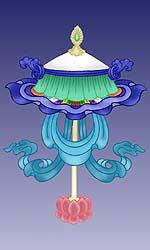
Canopy in form of a parasol (sangai 傘蓋, kasagata tengai 傘形天蓋)
An extensive articel about the parasol as a Buddhist symbol is given below.
Many were made of cloth and did not withstand the times, so there are few examples. They are often represented in Tibetan paintings above a deity. The parasol is one of the eight jewels of Tibetan Buddhism. It denotes respect; gives protection from all evil and the heat of evil desires.

http://www.mehndiskinart.com/tibet_eight_jewels.htm
Statue with white parasol

http://www.tenpodo.com/huusui-alacarte-40429-30.htm
.. .. ..
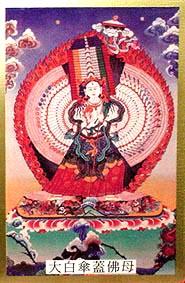
Here is a Buddha statue, holding such a parasol.

白傘蓋仏頂は密号を異相金剛と称する。白傘蓋は、傘が人を覆うことに例え、白い清浄な大慈悲をもって法界を覆い尽くす意味がある。写真(上)はモンゴル密教のバライシル仏をもとに作成しているが、胎蔵界曼荼羅釈迦院の白傘蓋仏頂は頭に五智宝冠を戴し、左手に開蓮華を握り、蓮華の上に白傘蓋を安置し、右手を揚げ、半跏跌座する。
http://store.yahoo.co.jp/kurita/571.html
This type is allso called "Canopy in a mountain form", yamagata tengai 山型天蓋) with eight corners.


These examples are from Minobusan. 身延山型人天蓋 八角
http://www7.ocn.ne.jp/~daisogon/nounyu/minobusan.htm
Look at this link for many more photos of canopies.
http://www7.ocn.ne.jp/~daisogon/nounyu/nounyuu.htm
:::::::::::::::::::::::::::::::::::::::::::::::::::::::::::::::::::::::::::::::::::::::::::::::::::::
Canopy of the Buddha Law, hoogai 法蓋
Dharma-Canopy
A special form of the Parasol Canopy.
Used for esoteric ceremonies for the initiation of a high priest (jushiki kanjoo) and is held by a layman over the initiand's head. In Japan also used when inthroning an emperor.
:::::::::::::::::::::::::::::::::::::::::::::::::::::::::::::::::::::::::::::::::::::::::::::::::::::
Canopy with treasures, hoogai 宝蓋
Schatz-Baldachin
Richly decorated. Above a Buddha statue or the seat of a priest.
Descirbed in detail in the sutra of Vimalakirti.

http://www.tctv.ne.jp/tobifudo/newmon/butugu/butugu/butugu.html
:::::::::::::::::::::::::::::::::::::::::::::::::::::::::::::::::::::::::::::::::::::::::::::::::::::
Canopy with Sanskrit letters of the Budhdas, sanmaya tengai, samaya tengai 三摩耶天蓋
The symbolic letters and mantras of the deities are encraved in the wooden canopy. Usually square with not so much other decorations.
Samaya Mandala
"Samaya" is a Sanskrit word meaning "a coming together, and agreement." So Samaya-mandalas express the ontological unity underlying the diversity of all things in space-time as forms of Dainichi’s Dharma Body. Accordingly, every thing and event in the universe is a samaya or "coming together, and agreement" of this ontological unity -- all things and events are forms of Dainichi -- experienced from the perspective of Dainichi, as well as all Buddhas.
http://www.religion-online.org/showarticle.asp?title=2853
:::::::::::::::::::::::::::::::::::::::::::::::::::::::::::::::::::::::::::::::::::::::::::::::::::::
White canopy, byakugai 白蓋
Made from white silk. It is used for initiation ceremonies of the esoteric Buddhist sects as a symbol of the Diamant Wolrd (kongookai 金剛界). To represent the Womb World (taizookai 胎蔵曼), a red canopy (sekigai 赤蓋) is used.
:::::::::::::::::::::::::::::::::::::::::::::::::::::::::::::::::::::::::::::::::::::::::::::::::::::
Canopy with banners for a person, 金襴幡蓮型人天蓋

http://wakabayashi.main.jp/lineup_n_tengai.php
:::::::::::::::::::::::::::::::::::::::::::::::::::::::::::::::::::::::::::::::::::::::::::::::::::::
Ritual of pulling strings for canopies, tengaibiki 天蓋引き
世界大神宮御神前奉納神楽
http://www.h4.dion.ne.jp/~s-tomi/page011.html
The Kagura performance and the Canopy Tengai
天蓋天にかかる蓋という意味で、仏像などの頭上に懸垂された蓋を指す。インドでは日差しが厳しく、説法の時には直射を避けるために傘を用いていたが、後に仏像が造立されるに及んで頭上に皿の形をした蓋を付ける風習が生まれた。石見神楽では舞座の頭上に吊るした飾りを天蓋という。(別名「青しば」、「くも」などとも呼ぶ)一間四方の竹の枠に榊の枝などを稠密に絡ませ、白幣や五色の幣が飾り付けられる。天蓋は秋祭りの当日に氏子によって丹念に作られ、神楽には欠かせないものの一つである。
http://www.h5.dion.ne.jp/~gf-4410/arekore.htm
:::::::::::::::::::::::::::::::::::::::::::::::::::::::::::::::::::::::::::::::::::::::::::::::::::::
Mural of the scene of Shakyamuni's "Pure Land"
Horyu-ji temple (Photo courtesy of Benrido)

There is a straw canopy (tengai) and angels in the upper portion of the mural, while at Shakyamuni's feet lies an altar with lions on its right and left sides.
Emi Koseto, Museum Science Department, National Museum of Japanese History)
http://www.rekihaku.ac.jp/e-rekihaku/123/cover.html
:::::::::::::::::::::::::::::::::::::::::::::::::::::::::::::::::::::::::::::::::::::::::::::::::::::
:::::::::::::::::::::::::::::::::::::::::::::::::::::::::::::::::::::::::::::::::::::::::::::::::::::
The above text unless links are given is mostly quoted from my book about Buddhist ritual tools.
Buddhistisches Kultgeraet
I took the first photo at temple Raikyuu-Ji, Takanashi:
Daruma Pilgrims in Japan: Kobori Enshuu
:::::::::::::::::::::::::::::::::::::::::::::::::::::::::::::::::::::::::::::::::::::::::::::::::::::
:::::::::::::::::::::::::::::::::::::::::::::::::::::::::::::::::::::::::::::::::::::::::::::::::::::
Back to the Daruma Museum
Back to the Daruma Forum
:::::::::::::::::::::::::::::::::::::::::::::::::::::::::::::::::::::::::::::::::::::::::::::::::::::
:::::::::::::::::::::::::::::::::::::::::::::::::::::::::::::::::::::::::::::::::::::::::::::::::::::
Canopy (tengai 天蓋, kengai 懸蓋 )
Sanskrit: chattra. Baldaquin.
Baldachin, Ehrendach, Schutzdach

Origin
In India during a religous assembly outside a temple the main priest had a servant who held a large umbrella over his head, to keep him some shade and coolness. The main priest would also sometimes sit with his back under a large tree.
Thus an umbrella (or rather a parasol) became the symbol for Shakyamuni, the Buddha himself.
The top part of a stupa, a reliquiar, usually also shows a decoration with the motive of an umbrella, since the bodily remains of Shakyamuni Buddha are sheltered in the building. This part of a stupa or pagod, usually with 13 tires, is called soorin 「相輪(そうりん)」

Reisan-ji, Temple Nr. 1 in Shikoku
http://darumapilgrim.blogspot.com/2005/05/shikoku-summer-2005.html
The canopy, once a symbol of Shakyamuni, was later installed as a kind of protecting conopy over a statue of Buddha or other deities. It is an expression of their honour and sanctity.
In a temple, it hangs over the main altar with the Buddha statue (butsu tengai 仏天蓋).
It also hangs over the special seat of a priest, where it is called "Canopy for a Human" (nintengai 人天蓋).

http://www.eitikai.co.jp/eitikai30s-7.htm
Example of Kobo Daishi (Kooboo Daishi 弘法大師 under a canopy with dragonhead decoration.
In esoteric Buddhist rites of initiation, a special canopy in the symbolic form of the Buddha is used.
Form
Round, oval, with four, six or eight corners. In the form of boxes, lotus flowers or like a real parasol.
From the sides, decorations hang down (yooraku 瓔珞), jewelled nets (ramoo 羅網) .
Material
Usually from wood, gilded, with mother of pearl inlay or metal decoration covers.
The canopy belongs to the lavish tempel decorations (shoogon 荘厳).

PHOTO: http://www.yasuda-shokeido.co.jp/shogon/shogon03.html
:::::::::::::::::::::::::::::::::::::::::::::::::::::::::::::::::::::::::::::::::::::::::::::::::::::
.. .. .. .. Special Types of Canopies
Canopy in form of a box (hakogata tengai 箱形天蓋)
Usually a square box with a flat wooden roof. Richly decorated on the sides and with hanging decorations, nets of pearls (jumoo重網). Sometimes figures of angles, apsaras, phenix or other things are attached to the roof part.
The most important canopy of this type is here:

Temple Hooryuu-Ji, Nara
It is from the Asuka period, with a width of 242,5 cm.
「法隆寺」 金堂西の間天蓋
幅242.5 奥行217 飛鳥時代 七世紀

Look at more details of this phantastic canopy.
http://www1.kcn.ne.jp/~lippi/kaiga11.htm
:::::::::::::::::::::::::::::::::::::::::::::::::::::::::::::::::::::::::::::::::::::::::::::::::::::
Canopy in form of a lotus flower (hanagata tengai 花形天蓋, kegyoo tengai 花行 天蓋, kagai 華蓋)
Usually round with three or more layers of concentrical circles. The innermost circle is the flower heart (kashin 花心). The various circles are separated by layers of pearl circles (renjumon).
Very popular during the Heian period. One example is at the famous Phoenix Hall in the Temple Byodo-In, Uji. 「宇治平等院」
Here is an example from the British Museum.

A canopy or tengai, hangs from the ceiling of Japanese Buddhist temples above the images of Buddhas and bodhisattvas. It originated in India as a sunshade used by the nobility and appears as such in early Indian Buddhist images, although it also suggests the folaige of a tree, beneath which persons in authority sat to speak in public. Fragments of textile from a parasol have been found at Dunhuang in China. In Japan, the tengai are usually made of painted wood on a metal frame and are often elaborately carved.
This example has a lotus flower at the centre surrounded by rings of floral and scroll designs. It has gilt, copper and glass fittings.
Diameter: 61 cm
http://tinyurl.com/b9vr4
:::::::::::::::::::::::::::::::::::::::::::::::::::::::::::::::::::::::::::::::::::::::::::::::::::::
Canopy in form of a parasol (sangai 傘蓋, kasagata tengai 傘形天蓋)
An extensive articel about the parasol as a Buddhist symbol is given below.
Many were made of cloth and did not withstand the times, so there are few examples. They are often represented in Tibetan paintings above a deity. The parasol is one of the eight jewels of Tibetan Buddhism. It denotes respect; gives protection from all evil and the heat of evil desires.

http://www.mehndiskinart.com/tibet_eight_jewels.htm
Statue with white parasol

http://www.tenpodo.com/huusui-alacarte-40429-30.htm
.. .. ..
Here is a Buddha statue, holding such a parasol.

白傘蓋仏頂は密号を異相金剛と称する。白傘蓋は、傘が人を覆うことに例え、白い清浄な大慈悲をもって法界を覆い尽くす意味がある。写真(上)はモンゴル密教のバライシル仏をもとに作成しているが、胎蔵界曼荼羅釈迦院の白傘蓋仏頂は頭に五智宝冠を戴し、左手に開蓮華を握り、蓮華の上に白傘蓋を安置し、右手を揚げ、半跏跌座する。
http://store.yahoo.co.jp/kurita/571.html
This type is allso called "Canopy in a mountain form", yamagata tengai 山型天蓋) with eight corners.


These examples are from Minobusan. 身延山型人天蓋 八角
http://www7.ocn.ne.jp/~daisogon/nounyu/minobusan.htm
Look at this link for many more photos of canopies.
http://www7.ocn.ne.jp/~daisogon/nounyu/nounyuu.htm
:::::::::::::::::::::::::::::::::::::::::::::::::::::::::::::::::::::::::::::::::::::::::::::::::::::
Canopy of the Buddha Law, hoogai 法蓋
Dharma-Canopy
A special form of the Parasol Canopy.
Used for esoteric ceremonies for the initiation of a high priest (jushiki kanjoo) and is held by a layman over the initiand's head. In Japan also used when inthroning an emperor.
:::::::::::::::::::::::::::::::::::::::::::::::::::::::::::::::::::::::::::::::::::::::::::::::::::::
Canopy with treasures, hoogai 宝蓋
Schatz-Baldachin
Richly decorated. Above a Buddha statue or the seat of a priest.
Descirbed in detail in the sutra of Vimalakirti.

http://www.tctv.ne.jp/tobifudo/newmon/butugu/butugu/butugu.html
:::::::::::::::::::::::::::::::::::::::::::::::::::::::::::::::::::::::::::::::::::::::::::::::::::::
Canopy with Sanskrit letters of the Budhdas, sanmaya tengai, samaya tengai 三摩耶天蓋
The symbolic letters and mantras of the deities are encraved in the wooden canopy. Usually square with not so much other decorations.
Samaya Mandala
"Samaya" is a Sanskrit word meaning "a coming together, and agreement." So Samaya-mandalas express the ontological unity underlying the diversity of all things in space-time as forms of Dainichi’s Dharma Body. Accordingly, every thing and event in the universe is a samaya or "coming together, and agreement" of this ontological unity -- all things and events are forms of Dainichi -- experienced from the perspective of Dainichi, as well as all Buddhas.
http://www.religion-online.org/showarticle.asp?title=2853
:::::::::::::::::::::::::::::::::::::::::::::::::::::::::::::::::::::::::::::::::::::::::::::::::::::
White canopy, byakugai 白蓋
Made from white silk. It is used for initiation ceremonies of the esoteric Buddhist sects as a symbol of the Diamant Wolrd (kongookai 金剛界). To represent the Womb World (taizookai 胎蔵曼), a red canopy (sekigai 赤蓋) is used.
:::::::::::::::::::::::::::::::::::::::::::::::::::::::::::::::::::::::::::::::::::::::::::::::::::::
Canopy with banners for a person, 金襴幡蓮型人天蓋

http://wakabayashi.main.jp/lineup_n_tengai.php
:::::::::::::::::::::::::::::::::::::::::::::::::::::::::::::::::::::::::::::::::::::::::::::::::::::
Ritual of pulling strings for canopies, tengaibiki 天蓋引き
世界大神宮御神前奉納神楽
http://www.h4.dion.ne.jp/~s-tomi/page011.html
The Kagura performance and the Canopy Tengai
天蓋天にかかる蓋という意味で、仏像などの頭上に懸垂された蓋を指す。インドでは日差しが厳しく、説法の時には直射を避けるために傘を用いていたが、後に仏像が造立されるに及んで頭上に皿の形をした蓋を付ける風習が生まれた。石見神楽では舞座の頭上に吊るした飾りを天蓋という。(別名「青しば」、「くも」などとも呼ぶ)一間四方の竹の枠に榊の枝などを稠密に絡ませ、白幣や五色の幣が飾り付けられる。天蓋は秋祭りの当日に氏子によって丹念に作られ、神楽には欠かせないものの一つである。
http://www.h5.dion.ne.jp/~gf-4410/arekore.htm
:::::::::::::::::::::::::::::::::::::::::::::::::::::::::::::::::::::::::::::::::::::::::::::::::::::
Mural of the scene of Shakyamuni's "Pure Land"
Horyu-ji temple (Photo courtesy of Benrido)

There is a straw canopy (tengai) and angels in the upper portion of the mural, while at Shakyamuni's feet lies an altar with lions on its right and left sides.
Emi Koseto, Museum Science Department, National Museum of Japanese History)
http://www.rekihaku.ac.jp/e-rekihaku/123/cover.html
:::::::::::::::::::::::::::::::::::::::::::::::::::::::::::::::::::::::::::::::::::::::::::::::::::::
| The Parasol (Skt. chattra; Tib. gdugs) One of The Eight Auspicious Symbols of Buddhism by Nitin Kumar Above the mountain is the dome of the sky. This is symbolized by the umbrella, whose important function is to cast a shadow, the shadow of protection. The dictionary defines a parasol as an umbrella used for protection from the sun. Thus its function is to protect exclusively from the heat rather than the rain - as the word 'parasol,' meaning 'to hold off the sun,' and 'umbrella,' meaning 'little shade,' similarly imply. The Sanskrit term 'chattra,' also means 'mushroom,' in an obvious reference to its shape. The parasol or umbrella is a traditional Indian symbol of both protection and royalty. The ability to protect oneself against inclement weather has always, in all cultures, been a status symbol. In Europe, until a few decades ago, a sunshade was a status symbol for society ladies. In Oriental thought, the fact that it protected the bearer from the scorching heat of the sun was transferred into the religious sphere as a "protection against the heat of defilements." Thus the coolness of its shade symbolizes protection from the heat of suffering, desire, and other spiritually harmful forces. The dome of the umbrella is held aloft by a vertical handle (just like the mountain upholds the sky), which is identified with the 'axis mundi,' or the central axis upholding the world. The umbrella is carried above an important dignitary or the image of a deity, to indicate that the person or symbol below the umbrella is in fact the center of the universe, and also its spiritual support. Umbrellas seem to be especially important in processional rites, being like mobile temples. Thus, depictions of the Buddha often display an elaborate and large umbrella above his head. As it is held above the head it naturally symbolizes honor and respect. In Vajrayana Buddhism, this large umbrella (atapatra) was even deified into the thousand-armed, -footed goddess Sitapatra, whose name literally means 'the white umbrella.' In Tibet, depending on their status, various dignitaries were entitled to different parasols, with religious heads being entitled to a silk one and secular rulers to a parasol with embroidered peacock feathers. Exalted personalities such as the Dalai Lama are entitled to both, and in processions, first a peacock parasol and then a silk one is carried after him. The Tibetan version of the parasol was adopted from its royal Indian and Chinese prototypes, and fashioned from a wooden, spoked frame with a domed silk cover and hanging silk pendants making up an overhanging skirt. The dome symbolizes wisdom, and the hanging skirt, compassion. Thus the composite form of the parasol signifies the union of these dual elements. Octagonal and square parasols are also common, representing the Noble Eightfold Path and the four directional quarters respectively. © This article by Nitin Kumar, Editor http://www.exoticindia.com Look here to see the illustrations with it and read more about the eight auspicious symbols in Buddhism. http://www.exoticindia.com/article/symbols |
:::::::::::::::::::::::::::::::::::::::::::::::::::::::::::::::::::::::::::::::::::::::::::::::::::::
The above text unless links are given is mostly quoted from my book about Buddhist ritual tools.
Buddhistisches Kultgeraet
I took the first photo at temple Raikyuu-Ji, Takanashi:
Daruma Pilgrims in Japan: Kobori Enshuu
:::::::::::::::::::::::::::::::::::::::::::::::::::::::::::::::::::::::::::::::::::::::::::::::::::::
| Text in German, see illustrations above. Baldachin (tengai, kengai, hoogai; S: chattra) Ehrendach, Schutzdach. Ursprung: Im heißen Indien saßen die Gläubigen bei Versammlungen oft im Freien unter einem Baum oder hielten Sonnenschirme über dem Kopf, um sich etwas Schatten und Kühlung zu verschaffen. Der Vorsteher der Versammlung saß mit dem Rücken zum Stamm. Diese Art der Versammlung wird auch in den Abbildungen des historischen Buddhas Shaakyamuni (Shakasama, Shaka Nyorai) beim Predigen dargestellt. Später galt der Sonnenschirm als Symobl der Würde des Herrschers und damit auch des Shaakyamuni. Vor dem Aufkommen von Buddhastatuen wurde die Anwesenheit des Shaakyamuni nur durch Symbole angedeutet, z.B. den Bodhi-Baum (bodaiju), unter dem er die Erleuchtung erlangte, oder einen Sonnenschirm als Zeichen seiner königlichen Abstammung. Auf einem Stupa, einem weiteren Symbol des Shaakyamuni, befindet sich als oberster Teil ein oder mehrere symbolische Sonnenschirme, die Ehrenschirme (soorin). Auch nachdem man zur Herstellung von Buddhastatuen übergegangen war, wurde über dem Haupt der Statue als Symbol eines Sonnenschirmes ein sehr stark verzierter Baldachin anbegracht, der nun die Funktion eines rituellen Schmuckobjektes bekam. Symbolik: Ausdruck der Würde eines Tathaagata-Buddhas oder Bodhisattvas. Ausdruck der Heiligkeit und Würde des sich darunter befindenden Gegenstandes bzw. der Statue. Funktion: Hängt als eine Art Würdezeichen im Tempel über der Altar-Plattform mit der Statue des Haupt-Heilswesens (butsutengai). Wenn er über dem Priestersitz hängt, wird er "Baldachin für einen Menschen" (nintengai, hoogai ) genannt. Im esoterischen Buddhismus bei Initiationszeremonien wird ein besonderer Baldachin der Symbolformen der Buddhas verwendet. Form: Rund, oval viereckig, sechseckig oder achteckig. An den Seiten hängen Schmuckketten (yooraku), Banner und andere Schmuckgegenstände herab. Mit Figuren von engelsartigen Himmelswesen (tennin, tennyo; S: apsaras) oder Blüten geschmückt. Nach Sekine unterscheidet man die bei den besonderen Typen beschriebenen drei Haupttypen: kastenförmig, lotusblütenförmig und sonnenschirmförmig. Material: Der Kasten ist meist aus Holz. Mit Perlmuttintarsien oder Metallbeschlägen oft reich verziert. Besondere Typen Kastenförmiger Baldachin (hakogata tengai) Ein viereckiger Kasten, auf dem sich eine Art Walmdach befindet. Das Dach selbst kann auch die Form einer flachen Dachplatte (tenpan) haben. Am Rand dieser Dachplatte und der Dachtraufe (nokimawari) sind "windabweisende" Bretter (fukigaeshiita, fukikaeshiita) angebracht, von denen Schmuckgegenstände herabhängen, z.B. hölzerne "Perlennetze" (jumoo). Auf dem Dachteil befinden sich manchmal holzgeschnitzte Figuren von engelsartigen Himmelswesen, Phönixen (hoooo) u.a. dekorativen Gegenständen. Die Seiten können auch mit Metallbeschlägen oder Perlmuttintarsien geschmückt sein. Beispiel: Baldachin in der Goldenen Halle des Temples Hooryuuji, Nara. Lotusblüten-Baldachin (kegyoo tengai, hanagata tengai) Dieser Baldachin ist immer rund (engai, enkei tengai); er hat sich aus dem einfachen Sonnenschirm-Baldachin entwickelt. Dieser Typ wurde seit der Heian-Zeit besonders häufig hergestellt. Er besteht im allgemeinen aus drei konzentrischen Kreisen: äußerer Kreis (gaienbu), mittlerer Kreis (chuuku) und innerster Kreis (kooshinbu), wörtlich "Blumenherz" (kashin). Die konzentrischen Kreise sind wie eine Lotusblüte geformt. Die Blütenblätter-Teile sind durch Perlleisten oder Perlschnüre (renjumon getrennt. Die Kreise können auch mit Blumenmustern im chinesischen Stil (hoosooge) verziert oder als Durchbrucharbeiten gefertigt sein. Der innerste Kreis, das Zentrum der Blüte, kann durch einen Spiegel aus Nickel gebildet werden. Beim äußeren Kreis ist die Lotusblütenform besonders deutlich ausgeprägt. Perlschnur: Stab zur Betonung der Grenzlinie zwischen Bau- und Ornamentgliedern. Es gibt auch Baldachine mit doppelter Struktur (nijuu koozoo). Außen befindet sich ein großer kastenförmiger Baldachin, in den innen ein kleinerer, runder Lotusblüten-Baldachin eingearabeitet ist. Beispiel: Phönixhalle (hoooodoo) des Tempels Byoodooin, Uji. Sonnenschirm-Baldachin (sangai) "Bergförmiger Baldachin" (yamagata tengai) mit acht Ecken. Adelige Personen in Indien hatten beim Ausgehen immer einen Träger dabei, der einen großen Schirm als Schattenspender über ihren Kopf halten mußte. Ein derartiger Baldachin wird daher nur über Personen verwendet. Im indischen Buddhismus durften nur die kranken und sehr alten Mönche einen Sonnenschirm tragen, erst später wurde er für alle Mönche beim Ausgehen zugelassen, aber nur, wenn es regnete. Die Schirme waren damals aus Bambus oder Ranken geflochten und mit Blättern oder Stoffteilen verstärkt. Wegen der vergänglichen Art des Materials (Stoff) gibt es nur wenige Beispiele dieser Art, z.B. als Abbildungen bei kleinen Halbrelief-Figuren von Heilswesen auf Bronzeplatten (oshidashibutsu) oder bei Figuren von Heilswesen auf Lehmziegeln (senbutsu). [Sekine] Sutra: Daranikyoo (Dhaaranii-suutra). Gesetz-Baldachin (hoogai) Eine Unterform des Sonnenschirm-Baldachins. Dieser Baldachin wird bei Zeremonien zum Amtsantritt eines Priesters (jushiki kanjoo) von einem Laien über dem Kopf des Priesters gehalten. In Japan wird er bei den Einsetzungsfeierlichkeiten eines Tennoo oder eines hohen Priesters verwendet. Die Farbe und die Verzierungen entsprechen der Stellung der Person. Schatz-Baldachin (hoogai) Mit Juwelen und Perlennetzen besonders reich geschmückter Baldachin. Er hängt entweder über einer Buddhastatue oder dem Priestersitz. Sutra: Yuimagyoo (Vimalakiirti Nirdesha Suutra). In den Tempeln des esoterischen Buddhismus findet man besonders die beiden folgenden Typen: Baldachin der Symbolformen der Buddhas (sanmaya tengai, samaya tengai) Funktion: Wird im esoterischen Buddhismus bei Initiationszeremonien verwendet. Über dem Großen Altar der Diamantwelt und dem der Mutterschoßwelt hängt jeweils ein entsprechender Baldachin (kontengai und taitengai). Form: Achteckig oder viereckig. An den vier Ecken hängen kleine Banner, die den Raum in vier Segmente einteilen. In jedem Segment befindet sich ein Symbol für die Gelübde des jeweiligen Heilswesens. Auf der Unterseite der Dachplatte befinden sich die Keimsilben bzw. Sanskritzeichen (shuji, bonji, S: biija) von vier oder acht Heilswesen. Weißer Baldachin (byakugai) Baldachin aus ausgespannter weißer Seide. Wird bei Initiationszeremonien und anderen wichtigen Zeremonien des esoterischen Buddhismus als Symbol der Diamantwelt verwendet. Als Symbol der Mutterschoßwelt wird ein roter Baldachin (shakugai, sekigai) benutzt. BACK ... ZUM INHALTSVERZEICHNIS Buddhistische Kultgegenstände Japans Gabi Greve Daruma Pilgrims in Japan |
:::::::::::::::::::::::::::::::::::::::::::::::::::::::::::::::::::::::::::::::::::::::::::::::::::::
Back to the Daruma Museum
Back to the Daruma Forum
:::::::::::::::::::::::::::::::::::::::::::::::::::::::::::::::::::::::::::::::::::::::::::::::::::::
8/06/2005
Flower Garlands
[ . BACK to Daruma Museum TOP . ]
:::::::::::::::::::::::::::::::::::::::::::::::::::::::::::::::::::::::::::::::::::::::::::::::::::::
Flower Garlands, Flower Hangers, keman 華鬘
Sanskrit: kusuma maalaa
Schmuckplatte, Blumengirlande, decorative discs, pendant discs

Origin
In India and other hot countries it was the cutom, to decorate the body of a guest with a flower garland. Statues of deities and highranking priests were also decorated in this way, so that the disciples could show their devotion. Only normal monks and nuns were not allowed to receive such a garland of living flowers as a present.
In the sects of esoteric Buddhism it is customary to decorate the body of the initiant for a priest with a flower garland to indicate, that from now on, he is in the ranks of the deities.
In esoteric Buddhism there is a special Bodhisattva for flower decorations, Keman Bosatsu, 華鬘菩薩.
Flower garlands are also placed on the head of a dead person, to help the departing soul find its way to the other shore. Thus a flower garland is also a symbol for rebirth.
Function
Since real flowers do not last long in hot countries, they were reproduced in lasting materials for decorative purposes in a temple and as flower offerings. They belong to the ritual decoration objects (shoogon 荘厳) of a temple.
The flower garlands are hung on a special beam (nageshi) in a special place in the inner sanctuary (naijin 内陣). Long after the introduction of these objects to Japan, they were also used in Shintoo Shrines.

Form
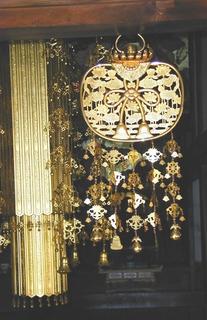
Most of the flower garlands are in the form of a Chinese hand-fan (uchiwa 団扇), some are round or oval. Since the end of the Haian period they are especially richly decorated.
Common patterns are Chinese arabesques and flower patterns, birds (karyoobingamon), Peonies and Lotus flowers, bird and flower patterns (kachoo 花鳥), angle-like maidens (apraras) or other religious motives.
On the top they have a hook of metal, which is usually decorated like a lotus blossom or a lotus leaf.
According to the form one can distinguish four types:
fretwork, form of a Chinese hand-fan, flower wreaths and pearl wreaths.
Material:
Wood, Jewels, seldom leather or woven material. Since the Heian period gilded bronze was often used.
Very fine silk gauze (ra keman 羅華鬘) was used in special situations, one of these pieces is still kept in the treasure storehouse of the Shoosoo-In 正倉院 of the temple Toodai-Ji in Nara.
Keman from material and thread (ito keman 糸華鬘, soshi keman ソシ華鬘) are known, also some of knotted thread (kumihimo keman 組みひも華鬘.
Keman with a replica of a real flower garland are called hana tsunagi-shiki keman 花つなぎ式華鬘. When pearls are used instead of flower motives, they are called tama tsunagi-shiki keman 玉つなぎ式華鬘, gyokushiki keman .
:::::::::::::::::::::::::::::::::::::::::::::::::::::::::::::::::::::::::::::::::::::::::::::::::::::
Let us look at some special types:
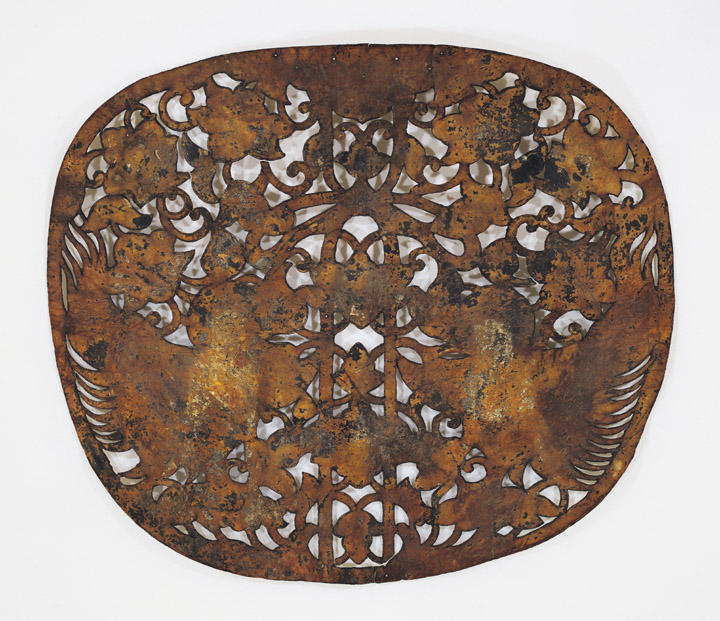
Flower decorations made of leather (gohi keman 牛皮華鬘)
They are usually in fretwork (sukashibori 透かし彫り)and covered with gold powder or color. Leather objects in a Buddhist temple are usually not seen, since it was now allowed to take the live of living beings and the killing of cows was forbidden.
Quote from the National Museum, Tokyo

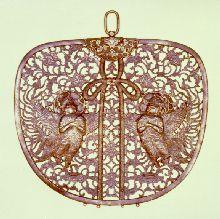
These stylized garlands, made of leather, originally belonged to Kyôôgokoku-ji Temple, more commonly known as Tô-ji, in Kyoto. Today, thirteen ornaments remain, all of them fashioned in openwork leather, which were lacquered, primed with white clay, and then decorated with polychrome patterns. The thirteen can be roughly divided into two types based on their motifs. One type has two Kalavinkas (J. Karyôbinga, karyoobinga, paradisiacal birds with human heads) facing each other on a ground of hôsôge, imaginary Buddhist flowers, made to look like real flowers. The center shows a bow reminiscent of that which would have bound together fresh flowers. The Kalavinkas hold floral baskets containing blossoms to scatter on the buddhas and bodhisattvas in praise. In the other type, the bow is placed at the center with floral tendrils and arabesques (J. karakusa) covering the entire surface.
The thirteen pieces exhibit individual differences in style. Since there are at least three or four distinguishable styles in both garland types, it is difficult to believe that these ornaments originally formed one set. The superior stylistic treatment exhibited in Stylized Garlands numbers 7 and 8, seen in the use of the red lines on the bodies of the Kalavinka and the delicate cut gold leaf on the robes, reflects traditional techniques of Buddhist painting of the Heian period (794-1185). On the ornaments with only floral tendrils and arabesques, a gradation technique called ungen zaishiki (in which several shades of similar hue are closely brushed together) and delicate patterns of cut gold leaf were applied.
The iconography of two Kalavinkas facing each other on a ground of floral tendrils can also be found on the gilt-bronze openwork garlands of Chûson-ji Temple in Iwate Prefecture, which are presumed to date from the first half of the twelfth century. The resplendent examples in the Nara National Museum are thought to have preceded the Chûson-ji pieces. Although there is no record as to the hall in which the former garlands were used, they are believed to have been produced sometime in the eleventh century.
Look at more keman from leather:
http://www.emuseum.jp/cgi/pkihon.cgi?SyoID=7&ID=w008&SubID=s000&Link=
. - The Six Birds of Paradise - 浄土の鳥 - .
:::::::::::::::::::::::::::::::::::::::::::::::::::::::::::::::::::::::::::::::::::::::::::::::::::::
Flower Garland in the form of a Chinese Hand-fan (uchiwagata 団扇形)
Maybe the most famous of this type is preserved at the Temple Chuuson-Ji in Hiraizumi.

http://www.pref.iwate.jp/~hp0910/kore_naani/t/h/05.html
The outside is formed by a metal band (fukurin). In the middle is a thread with a decorative knot with two hangers (agemaki 総角). This is part of the motive of a real flower decoration, when the blossoms were threaded to keep in form. It reminds of the knots used in a Japanese samurai body armour.
On the bottom are small metal bells in form of dewdrops (rogata kanagu ろ型金具) and stripes (tansakugata kanagu たんさく型金具.
華鬘といえば金色堂のこの華鬘のかたちが思いおこされるほどに、わが国の平安時代を代表(だいひょう)する金工芸品です。金色堂にはこの華鬘と同じ作りのものが三面残されており、金色に光りかがやくお堂の中の中央壇(ちゅうおうだん)を飾ったものと伝えられています。今から八百数十年前に岩手に花開いた奥州平泉文化の華やかさを物語るものといえましょう。
http://www.pref.iwate.jp/~hp0910/kore_naani/t/h/05.html
In esoteric Buddhism, we also find this form with Sanskrit letters (seed syllables) in the middle (shuji keman 種子華鬘). The sylables are sometimes in a circle (ensoo) on a small lotus podest. Sometimes they were shown within a small pagoda.

http://www.narahaku.go.jp/meihin/kougei/116.html
:::::::::::::::::::::::::::::::::::::::::::::::::::::::::::::::::::::::::::::::::::::::::::::::::::::
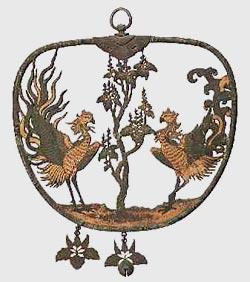
Keman with cut-out patterns (saimonshiki keman 裁文式華鬘)
saimon is short for: saidan shita monyoo 裁断した文様)

From Kamakura, Hachimangu Shrine
Muromachi Period
本品は、神仏習合期の鶴岡八幡宮社殿内に奉献された荘厳具と思われ、寺院に伝来する華鬘とは、形式や意匠がやや異なる。竹幹状につくった縁を団扇状につくり、その内の中央に桐樹、その両面に対向する鳳凰を配した図様を木板を切透して表現し、木地に布を着せ、薄く黒漆を塗り、その上に群青、朱の色彩に金銀の箔を押した配色の極彩色である。
中央上部の釣金具は金銅製で宝相華唐草文を毛彫であらわし、下部には金銅板の瓔珞(ようらく)が付けられている。元来は3個あったものであろうが、現存は2個で、ともに桐文をかたちどるが中央は鈴になっている。
鳳凰は、古来中国で尊ばれた瑞鳥で、梧桐に宿り竹実を食べ醴泉を飲むといい、聖徳の天子の時に出現すると伝えられている。鳳凰に桐竹を配しているのは、この伝説に基づくのであろう。わが国でも古くから瑞祥文として、この意匠が好まれたと思われる。
http://www.hachimangu.or.jp/about/precious/c05_03.html
Usually in form of a fan or round. Motives can be flowers (hanagata saimon)、 phoenix birds (hoo-oo gata saimon 鳳凰型裁文) like the one above, or Sanskrit letters. The material is usually wood or gildes bronze.
...............................
With Chrysanthemum and Peony Motives
Made in 1389

岡山県・弘法寺(こうぼうじ)より伝来した木製彩色透彫りの華鬘。同寺には重要文化財に指定されている2面が伝えられ、当館に2面が所蔵されている。同寺伝存の納置用黒漆箱蓋裏に「花慢十二流」、身底に「千手山/備前国熊山霊仙寺本堂花慢/箱常住物也/康応元年己巳十一月十五日/別当祐円/当行事祐盛」の墨書銘があり、もとは一具12枚のうちの2枚であること、康応元年ころの制作であることがわかる。団扇形の檜の薄板2枚を重ねて文様を透彫りし、周囲に金銅覆輪をめぐらし、中央に縦に金銅打出しの総角形金具を鋲留めしている。透彫りの文様は1面を菊花、他面を牡丹としており、漆下地に白土をおき、その上に緑青・群青・朱・代赭などを彩色している。文様はそれぞれ総角をはさんで左右対称に配されている。吊金具は金銅花先形猪目透(こんどうはなさきがたいのめすかし)しの二重座に菊座を重ね、茄子鐶付きの切子頭鐶台をのせている。花先形金具には魚々子地(ななこじ)に宝相華唐草文を毛彫りしている。
Nara National Museum
Made from wood
http://www.narahaku.go.jp/meihin/kougei/117.html
Some other links
http://www.mus.city.kasugai.aichi.jp/cultural_detail.php?id=2084&nu=13&page=1
円乗院寺宝
http://www.evam.ne.jp/enjyoin/jihou.html
Keman Bosatsu 金剛鬘菩薩, 金剛華鬘菩提
The Bodhisattva of Flower Garland Offerings

金剛鬘菩薩は梵名をバザラマリと云ひ、譯して金剛鬘と云ふ。又た密號を妙嚴金剛と稱し、大日如來の心中より流出し、南方寶生如來の徳を供養する菩薩にして、寶生如來の三摩地に相應するが如く華鬘の標幟を以てす。即ち華鬘は理智具足して萬徳開發の形にして、之れ寶生如來の三摩地に相應するなり。故に聖位經に曰く「毘盧遮那佛内心に於いて金剛華鬘菩提分法三摩地智を證得して自受用の故に乃至諸の衆生の醜陋の形を除いて三十二相八十種形の好身を獲得し乃至金剛華鬘菩薩の形を成し、毘盧遮那如來西南の隅の月輪に住す」と。
金剛界曼荼羅大月輪の西南隅に住し、成身會の像は白黄色にして兩手に花鬘を把り胸の前に横ふも、攝眞實經には高く額上に安んずと説く、微細會の像は成身會と同じく供養會の像は蓮上に莖あるを左手に持ち右手は拳にす。羯磨會の像は成身會と同じく花鬘を把る。
印相は攝眞實經に「金剛拳を結びて並に額上に置く」とあり、羯磨會は二手金剛拳にして頭指を伸べ旋し纏ひ、頭大二指を相支へて左右に引き兩掌を開いて肩に懸け、三昧耶會は外縛して二大指を竪て並べ頂上に散す。供養會は中指を竪て針の如くす。眞言に曰く、供養會はオンサラバタタギャタバザラハマサンマヂババナウハナウボジャナウババナウホジャメイキャサンボタラサハラトサンマエイウン。羯磨會はオンバザラマリタラタ。三昧耶會はロハユカイ。
http://homepage3.nifty.com/MandalaExplorer/kongou_kai/kon_1/kon_026-029/kon_027.html
On this link you can see the various forms of this Bodhisattva in the mandala world,
Nr. 27 金剛鬘菩薩(こんごうまんぼさつ)
They all wear flower garlands in their hands.
http://mandala.twinstar.jp/k-hotoke(2).htm
:::::::::::::::::::::::::::::::::::::::::::::::::::::::::::::::::::::::::::::::::::::::::::::::::::::
Read my haiku about these flower decorations:
Decoration Flowers in a Temple
:::::::::::::::::::::::::::::::::::::::::::::::::::::::::::::::::::::::::::::::::::::::::::::::::::::
Some references:
karyoobinga bird
http://www.aisf.or.jp/~jaanus/deta/k/karyoubinga.htm
agemaki, a special knotting in armour
http://www.oningyo.com/tango/koujin/meishou.html
:::::::::::::::::::::::::::::::::::::::::::::::::::::::::::::::::::::::::::::::::::::::::::::::::::::
The above text is mostly quoted from my book about Buddhist ritual tools.
Buddhistisches Kultgeraet
I took the first two photos at temple Raikyuu-Ji, Takanashi:
Daruma Pilgrims in Japan: Kobori Enshuu
:::::::::::::::::::::::::::::::::::::::::::::::::::::::::::::::::::::::::::::::::::::::::::::::::::::
plant kigo for late spring
kemansoo 華鬘草 (けまんそう) "Keman flower"
bleeding heart
keman けまん
keman botan 華鬘牡丹(けまんぼたん,
yooraku botan 瓔珞牡丹(ようらくぼたん)
fuji botan 藤牡丹(ふじぼたん)
taitsurisoo 鯛釣草(たいつりそう)"plant to catch a sea bream"
kikeman 黄華鬘(きけまん)yellow Keman
murasaki keman 紫華鬘(むらさきけまん)purple Keman
Dicentra spectabilis, Tränendes Herz
Lamprocapnos spectabilis
(formerly Dicentra spectabilis; old-fashioned bleeding-heart, Venus's car, Lady in a bath, Dutchman's trousers, or Lyre-flower)
is a rhizomatous perennial plant native to eastern Asia from Siberia south to Japan.
© More in the WIKIPEDIA !

The Japanese name comes from the fact that it resembles the KEMAN decorations of Buddhist temples.
幼いに花むしらるるけまんかな
osanai ni hana mushiraruru keman kana
一鷺
.................................................................................
plant kigo for late summer
komakusa 駒草 (こまくさ) "young horse plant"
Dicentra peregrina

:::::::::::::::::::::::::::::::::::::::::::::::::::::::::::::::::::::::::::::::::::::::::::::::::::::
:::::::::::::::::::::::::::::::::::::::::::::::::::::::::::::::::::::::::::::::::::::::::::::::::::::

Mon coeur suspendu
à son coup de téléphone -
premier rendez-vous.
My heart suspended
at her phone call -
first rendez-vous.
- Shared by Patrick Fetu -
Joys of Japan, July 2012
:::::::::::::::::::::::::::::::::::::::::::::::::::::::::::::::::::::::::::::::::::::::::::::::::::::

kuge 供花 flower offerings
In a temple or at home at the tokonoma or family home altar.
For a funeral.
:::::::::::::::::::::::::::::::::::::::::::::::::::::::::::::::::::::::::::::::::::::::::::::::::::::
[ . BACK to DARUMA MUSEUM TOP . ]
[ . BACK to WORLDKIGO . TOP . ]
:::::::::::::::::::::::::::::::::::::::::::::::::::::::::::::::::::::::::::::::::::::::::::::::::::::
:::::::::::::::::::::::::::::::::::::::::::::::::::::::::::::::::::::::::::::::::::::::::::::::::::::
Flower Garlands, Flower Hangers, keman 華鬘
Sanskrit: kusuma maalaa
Schmuckplatte, Blumengirlande, decorative discs, pendant discs

Origin
In India and other hot countries it was the cutom, to decorate the body of a guest with a flower garland. Statues of deities and highranking priests were also decorated in this way, so that the disciples could show their devotion. Only normal monks and nuns were not allowed to receive such a garland of living flowers as a present.
In the sects of esoteric Buddhism it is customary to decorate the body of the initiant for a priest with a flower garland to indicate, that from now on, he is in the ranks of the deities.
In esoteric Buddhism there is a special Bodhisattva for flower decorations, Keman Bosatsu, 華鬘菩薩.
Flower garlands are also placed on the head of a dead person, to help the departing soul find its way to the other shore. Thus a flower garland is also a symbol for rebirth.
Function
Since real flowers do not last long in hot countries, they were reproduced in lasting materials for decorative purposes in a temple and as flower offerings. They belong to the ritual decoration objects (shoogon 荘厳) of a temple.
The flower garlands are hung on a special beam (nageshi) in a special place in the inner sanctuary (naijin 内陣). Long after the introduction of these objects to Japan, they were also used in Shintoo Shrines.

Form
Most of the flower garlands are in the form of a Chinese hand-fan (uchiwa 団扇), some are round or oval. Since the end of the Haian period they are especially richly decorated.
Common patterns are Chinese arabesques and flower patterns, birds (karyoobingamon), Peonies and Lotus flowers, bird and flower patterns (kachoo 花鳥), angle-like maidens (apraras) or other religious motives.
On the top they have a hook of metal, which is usually decorated like a lotus blossom or a lotus leaf.
According to the form one can distinguish four types:
fretwork, form of a Chinese hand-fan, flower wreaths and pearl wreaths.
Material:
Wood, Jewels, seldom leather or woven material. Since the Heian period gilded bronze was often used.
Very fine silk gauze (ra keman 羅華鬘) was used in special situations, one of these pieces is still kept in the treasure storehouse of the Shoosoo-In 正倉院 of the temple Toodai-Ji in Nara.
Keman from material and thread (ito keman 糸華鬘, soshi keman ソシ華鬘) are known, also some of knotted thread (kumihimo keman 組みひも華鬘.
Keman with a replica of a real flower garland are called hana tsunagi-shiki keman 花つなぎ式華鬘. When pearls are used instead of flower motives, they are called tama tsunagi-shiki keman 玉つなぎ式華鬘, gyokushiki keman .
:::::::::::::::::::::::::::::::::::::::::::::::::::::::::::::::::::::::::::::::::::::::::::::::::::::
Let us look at some special types:
Flower decorations made of leather (gohi keman 牛皮華鬘)
They are usually in fretwork (sukashibori 透かし彫り)and covered with gold powder or color. Leather objects in a Buddhist temple are usually not seen, since it was now allowed to take the live of living beings and the killing of cows was forbidden.
Quote from the National Museum, Tokyo

These stylized garlands, made of leather, originally belonged to Kyôôgokoku-ji Temple, more commonly known as Tô-ji, in Kyoto. Today, thirteen ornaments remain, all of them fashioned in openwork leather, which were lacquered, primed with white clay, and then decorated with polychrome patterns. The thirteen can be roughly divided into two types based on their motifs. One type has two Kalavinkas (J. Karyôbinga, karyoobinga, paradisiacal birds with human heads) facing each other on a ground of hôsôge, imaginary Buddhist flowers, made to look like real flowers. The center shows a bow reminiscent of that which would have bound together fresh flowers. The Kalavinkas hold floral baskets containing blossoms to scatter on the buddhas and bodhisattvas in praise. In the other type, the bow is placed at the center with floral tendrils and arabesques (J. karakusa) covering the entire surface.
The thirteen pieces exhibit individual differences in style. Since there are at least three or four distinguishable styles in both garland types, it is difficult to believe that these ornaments originally formed one set. The superior stylistic treatment exhibited in Stylized Garlands numbers 7 and 8, seen in the use of the red lines on the bodies of the Kalavinka and the delicate cut gold leaf on the robes, reflects traditional techniques of Buddhist painting of the Heian period (794-1185). On the ornaments with only floral tendrils and arabesques, a gradation technique called ungen zaishiki (in which several shades of similar hue are closely brushed together) and delicate patterns of cut gold leaf were applied.
The iconography of two Kalavinkas facing each other on a ground of floral tendrils can also be found on the gilt-bronze openwork garlands of Chûson-ji Temple in Iwate Prefecture, which are presumed to date from the first half of the twelfth century. The resplendent examples in the Nara National Museum are thought to have preceded the Chûson-ji pieces. Although there is no record as to the hall in which the former garlands were used, they are believed to have been produced sometime in the eleventh century.
Look at more keman from leather:
http://www.emuseum.jp/cgi/pkihon.cgi?SyoID=7&ID=w008&SubID=s000&Link=
. - The Six Birds of Paradise - 浄土の鳥 - .
:::::::::::::::::::::::::::::::::::::::::::::::::::::::::::::::::::::::::::::::::::::::::::::::::::::
Flower Garland in the form of a Chinese Hand-fan (uchiwagata 団扇形)
Maybe the most famous of this type is preserved at the Temple Chuuson-Ji in Hiraizumi.

http://www.pref.iwate.jp/~hp0910/kore_naani/t/h/05.html
The outside is formed by a metal band (fukurin). In the middle is a thread with a decorative knot with two hangers (agemaki 総角). This is part of the motive of a real flower decoration, when the blossoms were threaded to keep in form. It reminds of the knots used in a Japanese samurai body armour.
On the bottom are small metal bells in form of dewdrops (rogata kanagu ろ型金具) and stripes (tansakugata kanagu たんさく型金具.
華鬘といえば金色堂のこの華鬘のかたちが思いおこされるほどに、わが国の平安時代を代表(だいひょう)する金工芸品です。金色堂にはこの華鬘と同じ作りのものが三面残されており、金色に光りかがやくお堂の中の中央壇(ちゅうおうだん)を飾ったものと伝えられています。今から八百数十年前に岩手に花開いた奥州平泉文化の華やかさを物語るものといえましょう。
http://www.pref.iwate.jp/~hp0910/kore_naani/t/h/05.html
In esoteric Buddhism, we also find this form with Sanskrit letters (seed syllables) in the middle (shuji keman 種子華鬘). The sylables are sometimes in a circle (ensoo) on a small lotus podest. Sometimes they were shown within a small pagoda.

http://www.narahaku.go.jp/meihin/kougei/116.html
:::::::::::::::::::::::::::::::::::::::::::::::::::::::::::::::::::::::::::::::::::::::::::::::::::::
Keman with cut-out patterns (saimonshiki keman 裁文式華鬘)
saimon is short for: saidan shita monyoo 裁断した文様)

From Kamakura, Hachimangu Shrine
Muromachi Period
本品は、神仏習合期の鶴岡八幡宮社殿内に奉献された荘厳具と思われ、寺院に伝来する華鬘とは、形式や意匠がやや異なる。竹幹状につくった縁を団扇状につくり、その内の中央に桐樹、その両面に対向する鳳凰を配した図様を木板を切透して表現し、木地に布を着せ、薄く黒漆を塗り、その上に群青、朱の色彩に金銀の箔を押した配色の極彩色である。
中央上部の釣金具は金銅製で宝相華唐草文を毛彫であらわし、下部には金銅板の瓔珞(ようらく)が付けられている。元来は3個あったものであろうが、現存は2個で、ともに桐文をかたちどるが中央は鈴になっている。
鳳凰は、古来中国で尊ばれた瑞鳥で、梧桐に宿り竹実を食べ醴泉を飲むといい、聖徳の天子の時に出現すると伝えられている。鳳凰に桐竹を配しているのは、この伝説に基づくのであろう。わが国でも古くから瑞祥文として、この意匠が好まれたと思われる。
http://www.hachimangu.or.jp/about/precious/c05_03.html
Usually in form of a fan or round. Motives can be flowers (hanagata saimon)、 phoenix birds (hoo-oo gata saimon 鳳凰型裁文) like the one above, or Sanskrit letters. The material is usually wood or gildes bronze.
...............................
With Chrysanthemum and Peony Motives
Made in 1389

岡山県・弘法寺(こうぼうじ)より伝来した木製彩色透彫りの華鬘。同寺には重要文化財に指定されている2面が伝えられ、当館に2面が所蔵されている。同寺伝存の納置用黒漆箱蓋裏に「花慢十二流」、身底に「千手山/備前国熊山霊仙寺本堂花慢/箱常住物也/康応元年己巳十一月十五日/別当祐円/当行事祐盛」の墨書銘があり、もとは一具12枚のうちの2枚であること、康応元年ころの制作であることがわかる。団扇形の檜の薄板2枚を重ねて文様を透彫りし、周囲に金銅覆輪をめぐらし、中央に縦に金銅打出しの総角形金具を鋲留めしている。透彫りの文様は1面を菊花、他面を牡丹としており、漆下地に白土をおき、その上に緑青・群青・朱・代赭などを彩色している。文様はそれぞれ総角をはさんで左右対称に配されている。吊金具は金銅花先形猪目透(こんどうはなさきがたいのめすかし)しの二重座に菊座を重ね、茄子鐶付きの切子頭鐶台をのせている。花先形金具には魚々子地(ななこじ)に宝相華唐草文を毛彫りしている。
Nara National Museum
Made from wood
http://www.narahaku.go.jp/meihin/kougei/117.html
Some other links
http://www.mus.city.kasugai.aichi.jp/cultural_detail.php?id=2084&nu=13&page=1
円乗院寺宝
http://www.evam.ne.jp/enjyoin/jihou.html
Keman Bosatsu 金剛鬘菩薩, 金剛華鬘菩提
The Bodhisattva of Flower Garland Offerings

金剛鬘菩薩は梵名をバザラマリと云ひ、譯して金剛鬘と云ふ。又た密號を妙嚴金剛と稱し、大日如來の心中より流出し、南方寶生如來の徳を供養する菩薩にして、寶生如來の三摩地に相應するが如く華鬘の標幟を以てす。即ち華鬘は理智具足して萬徳開發の形にして、之れ寶生如來の三摩地に相應するなり。故に聖位經に曰く「毘盧遮那佛内心に於いて金剛華鬘菩提分法三摩地智を證得して自受用の故に乃至諸の衆生の醜陋の形を除いて三十二相八十種形の好身を獲得し乃至金剛華鬘菩薩の形を成し、毘盧遮那如來西南の隅の月輪に住す」と。
金剛界曼荼羅大月輪の西南隅に住し、成身會の像は白黄色にして兩手に花鬘を把り胸の前に横ふも、攝眞實經には高く額上に安んずと説く、微細會の像は成身會と同じく供養會の像は蓮上に莖あるを左手に持ち右手は拳にす。羯磨會の像は成身會と同じく花鬘を把る。
印相は攝眞實經に「金剛拳を結びて並に額上に置く」とあり、羯磨會は二手金剛拳にして頭指を伸べ旋し纏ひ、頭大二指を相支へて左右に引き兩掌を開いて肩に懸け、三昧耶會は外縛して二大指を竪て並べ頂上に散す。供養會は中指を竪て針の如くす。眞言に曰く、供養會はオンサラバタタギャタバザラハマサンマヂババナウハナウボジャナウババナウホジャメイキャサンボタラサハラトサンマエイウン。羯磨會はオンバザラマリタラタ。三昧耶會はロハユカイ。
http://homepage3.nifty.com/MandalaExplorer/kongou_kai/kon_1/kon_026-029/kon_027.html
On this link you can see the various forms of this Bodhisattva in the mandala world,
Nr. 27 金剛鬘菩薩(こんごうまんぼさつ)
They all wear flower garlands in their hands.
http://mandala.twinstar.jp/k-hotoke(2).htm
:::::::::::::::::::::::::::::::::::::::::::::::::::::::::::::::::::::::::::::::::::::::::::::::::::::
Read my haiku about these flower decorations:
Decoration Flowers in a Temple
:::::::::::::::::::::::::::::::::::::::::::::::::::::::::::::::::::::::::::::::::::::::::::::::::::::
Some references:
karyoobinga bird
http://www.aisf.or.jp/~jaanus/deta/k/karyoubinga.htm
agemaki, a special knotting in armour
http://www.oningyo.com/tango/koujin/meishou.html
:::::::::::::::::::::::::::::::::::::::::::::::::::::::::::::::::::::::::::::::::::::::::::::::::::::
The above text is mostly quoted from my book about Buddhist ritual tools.
Buddhistisches Kultgeraet
I took the first two photos at temple Raikyuu-Ji, Takanashi:
Daruma Pilgrims in Japan: Kobori Enshuu
:::::::::::::::::::::::::::::::::::::::::::::::::::::::::::::::::::::::::::::::::::::::::::::::::::::
plant kigo for late spring
kemansoo 華鬘草 (けまんそう) "Keman flower"
bleeding heart
keman けまん
keman botan 華鬘牡丹(けまんぼたん,
yooraku botan 瓔珞牡丹(ようらくぼたん)
fuji botan 藤牡丹(ふじぼたん)
taitsurisoo 鯛釣草(たいつりそう)"plant to catch a sea bream"
kikeman 黄華鬘(きけまん)yellow Keman
murasaki keman 紫華鬘(むらさきけまん)purple Keman
Dicentra spectabilis, Tränendes Herz
Lamprocapnos spectabilis
(formerly Dicentra spectabilis; old-fashioned bleeding-heart, Venus's car, Lady in a bath, Dutchman's trousers, or Lyre-flower)
is a rhizomatous perennial plant native to eastern Asia from Siberia south to Japan.
© More in the WIKIPEDIA !

The Japanese name comes from the fact that it resembles the KEMAN decorations of Buddhist temples.
幼いに花むしらるるけまんかな
osanai ni hana mushiraruru keman kana
一鷺
.................................................................................
plant kigo for late summer
komakusa 駒草 (こまくさ) "young horse plant"
Dicentra peregrina

:::::::::::::::::::::::::::::::::::::::::::::::::::::::::::::::::::::::::::::::::::::::::::::::::::::
... Schmuckgehänge (keman; S: kusuma-maalaa) Schmuckplatte; Blumengirlande. (kusuma mala) Ursprung: In Indien und anderen heißen Ländern war es Brauch, den Körper eines Gastes mit langen Blütengirlanden zu schmücken. Götterstatuen und hohe Priester wurden mit Girlanden geschmückt, um der Hingabe des Gläubigen Ausdruck zu verleihen. Mönche und Nonnen durften allerdings nicht mit Blütengirlanden geschmückt werden. Bei der Priesterweihe des esoterischen Buddhismus wird der Initiand mit Blumengirlanden geschmückt, da er quasi zur Gottheit selbst wird. Im esoterischen Buddhismus gibt es einen eigenen Bodhisattva des Blumenschmucks (Keman Bosatsu) im Mandala der Mutterschoßwelt (taizookai mandara). Blütenkränze wurden auch auf das Haupt eines Toten gelegt, damit die Seele sich leichter einfinden und dann zum anderen Ufer aufbrechen konnte. So symbolisiert der Blütenkranz auch die Wiedergeburt. Funktion: Da echte Blüten besonders in warmen Ländern nicht lange halten, fertigte man aus haltbarem Material Nachahmungen von echten Blumenkränzen und stiftete diese als Opfergaben. Es sind besonders dekorative, rituelle Schmuckobjekte in einem Tempelraum. Sie hängen meist an einem Koppelbalken (nageshi) oder den oberen durchbrochenen Zierleisten des inneren Sanktuariums. Schmuckgehänge finden sich später auch als Schmuckobjekte in Shintoo-Schreinen. Form: Fächerförmige (uchiwagata), runde oder ovale Platten. Seit dem Ende der Heian-Zeit sind die Schmuckgehänge besonders reichlich verziert. Als Muster finden sich chinesische Blumenmuster und Arabesken (hoosooge karakusamon), Vogelformen (karyoobingamon), Päonien und Lotusblüten, Blumen und Vögel (kachoo), engelsartige Himmelswesen (apsaras) und anderes. Oben befindet sich als Haltevorrichtung ein Metall-Aufhänger, der oft die Form von nach unten weisenden Lotusblüten oder eines Lotusblattes hat. Leder-Schmuckgehänge (gohi keman) waren meist mit Durchbrucharbeiten verziert und mit einem Lacküberzug versehen oder mit Farben und Goldpulver (kinpun) bemalt. Ledergegenstände in einem buddhistischen Tempel sind besonders außergewöhnlich, da den frommen Buddhisten das Töten von Tieren untersagt ist. Nach der Form unterscheidet Sekine die folgenden vier Typen: Schmuckgehänge mit Durchbrucharbeiten, in Fächerform, als Blütenkranz und als Perlenkranz. Material: Holz, Juwelen, selten Leder oder Stoff. Seit der Heian-Zeit häufig vergoldete Bronze. Beispiel: Ein besonderes Stück ist das "Seidengaze-Schmuckgehänge" (ra keman) aus sehr dünnem Seidengewebe, das sich im Schatzhaus Shoosoin des Tempels Toodaiji, Nara befindet. Schmuckgehänge aus Stoffen sind wegen ihres vergänglichen Materials nur in geringer Zahl erhalten. Sie werden Faden-Schmuckgehänge (ito keman, shiso keman) oder Schmuckgehänge aus geknüpften Schnüren (kumihimo keman,) bzw. Schnur-Schmuckgehänge, Schnur-Keman (soshi keman) genannt. ...Besondere Typen ... ... Schmuckgehänge in Fächerform (uchiwagata keman) Dieser Typ in Form eines chinesischen Stielfächers (uchiwa) findet sich am häufigsten als Schmuckgehänge in Japan. Der Umriß wird von einem Metallband gebildet (fukurin) und hat die Form eines flachen Fächers. In der Mitte befindet sich eine Schnur mit einem verschlungenen Zierknoten, der in zwei Schleifen nach unten hängt (agemaki). Dieser Schmuckteil ist eine Nachahmung der echten Blütengirlanden, die auf Schnüre aufgezogen waren; die Bezeichnung "agemaki" erinnert an die Verschnürung einer japanischen Ritterrüstung. Oben ist ein Metall-Aufhänger) und am unteren Teil hängen kleine Schellen und Glocken (suzu) oder Metallstücke in Form von Tautropfen (rogata kanagu) oder schmalen Streifen (tansakugata kanagu). Schmuckgehänge späterer Zeiten haben als Verzierungen auch japanische Blumenmuster von Chrysanthemen oder Päonien. Im esoterischen Buddhismus entstand zu Beginn der Kamakura-Zeit ein besonderer fächerförmiger Typ mit Keimsilben (shuji keman), nach dem Material auch Faden-Schmuckgehänge" (shiso keman) genannt. Die Keimsilben befinden sich meist in einem Kreis (ensoo), der auf einem kleinen Lotuspodest (rendai, rengedai, keza) schwebt. Zwischen den herabhängenden Schnüren der Schleife kann sich eine Miniatur-Pagode befinden. Die Schnüre können auch eine Mandorla bzw. einen bootförmigen Nimbus (funagata koohai) um eine einzelne Keimsilbe bilden. ... ... Schmuckgehänge mit Durchbrucharbeiten (saimonshiki keman) "saimon" ist eine Abkürzung von "saidan shita monyoo" (ausgeschnittene Muster). Meist fächerförmig oder rund. Als ausgeschnittene Muster finden sich Blumen (hanagata saimon), Phönixfiguren (hoooogata saimon) oder Keimsilben. Das Material kann vergoldete Bronze oder Holz und sehr selten Leder sein. Die bekanntesten 16 Beispiele finden sich im Schatzhaus Shoosooin des Tempels Toodaiji, Nara. ... ... Blütenkranz-Schmuckgehänge (hana-tsunagi-shiki keman, hana-washiki keman) Bei diesem Typ ist die ursprüngliche Funktion als Blütenkranz noch am deutlichsten erkennbar. Beispiele dieser Art sind allerdings selten. Meist bilden mehr als zehn Lotusblüten einen Kranz, in dessen Mitte eine $Schleife herabhängt. ... ... Perlenkranz-Schmuckgehänge (tama-tsunagi-shiki keman, gyokushiki keman) Zahlreiche Glas- oder Bergkristallperlen (suishootama) sind auf einem Metalldraht aufgefädelt und bilden einen Kranz, in dessen Mitte eine Schleife herabhängt. Am unteren Teil können Metallstücke in Form von Tautropfen oder weitere Perlen (shinju, tama) angehängt sein. BACK ... ZUM INHALTSVERZEICHNIS Buddhistische Kultgegenstände Japans Gabi Greve Daruma Pilgrims in Japan |
:::::::::::::::::::::::::::::::::::::::::::::::::::::::::::::::::::::::::::::::::::::::::::::::::::::

Mon coeur suspendu
à son coup de téléphone -
premier rendez-vous.
My heart suspended
at her phone call -
first rendez-vous.
- Shared by Patrick Fetu -
Joys of Japan, July 2012
:::::::::::::::::::::::::::::::::::::::::::::::::::::::::::::::::::::::::::::::::::::::::::::::::::::

kuge 供花 flower offerings
In a temple or at home at the tokonoma or family home altar.
For a funeral.
:::::::::::::::::::::::::::::::::::::::::::::::::::::::::::::::::::::::::::::::::::::::::::::::::::::
[ . BACK to DARUMA MUSEUM TOP . ]
[ . BACK to WORLDKIGO . TOP . ]
:::::::::::::::::::::::::::::::::::::::::::::::::::::::::::::::::::::::::::::::::::::::::::::::::::::
Subscribe to:
Posts (Atom)